Study links brain inflammation triggered by chronic pain to anxiety and depression

Brain inflammation caused by chronic nerve pain alters activity in regions that regulate mood and motivation, suggesting for the first time that a direct biophysical link exists between long-term pain and the depression, anxiety and substance abuse seen in more than half of these patients, University of California (UC), Irvine and UCLA researchers report.

This breakthrough finding also points to new approaches for treating chronic pain, which is second only to bipolar disorder among illness-related causes of suicide. About a quarter of Americans suffer from chronic pain, making it the most common form of enduring illness for those under the age of 60. The Institute of Medicine estimates that this costs our society more than $635 billion per year.

In work with rodents, Catherine Cahill, associate professor of anesthesiology & perioperative care at UCI, Christopher Evans of UCLA’s Brain Research Institute, and colleagues discovered that pain-derived brain inflammation causes the accelerated growth and activation of immune cells called microglia. These cells trigger chemical signals within neurons that restrict the release of dopamine, a neurotransmitter that helps control the brain’s reward and pleasure centers.

The study also reveals why opioid drugs such as morphine can be ineffective against chronic pain. Morphine and its derivatives normally stimulate the release of dopamine. But in research on mice and rats in chronic pain, Cahill and her colleagues learned that these drugs failed to stimulate a dopamine response, resulting in impaired reward-motivated behavior.

Treating these animals in chronic pain with a drug that inhibits microglial activation restored dopamine release and reward-motivated behavior, Cahill said.

‘For over 20 years, scientists have been trying to unlock the mechanisms at work that connect opioid use, pain relief, depression and addiction,’ she added. ‘Our findings represent a paradigm shift which has broad implications that are not restricted to the problem of pain and may translate to other disorders.’

The results of the five-year study appear online in the Journal of Neuroscience.

Next, Cahill and her team aim to establish that pain-derived changes in human brain circuitry can account for mood disorders. “We have a drug compound that has the potential to normalize reward-like behavior,” she said, “and subsequent clinical research could then employ imaging studies to identify how the same disruption in reward circuitry found in rodents occurs in chronic pain patients.”

http://neuroscientistnews.com/research-news/study-links-brain-inflammation-triggered-chronic-pain-anxiety-and-depression

Missing link found between brain, immune system — with major disease implications –

Brain lymph network

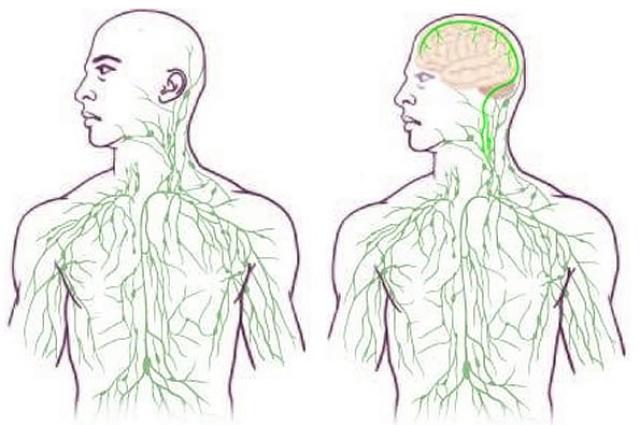
Until now, no one knew that lymphatic vessels existed in the brain. That is why the announcement from the University of Virginia School of Medicine is stunning! People in Professor Kipris’ lab have found that there are indeed lymphatic vessels. This is the missing link between the brain and the immune system. This means that the brain is connected directly to the immune system. The true significance of this discovery lies in the effect it will have on the treatment of neurological diseases. In the article below, they only talk about neurological diseases, such as Alzheimer’s, multiple sclerosis, and autism. I would add mental illness to those illnesses above. After all mental illness is also a neurological disease. There are many immune symptoms associated with mental illness. People who have mental illness also, many times, have auto immune diseases like lupus, rheumatoid arthritis, Hashimoto’s thyroiditis. There is some sort of an immune component in mental illness. The finding of these lymph vessels directly in the brain may shed light on not only neurological illnesses, but mental illnesses as well. Amazing that it took this long to discover such an important discovery as the brain has lymph vessels.

The brain actually has it’s own immune cells, the microglia, which are the resident macrophages of the brain (they clean up cellular debris if there is a brain injury or illness) and astrorocytes which secrete neutrotrophic factors after a brain injury to help neurons grow and recover and survive.

The lymphatic system is a network of tissues and organs made up of lymph vessels, lymph nodes and lymph that drain lymph fluid (a fluid containing white blood cells, water, proteins, salts and lipids) from all over the body. This fluid is then returned to the bloodstream.

Until this article came out, no one knew lymph vessels existed in the brain. Now that we know they do, it can be studied as to how they work and exactly what their function is. It can also be studied whether they are involved in diseases such as Alzheimer’s. A very exciting time, the beginning. It always is 🙂

http://www.neuroscientistnews.com/research-news/missing-link-found-between-brain-immune-system-major-disease-implications

Food and bipolar d/o

IMG_2981

I have been having problems with food allergies for a few years now. Actually, these are not the full fledged anaphylactic reaction (where your throat closes up and without an epinephrine shot, you have danger of dying) kind of allergies, I suppose my allergies would be better described as food sensitivities. My symptoms are not the typical gastrointestinal ones, but rather are joint pains and fatigue. A few years ago, I was tested for food allergies using an IgG test, by a rather unconventional doctor. My tests came out positive for many food, including bananas, beef, corn, wheat, rice, casein (a milk protein). I stayed off those foods for a year and then tried to add them in, unfortunately, it didn’t really help. Then when I moved to Louisville, I went to a doctor in Cincinnati, an extremely unconventional doctor, to the point of charlatanism. He offered to cure my bipolar disorder! That’s when I stopped seeing him. Now I am seeing an allergist, he has done IgE food allergy testing and found I am allergic to about 12 foods. I’ve been avoiding those foods for two months. A few days ago, I added dairy back in and started having knee pain and fatigue. Darn! I love ice cream, and whipped cream, and butter and Flan! Now I will have to go off dairy for a year.

Considering my food allergies and my having bipolar disorder (BPD), I decided to do a search about food and bipolar d/o. Below is an article I found about the five so called worst foods for bipolar d/o. In my experience, caffeine is only bad when I am not on Lithium, when my mood is controlled on Lithium, I can have 5 cups of coffee and I will not get jittery, hyper, neither will my muscles start trembling, all the case if I am not on Lithium. I once asked my doctor, a long time ago, if Caffeine can push someone with BPD into mania, because I had felt the “upness” after having coffee. He didn’t really have an answer for me. Now I believe it can, if your mood is not managed wit Lithium (for me) or another mood stabilizer.

Alcohol, definitely reacts badly with the medications used for BPD. The meds potentiate the effect of alcohol, which means a very little amount of alcohol can have quite a big effect. I drink one glass of wine and my dead starts swimming, although it does make me really happy 🙂 It says below that people with BPD can become addicted to alcohol easily, may well be the case, but not in my experience.

Sugar can of course. spike your blood sugar, and the ensuing elevation in Insulin can make your blood sugar levels drop. Not so good for people with mood disorders. Stability, evenness, and steadiness are the most coveted states, in sugar levels and moods for any one with BPD!

Salt can interfere with Lithium metabolism and of course, water metabolism. When one is on Lithium, one has to stay very well hydrated as Lithium is a diuretic as well as a mood stabilizer. Also salt can be dehydrating, with Lithium, that is not a good idea. I find that I crave salt when I’m on 900 mg of Lithium. I don’t eat too much salt, but neither do I restrict my salt intake. And my doctor told me to eat more salt if my side effects such as fine muscle tremors (mostly in my right hand) get to be too bothersome. I suppose the extra salt lowering Lithium levels to stop the tremors.

Fat, I don’t understand why fat is on the list below… Good fats such as nuts, olive oil, coconut oil, omega 3 and 6 fatty acids are actually quite beneficial for the brain. The cell membranes of neurons, as well as glia are made of fat, so this one, I don’t know. I would leave fat off the list of the five worst foods for BPD.

http://www.everydayhealth.com/bipolar-disorder/the-five-worst-foods-for-bipolar-disorder.aspx

The Five Worst Foods for Bipolar Disorder

  • Caffeine. “Stimulants can trigger mania and should be avoided,” Fiedorowicz says. “Caffeine is an under-appreciated trigger and can additionally impair sleep,” and sleep deprivation is a notorious trigger for bipolar mood swings and mania. Caffeine can also worsen anxiety, which tends to go hand in hand with bipolar disorder and, if you’re taking antipsychotic medications, might also affect how those drugs work. Fiedorowicz adds that some over-the-counter medications — such as pseudoephedrine, found in some cough and cold medications, for instance — have stimulant properties similar to caffeine and can also trigger bipolar mood swings.
  • Alcohol. Bottom line, alcohol and bipolar disorder make a bad combination. Alcohol can negatively affect bipolar mood swings and also may interact negatively with medications. People with bipolar disorder are also more likely to become addicted to alcohol and other substances.
  • Sugar. People with bipolar disorder are at risk for metabolic syndrome, a pre-diabetes condition that may make it hard to manage blood sugar levels. Furthermore, the highs and lows that come with the sugar roller coaster could just add to bipolar mood swings, particularly mania. If you really want a sweet treat, reach for fruit.
  • Salt. If you’re on lithium, moderating salt intake can be tricky because a change in salt intake, either an increase or a sudden decrease, can affect lithium levels. Talk to your doctor about how to safely manage the salt in your diet to stay within a healthy range, often between 1,500 and 2,300 milligrams a day. Equally important when taking lithium is to make sure to drink enough fluids — dehydration could cause dangerous side effects, Fiedorowicz cautions.
  • Fat. Fiedorowicz suggests following the recommendations of the American Heart Association for a healthy diet in order to limit saturated fat and trans fat in your diet. That means opting for lean protein and low-fat dairy products when choosing animal products. You might have heard that the fat in foods could alter the way your body uses medications. Generally, your medications will still be effective, but eating a lot of fried, fatty foods just isn’t good for your heart.
Over 7000 Views! Thank You Readers!

Over 7000

Thrilled, happy and excited! Thank you all my readers! How amazing, from that first view of my first post, to more than 7000 views! I am absolutely floored, and will continue to write to the best of my ability and provide you all with more reading material.

Love and hugs to all.

Seroquel to the rescue, I hope.

IMG_5313

My doctor, as it happens, is out of town, but when I texted him,  he answered immediately! I am to increase my Seroquel from the recently decreased amount of 75 mg to back up to 100 mg. I decreased my dose with my doctor’s approval, on May 19th, started feeling (more) anxious the next day, and the depression started on May 28 (on the way home from Buffalo.) Of course, it is my biochemistry that I have depression, but events do precipitate depression. So being on a lower dose of Seroquel, which not only acts as a mood stabilizer, but also as an antidepressant, and undergoing stressful events such as having to leave my son, will precipitate depression. I hope increasing the dose will stop the depression symptoms.

Unfortunately, Seroquel causes weight gain in the belly region and I was experiencing that. One reason for cutting down the dose. I, never in my life have had a jiggly stomach! But if it means I will not be depressed, then jiggly stomach it is, haha. My friends and loved ones will love me despite that I’m sure 🙂 Or I could start doing 1,500 crunches every day, probably not!

As you may be able to tell, I feel better already! Talking  (or texting) with your doctor does have that effect. The fact that he cares and responds and then has a strategy (increase Seroquel) to make one feel better is very heartening. So looking forward to feeling better, jiggles and all!

Up to me

self

Depression. It works that way. It robs you of your laughter. It makes you feel shaky and unsure, weak. You need more stimuli to feel good. My son called me and told me he got another A in his course this semester, that was a joyful moment! I got texts from my niece, those were joyful moments. Talked to my lovely girl friends, of course, wonderful! Saw some funny videos on FB, laughed. But, the internal happiness, contentedness, surety is gone. Replaced by a shakiness, a longing, a sadness, and sighs. I cannot rely on things outside of myself to make me happy, I have to find my own compass, my own solid ground. Who has time to be my vigilant guard? Everyone is busy, and rightly so, with their own lives. I have to do this for myself, calling my doctor is a good first step.

Damn it depression, snuck up on me again. Well, this time, as every other time, I’ll fight you and I will win. You don’t have any place here, you are not welcome here. Away with you, with your chest crushing weight, and darkness, lethargy, and stillness. Go! Be gone!

And let in the lightness, the airiness, the expansiveness, the “everything is well with the world” ness. Up to me, yes it is. But in a depression, not so easy to accomplish. Ok! That’s it! I’m bringing out the big guns!

“The greatest glory in living lies not in never failing, but in rising every time we fail.”
Nelson Mandela

“Sometimes your joy is the source of your smile, but sometimes your smile can be the source of your joy.”
Thich Nhat Hanh

“When you feel like giving up, remember why you held on for so long in the first place.”
Unknown

“The greatest degree of inner tranquility comes from the development of love and compassion. The more we care for the happiness of others, the greater is our own sense of well-being.”
Tenzin Gyatso, the 14th Dalai Lama

“Pain insists upon being attended to. God whispers to us in our pleasures, speaks in our consciences, but shouts in our pains. It is his megaphone to rouse a deaf world.”
C.S. Lewis

“Success is the ability to go from failure to failure without losing your enthusiasm.”
Winston Churchill

“Too often we underestimate the power of a touch, a smile, a kind word, a listening ear, an honest compliment, or the smallest act of caring, all of which have the potential to turn a life around.”
Leo Buscaglia