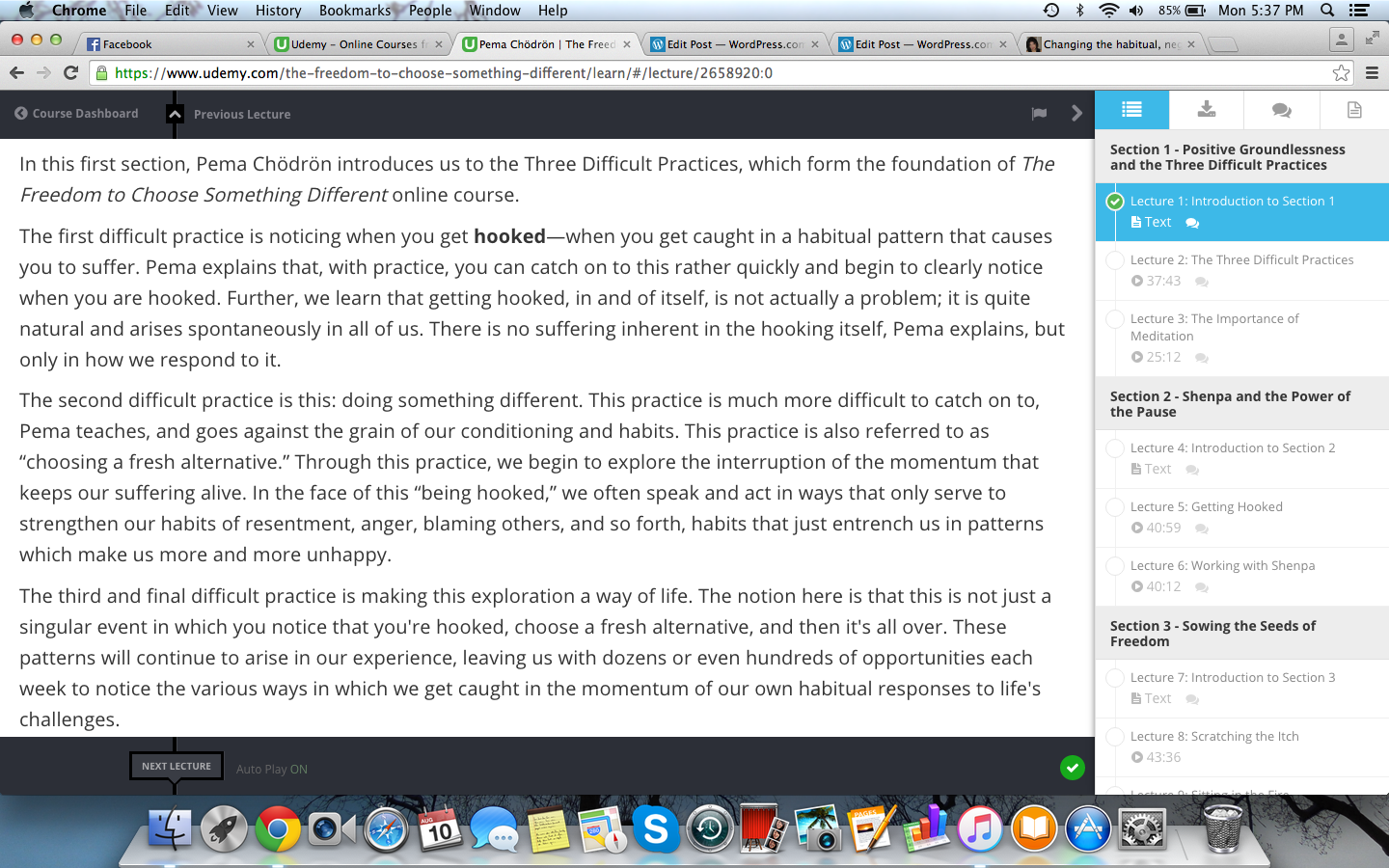
Registered for Pema Chödrön’s course, fingers crossed!
If this course can really do what it says it can do, it would be quite miraculous for my life. I wouldn’t have to live with a fight or flight response that gets activated at the drop of a hat (in mania), and sometimes so over the top extreme that it’s like using a machine gun to kill a mosquito. Usually the situations I am reacting to are quite extreme, so many bad things have happened to me and my family 😦 I don’t know why some people carry more of a sorrow or trouble burden. Maybe I’m wrong, but some people seem to have lighter, airier, less troubled lives. Maybe they’re the ones who already taken this course and possess the equanimity that I lack. I want to stop being so reactive, and so hooked into the negative things in life. I want to be even keeled, and be the genuine, true me, who is loving and positive, and calm. Yes CALM, that is the operative word. I am going to enroll in this course, and see what happens. I am so tired of being triggered by stressful situations into an awful negative state of mind and being. I need to stop it, for now and for good! I’ll post about it, and hopefully I will make good progress with my goal of reaching equanimity, serenity, and calmness. Oh it sounds like a wonderful dream.
Here’s the information for the course:
Ever feel triggered and stuck in a reactive tailspin despite all your efforts?
It is from this place — this hooked feeling — that we find ourselves responding in less than ideal ways. These are the moments when we may speak with venom, act out, or completely shut down when faced with challenging situations.
It is only later, when we’ve had the opportunity to calm down and reflect on our actions, that we wonder where we went wrong and how we could have chosen a more grounded response.
In The Freedom to Choose Something Different, Pema Chödrön examines and illuminates this nebulous process, clearly identifying where and when you have the opportunity to change your habitual response patterns. . . to choose something different. In this eight-part video course, Pema personally walks you through the landscape of these internal thunderstorms and guides you through the tools to cultivate inner freedom.
What does it mean to be “hooked”?
Maybe it’s a comment from a friend about your new shirt or the dinner you just cooked. Maybe it’s a look, a glance from a stranger. But something about it sets you off. . .
Whatever you call it . . . You’re hooked.
How do you choose something different?
Are you ready to get unhooked?
Take this course and discover the tools needed to cultivate true inner freedom.
| Section 1: Positive Groundlessness and the Three Difficult Practices | |||
|---|---|---|---|
| Lecture 1 | Text | ||
| Lecture 2 | 37:43 | ||
| Lecture 3 | 25:12 | ||
| Section 2: Shenpa and the Power of the Pause | |||
| Lecture 4 | Text | ||
| Lecture 5 | 40:59 | ||
| Lecture 6 | 40:12 | ||
| Section 3: Sowing the Seeds of Freedom | |||
| Lecture 7 | Text | ||
| Lecture 8 | 43:36 | ||
| Lecture 9 | 32:36 | ||
| Section 4: Being Kind to Yourself | |||
| Lecture 10 | Text | ||
| Lecture 11 | 31:20 | ||
| Lecture 12 | 32:47 | ||
| Lecture 13 | 26:46 | ||
| Section 5: The Practice of Meditation and Its Relevance to Shenpa | |||
| Lecture 14 | Text | ||
| Lecture 15 | 44:12 | ||
| Section 6: Choosing a Fresh Alternative | |||
| Lecture 16 | Text | ||
| Lecture 17 | 24:21 | ||
| Lecture 18 | 23:54 | ||
| Lecture 19 | 34:57 | ||
| Section 7: BONUS MATERIAL – Live Sessions with Glenna Olmstead | |||
| Lecture 20 |
Live Session with Glenna Olmsted – 1
|
56:21 | |
| Lecture 21 |
Live Session with Glenna Olmsted – 2
|
01:01:05 | |

Sounds True was founded in 1985 by Tami Simon with a clear mission: to disseminate spiritual wisdom. Since starting out as a project with one woman and her tape recorder, we have grown into a multimedia publishing company with more than 80 employees, a library of more than 600 titles featuring some of the leading teachers and visionaries of our time, and an ever-expanding family of customers from across the world. In more than two decades of growth, change, and evolution, Sounds True has maintained its focus on its overriding purpose, as summed up in our Vision Statement:
Sounds True exists to inspire, support, and serve personal transformation and spiritual awakening.
Sounds True is an independent multimedia publishing company that embraces the world’s major spiritual traditions, as well as the arts and humanities, embodied by the leading authors, teachers, and visionary artists of our time. Our approach to publishing is not dependent on a single format or technology—rather, we strive with every title to preserve the essential “living wisdom” of the author, artist, or spiritual teacher. It is our goal to create products that not only provide information to a reader or listener, but that also embody the essential quality of a wisdom transmission between a teacher and a student.
Throughout the years, Sounds True has developed a guiding philosophy that we call “multiple bottom lines.” Our dedication to this principle is embodied in our Mission Statement:
The mission of Sounds True is to find teachers and artists who serve as a gateway to spiritual awakening and to produce, publish, and distribute their work with beauty, intelligence, and integrity. We treat our authors, vendors, and partners in the same way we would want to be treated. We work flexibly and efficiently together to create a cooperative, loving environment that honors respectful authenticity and individual growth. We maintain a healthy level of profitability so that we are an independent and sustainable employee-owned organization.
The three essential bottom lines for Sounds True are the integrity of our purpose, the well-being of our people, and the maintaining of healthy profits. All three of these priorities are important in the decisions we make as a company. It is our conviction that each of these bottom lines must be healthy for the company to prosper as a whole.
In our history as a publisher, Sounds True has produced a wide variety of formats in order to fulfill our goal of disseminating spiritual wisdom.

Ani Pema Chödrön was born Deirdre Blomfield-Brown in 1936, in New York City. She attended Miss Porter’s School in Connecticut and graduated from the University of California at Berkeley. She taught as an elementary school teacher for many years in both New Mexico and California. Pema has two children and three grandchildren.
While in her mid-thirties, Ani Pema traveled to the French Alps and encountered Lama Chime Rinpoche, with whom she studied for several years. She became a novice nun in 1974 while studying with Lama Chime in London. His Holiness the Sixteenth Karmapa came to Scotland at that time, and Ani Pema received her ordination from him.
Pema first met her root guru, Chögyam Trungpa Rinpoche, in 1972. Lama Chime encouraged her to work with Rinpoche, and it was with him that she ultimately made her most profound connection, studying with him from 1974 until his death in 1987. At the request of the Sixteenth Karmapa, she received the full bikshuni ordination in the Chinese lineage of Buddhism in 1981 in Hong Kong.
Ani Pema served as the director of Karma Dzong in Boulder, Colorado until moving in 1984 to rural Cape Breton, Nova Scotia to be the director of Gampo Abbey. Chögyam Trungpa Rinpoche gave her explicit instructions on establishing this monastery for western monks and nuns.
Ani Pema currently teaches in the United States and Canada and plans for an increased amount of time in solitary retreat under the guidance of Venerable Dzigar Kongtrul Rinpoche. She is also a student of Sakyong Mipham Rinpoche, the oldest son and lineage holder of Chögyam Trungpa Rinpoche.
Ani Pema is interested in helping establish Tibetan Buddhist monasticism in the West, as well as continuing her work with western Buddhists of all traditions, sharing ideas and teachings. Her non-profit, The Pema Chödrön Foundation, was set up to assist in this purpose.
She has written several books: The Wisdom of No Escape, Start Where You Are, When Things Fall Apart, The Places that Scare You, No Time To Lose,Practicing Peace in Times of War, How to Meditate, and Living Beautifully. All are available from Shambhala Publications and Sounds True.
If this course can really do what it says it can do, it would be quite miraculous for my life. I wouldn’t have to live with a fight or flight response that gets activated at the drop of a hat (in mania), and sometimes so over the top extreme that it’s like using a machine gun to kill a mosquito. Usually the situations I am reacting to are quite extreme, so many bad things have happened to me and my family 😦 I don’t know why some people carry more of a sorrow or trouble burden. Maybe I’m wrong, but some people seem to have lighter, airier, less troubled lives. Maybe they’re the ones who already taken this course and possess the equanimity that I lack. I want to stop being so reactive, and so hooked into the negative things in life. I want to be even keeled, and be the genuine, true me, who is loving and positive, and calm. Yes CALM, that is the operative word. I am going to enroll in this course, and see what happens. I’ll post about it, and hopefully I will make good progress with my goal of reaching equanimity, serenity, and calmness. Oh it sounds like a wonderful dream.
Here’s the information for the course:
Ever feel triggered and stuck in a reactive tailspin despite all your efforts?
It is from this place — this hooked feeling — that we find ourselves responding in less than ideal ways. These are the moments when we may speak with venom, act out, or completely shut down when faced with challenging situations.
It is only later, when we’ve had the opportunity to calm down and reflect on our actions, that we wonder where we went wrong and how we could have chosen a more grounded response.
In The Freedom to Choose Something Different, Pema Chödrön examines and illuminates this nebulous process, clearly identifying where and when you have the opportunity to change your habitual response patterns. . . to choose something different. In this eight-part video course, Pema personally walks you through the landscape of these internal thunderstorms and guides you through the tools to cultivate inner freedom.
What does it mean to be “hooked”?
Maybe it’s a comment from a friend about your new shirt or the dinner you just cooked. Maybe it’s a look, a glance from a stranger. But something about it sets you off. . .
Whatever you call it . . . You’re hooked.
How do you choose something different?
Are you ready to get unhooked?
Take this course and discover the tools needed to cultivate true inner freedom.
| Section 1: Positive Groundlessness and the Three Difficult Practices | |||
|---|---|---|---|
| Lecture 1 | Text | ||
| Lecture 2 | 37:43 | ||
| Lecture 3 | 25:12 | ||
| Section 2: Shenpa and the Power of the Pause | |||
| Lecture 4 | Text | ||
| Lecture 5 | 40:59 | ||
| Lecture 6 | 40:12 | ||
| Section 3: Sowing the Seeds of Freedom | |||
| Lecture 7 | Text | ||
| Lecture 8 | 43:36 | ||
| Lecture 9 | 32:36 | ||
| Section 4: Being Kind to Yourself | |||
| Lecture 10 | Text | ||
| Lecture 11 | 31:20 | ||
| Lecture 12 | 32:47 | ||
| Lecture 13 | 26:46 | ||
| Section 5: The Practice of Meditation and Its Relevance to Shenpa | |||
| Lecture 14 | Text | ||
| Lecture 15 | 44:12 | ||
| Section 6: Choosing a Fresh Alternative | |||
| Lecture 16 | Text | ||
| Lecture 17 | 24:21 | ||
| Lecture 18 | 23:54 | ||
| Lecture 19 | 34:57 | ||
| Section 7: BONUS MATERIAL – Live Sessions with Glenna Olmstead | |||
| Lecture 20 |
Live Session with Glenna Olmsted – 1
|
56:21 | |
| Lecture 21 |
Live Session with Glenna Olmsted – 2
|
01:01:05 | |
Sounds True was founded in 1985 by Tami Simon with a clear mission: to disseminate spiritual wisdom. Since starting out as a project with one woman and her tape recorder, we have grown into a multimedia publishing company with more than 80 employees, a library of more than 600 titles featuring some of the leading teachers and visionaries of our time, and an ever-expanding family of customers from across the world. In more than two decades of growth, change, and evolution, Sounds True has maintained its focus on its overriding purpose, as summed up in our Vision Statement:
Sounds True exists to inspire, support, and serve personal transformation and spiritual awakening.
Sounds True is an independent multimedia publishing company that embraces the world’s major spiritual traditions, as well as the arts and humanities, embodied by the leading authors, teachers, and visionary artists of our time. Our approach to publishing is not dependent on a single format or technology—rather, we strive with every title to preserve the essential “living wisdom” of the author, artist, or spiritual teacher. It is our goal to create products that not only provide information to a reader or listener, but that also embody the essential quality of a wisdom transmission between a teacher and a student.
Throughout the years, Sounds True has developed a guiding philosophy that we call “multiple bottom lines.” Our dedication to this principle is embodied in our Mission Statement:
The mission of Sounds True is to find teachers and artists who serve as a gateway to spiritual awakening and to produce, publish, and distribute their work with beauty, intelligence, and integrity. We treat our authors, vendors, and partners in the same way we would want to be treated. We work flexibly and efficiently together to create a cooperative, loving environment that honors respectful authenticity and individual growth. We maintain a healthy level of profitability so that we are an independent and sustainable employee-owned organization.
The three essential bottom lines for Sounds True are the integrity of our purpose, the well-being of our people, and the maintaining of healthy profits. All three of these priorities are important in the decisions we make as a company. It is our conviction that each of these bottom lines must be healthy for the company to prosper as a whole.
In our history as a publisher, Sounds True has produced a wide variety of formats in order to fulfill our goal of disseminating spiritual wisdom.
Ani Pema Chödrön was born Deirdre Blomfield-Brown in 1936, in New York City. She attended Miss Porter’s School in Connecticut and graduated from the University of California at Berkeley. She taught as an elementary school teacher for many years in both New Mexico and California. Pema has two children and three grandchildren.
While in her mid-thirties, Ani Pema traveled to the French Alps and encountered Lama Chime Rinpoche, with whom she studied for several years. She became a novice nun in 1974 while studying with Lama Chime in London. His Holiness the Sixteenth Karmapa came to Scotland at that time, and Ani Pema received her ordination from him.
Pema first met her root guru, Chögyam Trungpa Rinpoche, in 1972. Lama Chime encouraged her to work with Rinpoche, and it was with him that she ultimately made her most profound connection, studying with him from 1974 until his death in 1987. At the request of the Sixteenth Karmapa, she received the full bikshuni ordination in the Chinese lineage of Buddhism in 1981 in Hong Kong.
Ani Pema served as the director of Karma Dzong in Boulder, Colorado until moving in 1984 to rural Cape Breton, Nova Scotia to be the director of Gampo Abbey. Chögyam Trungpa Rinpoche gave her explicit instructions on establishing this monastery for western monks and nuns.
Ani Pema currently teaches in the United States and Canada and plans for an increased amount of time in solitary retreat under the guidance of Venerable Dzigar Kongtrul Rinpoche. She is also a student of Sakyong Mipham Rinpoche, the oldest son and lineage holder of Chögyam Trungpa Rinpoche.
Ani Pema is interested in helping establish Tibetan Buddhist monasticism in the West, as well as continuing her work with western Buddhists of all traditions, sharing ideas and teachings. Her non-profit, The Pema Chödrön Foundation, was set up to assist in this purpose.
She has written several books: The Wisdom of No Escape, Start Where You Are, When Things Fall Apart, The Places that Scare You, No Time To Lose,Practicing Peace in Times of War, How to Meditate, and Living Beautifully. All are available from Shambhala Publications and Sounds True.
Basically 6 metabolites in urine can be used to determine whether a person has bipolar d/o (BPD) or major depressive disorder (MDD) depending on the levels of the metabolites. If this is really valid, it is a valuable test, as BPD patients cannot be put on anti depressants (like MDD patients can) because they will be pushed into full blown mania. This would be a really great diagnostic tool!
http://pubs.acs.org/doi/abs/10.1021/acs.jproteome.5b00434
Bipolar disorder (BD) is a complex debilitating mental disorder that is often misdiagnosed as major depressive disorder (MDD). Therefore, a large percentage of BD subjects are incorrectly treated with antidepressants in clinical practice. To address this challenge, objective laboratory-based tests are needed to discriminate BD from MDD patients. Here, a combined gas chromatography–mass spectrometry (GC–MS)-based and nuclear magnetic resonance (NMR) spectroscopic-based metabonomic approach was performed to profile urine samples from 76 MDD and 43 BD subjects (training set) to identify the differential metabolites. Samples from 126 healthy controls were included as metabolic controls. A candidate biomarker panel was identified by further analyzing these differential metabolites. A testing set of, 50 MDD and 28 BD subjects was then used to independently validate the diagnostic efficacy of the identified panel using an area under the receiver operating characteristic curve (AUC). A total of 20 differential metabolites responsible for the discrimination between MDD and BD subjects were identified. A panel consisting of six candidate urinary metabolite biomarkers (propionate, formate, (R*,S*)2,3-dihydroxybutanoic acid, 2,4-dihydroxypyrimidine, phenylalanine, and β-alanine) was identified. This panel could distinguish BD from MDD subjects with an AUC of 0.913 and 0.896 in the training and testing sets, respectively. These results reveal divergent urinary metabolic phenotypes between MDD and BD. The identified urinary biomarkers can aid in the future development of an objective laboratory-based diagnostic test for distinguishing BD from MDD patients.

In the best of times, I am an intense person. But when I become manicky, my emotions, reactions, speech, intensity, and volume go up, way up. When I’m angry, I’m furious. When I’m happy, I’m overly joyous. When I argue, I do it at full volume, and will not really listen to an opposing viewpoint. I’m aggressive, I’ll say things plainly, to the point of rudeness, without really meaning to be rude in the least bit. I become extremely sensitive, I might think someone is attacking me (in words) and attack them (with words) in returns. If I think about being with a person who is like the one I just described above, it sounds like a nightmare. Anger, aggression, “attacking” people, arguments, all in a loud voice. Ugh, I think you might find that as the definition of the “psycho bitch from hell” entry in the Mirriam Webster edition of the dictionary! I wonder if all the poor psycho bitches from hell have bipolar disorder?
But the crazy thing is that after this manicky behavior manifests itself, I realize what has happened and I am full of regret, but by that time, my friends and family have already been exposed to this unpleasant behavior. Too late to do anything except apologize 😦
How can I realize that this is about to happen and head it off at the pass? If I could do that, I would consider myself almost cured! I have been on higher doses of Lithium and have been stable for a while, with some minor ups and downs. But major stress in my life will push me into a manic or depressive phase. And by the time I realize it’s happening, I have been somewhat extreme in my behavior.
I’m trying, I’m really trying. I don’t want to upset my dear friends and family, I don’t want to impose on them with my “insanity.” I want them to know how much I appreciate them and how much I wish for good things in their lives. I want them to know I am there to help them through thick or thin. Not the negative things that happen because of my illness and are not coming from my true self, My true self is positive, supportive and loving. Really it is. And I wish the banshee in me would fall asleep forever and never resurface.
To all my friends and family, with love, hugs and peace.
Please dear friends and family, the loud woman is not me
The angry woman is not me
I am peaceful, loving, positive
My true self, my true heart wishes only love and happiness for you
The anger and loudness come from illness
An illness that tests me daily
But an illness that I will conquer for the sake of all my loving and beloved friends and family!

The stress of seeing my aunt so frail and ill, stress in general, has me visiting the land of manic behavior again. My emotions are exaggerated, intense. My voice volume has risen several decibels. People are actually leery of me as I must seem like a crazy woman on the warpath. I might have terrorized one of my sweetest friends and my friend Madiha, who is actually a psychiatrist, was having a difficult time “conversating” with me as my intensity level was off the charts.
I’m sorry my friends, I don’t mean to terrorize you, sadly sometimes I simply cannot help it. I value everyone of your friendship. I know you’ve been patient with me before, I beg your indulgence now. These blips in my mood catch me off guard and by the time I realize it’s happening, some damage has always been done 😦 I know it’s time to increase the Lithium, and I am increasing it tonight.
I know my friends don’t have to put up with this, they can simply go find another more normal person with whom to be friends, someone whose reaction intensity doesn’t frighten them. I know that. I am stuck with this illness, on the one hand it makes me ultra sensitive, able to feel intensely, but it also makes me react just as intensely to seemingly innocuous things. Maybe it’s like PTSD, where a loud noise will illicit the same response as bombs going off in a temporally distant war had. Or in my case. the noise doesn’t even have to be that loud, I just react intensely and loudly to all things if you catch me in my intense mood. Damn this mood disorder. Difficulties in life are enough to try one’s patience but having a mood disorder which can throw your emotions, and behaviors off, make your friends afraid of you, cause you yourself untold pain and suffering… because, you know, people can walk away from you, but you can’t walk away from yourself, no matter how much you may want to… Lithium, yes time to increase the Lithium! All will be well.


My aunt, my mother’s youngest sister is sick, very sick. She has always been thin and frail, but now she is quite severely ill. She has had cerebellar ataxia for as long as i have known her. That is an illness of the cerebellum, the part of your brain that controls voluntary movement. There seem to be mini strokes in this region so that there is cell death and the person who suffers from it loses control of their limbs, extremities, and finally they even lose their swallowing reflex, so they cannot even eat. She has always been painfully thin, since her twenties. She lived with my family in Buffalo from 1979 1984. When she came to live with us, she was like a stick figure, and I nursed her and fed her and took care of her until she looked a bit better. Then in 1984, one of my cousins was getting married in Pakistan, we were all going to attend the wedding, and she insisted on going with us, although she was not an American citizen. We told her to stay back, she may not be able to get a visa to come back with us again, but she insisted, so she went and she was not given a visa to return back with us. So we had to leave her behind with another one of my aunts. Then for a while she and her brother (my uncle) lived on their own in their own apartment, and then my uncle passed away and she moved to live with my cousin Munib. He recently sent me a picture of her on Whats App and I was totally shocked and appalled to see her skeletal condition. Gentle readers, if I posted that picture her, you too would be shocked. Anyway, my cousins have been taking her to the doctor and having her treated. But what i worry about after having seen that picture is: can anyone recover from the state I saw her in in the picture? I don’t know. I hope so.
She took care of me when I was a newborn baby. My mother was still in Medical School in Bhopal when I was born, my grandmother took me to Karachi, Pakistan. I lived with her, my two aunts and my uncle for two years. They took care of me as if I was their own. That is the love, the love I got from the four of them, that love has carried me through to this day. This aunt of mine was like a little mother to me, she was 20 years old then. And she took care of me day and night. And now she is in dismally bad shape and I am not there to take care of her. Just looking at her last picture, I broke down in tears of sadness, anger and dejection, I cannot look at it anymore, yet it is burned in my memory.
Her illness and my powerlessness to do much to help her directly has been having a bad effect on my affective disorder. Sadness, anger, hopelessness, helplessness, and fear, all working in my brain to create a hyper alert, worried state that I cannot shake. Haven’t been feeling very normal, sort of up, sort of down, easy to anger, just all out of sorts.
I will go to Pakistan. I am planning a trip in September. I am in close contact with my cousins, they tell me she is doing better, getting better nutrition, vitamins, minerals, Ensure, all things the doctor ordered.
She is 70 years old, she has always been frail. I hope she recovers, I hope I see her once more so I can tell her I love her and make her smile.

I know I haven’t been posting a lot here of late. But I promise my readers, I will start again soon. An illness of a very dear family member had me a little unhinged and now I’m away from home for a week. Then away again for 10 days. And then depending on the health of my aunt, I may be going to Pakistan. But I will be posting again, my story, scientific findings, pictures. Happy Saturday all!

All the information below is great, but if you aren’t on Lithium, or if you cannot tolerate that, then another mood stabilizer, then you can practice these steps till the cows come home, but you most likely will not be able to avoid hypomania or full blown mania.
So take your Lithium or whichever mood stabilizer is right for you. Lithium is just the GOLD standard in Bipolar d/o treatment, therefore I keep talking about it. Take your medication and stay out of trouble. You can even practice all 10 or as many steps below as you like, that won’t hurt you. What will hurt is not taking your meds.
So, have I said “Take you meds, stay on your meds, don’t come off your meds!” And life will be peachy!
http://www.everydayhealth.com/columns/therese-borchard-sanity-break/ways-curb-mania-and-hypomania/
Published Jul 1, 2015
Bipolar disorder is one of the most difficult illnesses to treat because by addressing the depression part of the illness, you can inadvertently trigger mania or hypomania. Even in Bipolar II, where the hypomania is less destabilizing than the often-psychotic manic episodes of Bipolar I, persons often experience from a debilitating depression that can’t be lifted by mood stabilizers and antipsychotics. Antidepressants, though, can cause a person with bipolar to cycle between hypomania and depression.
I have worked with psychiatrists who were too afraid of cycling to risk using antidepressants for bipolar patients. They put me strictly on mood stabilizers and antipsychotics. However, I did not get well. I stayed depressed, and all original thoughts in my brain vanished. My current psychiatrist knows that depression is my primary threat, not so much the hypomania, so she was able to pull me out of the depression with the right combination of antidepressants, but is vigilant for any signs of hypomania. Because I know how vulnerable I am to hypomania, I have learned several strategies to help me stay grounded. By making them part of my life, I have been able to take less lithium, my mood stabilizer, which ensures that I continue producing original thoughts and not get too medicated. Here are 10 tools I use to avert hypomania.
Developing good sleep habits is by far the most potent tool for preventing mania and hypomania. There are a handful of studies documenting that sleep deprivation is associated with mania and hypomania. By going to bed at 10 every night and sleeping a good eight or nine hours, we have the power to stop rapid cycling and to reverse mania or hypomania. In a study published in Biological Psychiatry a rapid-cycling patient was asked to remain on bed rest in the dark for 14 hours each night (gradually reduced to 10 hours). Times of sleeping and waking were recorded with sleep logs, polygraphic recordings, and computer-based event recordings. His sleep and mood stabilized when he adhered to a regimen of long nightly periods of enforced bed rest in the dark. The abstract’s conclusion: “Fostered sleep and stabilizing its timing by scheduling regular nightly periods of enforced bed rest in the dark may help to prevent mania and rapid cycling in bipolar patients.”
Good sleep hygiene means you go to bed at the same time every night, ideally before 10:30 p.m. — not one night 2 a.m. and another night 7 p.m.; you sleep at least eight hours a night; and you wake at the same time in the morning. Since many folks with bipolar disorder havesleep disorders, a nighttime routine is often needed. For example, I shut down my computer at 8 p.m. and try not to check my emails or messages on my phone. Reading a disconcerting email at 9 p.m. will keep me up all night. It takes me a good two hours to calm down, so I get out the lavender oil around 8:30 p.m., pull out a real book (not an iBook), and begin to tell my body it needs to seriously chill out.
CNN did a story a few years ago on iPads (or LCD screens) and sleep. Journalist John D. Sutter asked Phyllis Zee, MD, a neuroscience professor at Northwestern and director of the school’s Center for Sleep & Circadian Biology, if our gadgets can disturb sleep patterns and exacerbate insomnia. Dr. Zee said:
Potentially, yes, if you’re using [the iPad or a laptop] close to bedtime … that light can be sufficiently stimulating to the brain to make it more awake and delay your ability to sleep. And I think more importantly, it could also be sufficient to affect your circadian rhythm. This is the clock in your brain that determines when you sleep and when you wake up.
I absolutely know that to be true, because for awhile, I was reading iBooks for a half-hour before bed and staying awake until 2 a.m. My concern with LCD screens isn’t limited to bedtime. I know from people in my depression community that persons with bipolar disorder have to be careful with LCD screens at all times, as they can make the highly sensitive personhypomanic if the person doesn’t take a break from them. For me and for many fragile persons with bipolar, looking into an LCD screen for too long is like keeping your light therapy sunboxon all day. I made the mistake of firing up that baby from 9 p.m. to midnight right after I got it, and I did not sleep one iota the next day, and felt hypomanic all day long. Keep in mind that not only is the light stimulating, but so is all of the messages and tagging and poking — especially if you have as many social media handles as I do.
Most of us have a few people in our lives that appear as though they’ve downed three shots of espresso every time we see them. They are usually great fun and make us laugh. However, the hyperactivity isn’t what you need if you haven’t slept well in a few weeks and are trying to calm down your body and mind. Same goes with places. I don’t dare step foot inside the mall, for example, between Halloween and New Year’s. There is just too much stuff being forced in front of my face. I also hate Toys-R-Us. I still have nightmares about the time my husband pressed three dozen Tickle Me Elmos and the entire shelf began to shake.
Before attending the mindfulness-based stress reduction (MBSR) program modeled after the one developed by Jon Kabat-Zinn at the University of Massachusetts Medical Center, I did not pay attention to my body’s cues preceding a hypomanic episode. In fact, it was usually another person who would point out the embarrassing truth — like the time my editor wrote a letter to my doctor after I started publishing eight blogs a day thinking my traffic would go up. Now, though, when my heart races and I feel as though I have consumed eight cups of coffee, I know this is my opportunity to reverse my symptoms by doing lots of deep breathing exercises.
Of all the automatic functions of the body — cardiovascular, digestive, hormonal, glandular, immune — only the breath can be easily controlled voluntarily, explain Richard P. Brown, MD, and Patricia L. Gerbarg, MD, in their book The Healing Power of the Breath. They write:
By voluntarily changing the rate, depth, and pattern of breathing, we can change the messages being sent from the body’s respiratory system to the brain. In this way, breathing techniques provide a portal to the autonomic communication network through which we can, by changing our breathing patterns, send specific messages to the brain using the language of the body, a language the brain understands and to which it responds. Messages from the respiratory system have rapid, powerful effects on major brain centers involved in thought, emotion, and behavior.
A good caffeine rush mimics hypomania. You feel more alive, more alert, like you could actually contribute something of worth to the world. That’s all fine and dandy except when you are teetering on the hypomanic edge. Caffeine can provide the ever-so-subtle push to the other side, especially if you aren’t sleeping well, which is when most people most crave caffeine. Stephen Cherniske, MS, calls caffeine “America’s number one drug” in his bookCaffeine Blues because of the withdrawal our body goes through three hours after we’ve drank a cup of coffee or a Diet Coke. Persons with bipolar are even more sensitive to amphetamine-like substances that raise dopamine levels, so the safest way to prevent hypomania is to eliminate the stuff altogether.
My best workouts have been when I’m either on the verge of becoming hypomanic or when I am ticked off. My usual 10-minute mile goes down to an eight. I start passing people along my route, at the Naval Academy, feeling like Lynda Carter in her Wonder Woman getup. And my swim interval is consistent with the people who swam across the Chesapeake Bay in under two hours. The truth is I have averted many hypomanic episodes by working out until I collapse or at least become tired, which can take a few hours. Two years ago, the only way I was able to sleep was by swimming more than 300 laps a day. There are people for whom vigorous exercise triggers mania, but most experts report on the benefits of exercise for bipolar disorder.
There is a reason why ice cream, Swedish Fish, and animal crackers are comfort food for the bipolar person. The rush of insulin generated by those foods will calm those carbohydrate-craving brain pathways for a bit, until a crash in blood sugar has the person binging again on sweets. It’s a vicious cycle, one that can keep a bipolar person cycling indefinitely.
I will tell you a true story about sugar and bipolar. About 16 years ago, before I knew I wasallergic to sugar and that a high-carb diet was the worst thing I could do for my mental health, I would sometimes drink two bottles of Arizona Iced Tea and eat two or three chocolate-chip oatmeal bars for lunch. One day, there was a Horizon milk truck in front of our house with a large cow on the side. I started mooing at the cow. My new husband, behind me, was truly frightened by this and told me to lay off the Arizona Iced Teas and granola bars for awhile. I haven’t mooed at a truck since.
I am all for good, healthy friendships between men and women. If you’re not bipolar. Consider me a prude, but I know how difficult it can be to be consistent with good boundaries if you are even the tiniest bit hypomanic. You sincerely didn’t mean for something you sent in an email to sound flirtatious — you were just being playful, like you are with your girlfriends. However, when you do get a reaction from a person of the opposite sex, something in the least bit flattering, that communication can ignite a rush that sends a signal throughout your entire body that you want more of the feel-good hormone it just experienced — dopamine, essentially. It’s even riskier if you have a history of substance abuse and bipolar — because your body will compromise any moral agreements you have signed off on prior to that email in order to get that damn rush again. If you’re not careful, this dangerous game will trigger a full blown manic episode. I have had the best intentions with 85-year-old men, and still, somehow, found myself in trouble. So for the time being, I’m sticking to female friendships.
One of the most common manic behaviors is uncontrollable spending or shopping. Therefore, it is sometimes helpful for persons with bipolar disorder to make out a list beforehand of the items you absolutely need to buy — be it a grocery list, a Home Depot run, or a mission to get a your daughter’s friend a birthday gift. That way you won’t end up with 20 different kinds of paint swatches for the kitchen and living room you’ve decided to paint while you were at the store.
This one is probably the second most important for me to prevent mania. I would say meditate, but that word produces too much expectation and pressure for me right now. Decompressing means after you finish something like a blog post or after you’ve forced yourself to be social for a few hours at a party that you didn’t want to attend, you allow yourselves 15 to 30 minutes to look at the ceiling fan in your bedroom and think about just that: the ceiling fan.
The case has been made that persons with bipolar disorder are creative and therefore need more chill time than the average person. Our brains are operating at a faster pace and more intensely than our non-bipolar friends for the periods of time where we must appear normal. So it is absolutely imperative that we allow some time where nothing is required — where we can drool, or lie in the grass, or doodle, or collapse in front of the front door. Although it seems as though these hours are unproductive, this activity will rebuild the gray matter of our brains and safeguard us from a manic episode.”

 Palestine WILL Be Free