Well, here’s why I went to Pakistan.

IMG_0407IMG_0410

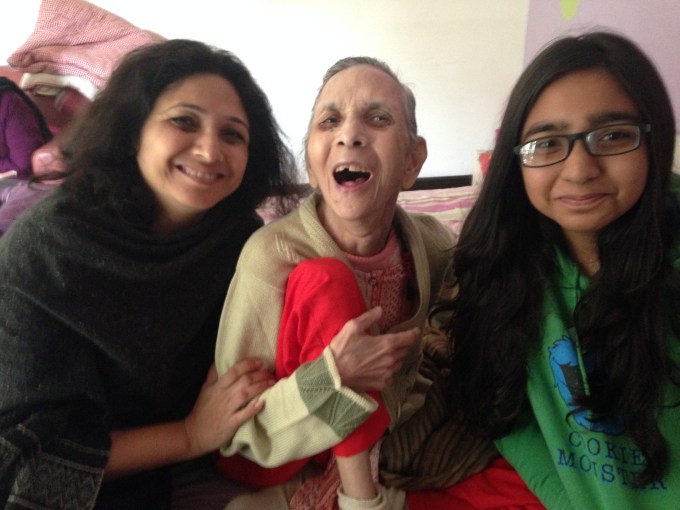
This was the reason I went to Pakistan, to see my Fatto Khala (aunt). They hadn’t told her we were coming because she gets very anxious about changes. So when I walked into her room on the morning of December 27, she was totally surprised, her face broke out into a huge smile and she said in utter surprise “Samina ?!” I will never forget her happy face and exclamation for as long as I live.

I was afraid to see her, the pictures my cousin had sent me months ago were awful, awful! I didn’t know if I could handle seeing my beloved aunt in such poor shape. But I was so happily surprised to see that she is doing really well. Yes, because of the cerebellar ataxia, she is rail thin, and she has trouble speaking (but my cousins can understand her really well,)  but her spirit and her personality and nature are still the same! She laughs a lot, she is happy and beloved and very well taken care of by my cousins. She never got married and never had children, so it is we, her nieces and nephews, who take care of her.

The fear of the unknown is always greater than facing the thing you fear most. For me, in this instance, it was the fear of seeing my aunt in such bad shape that I wouldn’t be able to handle it. But what I saw was so good and so positive that all my fears vanished and a deep gratitude welled up inside of me, that even though my aunt has such an awful disease, she is still loved, and she lives in the very heart of her family, and is happy and joyous and taken care of in an excellent manner. May we all find ourselves in such happy circumstances if we need care.

Thank you Munib and Mahrukh, I absolutely adore both of you.

More about Pakistan soon. I took so many pictures and videos, I will share those in the coming days.

I am so happy I went, we had a WONDERFUL trip, couldn’t possibly have been better.


Ok, yes I’m posting at the airport…

Ok, yes, I’m posting. Yes I’m on my way to Karachi, via Atlanta, New York, and Istanbul. I am traveling alone because my sister, brother and I didn’t book our tickets at the same time, or even with the same airline, so I confess, I am a bit bored. Started from home in Louisville at 10:00 am, got to JFK at 5:30 pm. My flight for Istanbul doesn’t leave till 11:50 pm, no such luck, it’s delayed to 12:30 am. Then I don’t get into Karachi till about 3 pm EST tomorrow, barring any delays. It once took me 3 days to get to Karachi, 3 days that I spent in Heathrow because they had 1/2 an inch of snow… yes 1/2 an inch.

I’m not planning on spending 3 days at Atatürk Havalimani (Airport), I’m hoping to get to Karachi on time. But even on time is a hell of a long trip, especially alone. Oh fine, I’ll stop whining, wait, one more thing, the airplane is as big as a sardine can, I asked, because in June, when I had gone to Istanbul, it was a sardine can, so I asked, and I was informed that it was tiny 😦 Ugh, trip, can you please be over now.

On a positive note, I saw the most adorable, little, miniature, poodle, walking with its human with shoes on. Yes, the human had shoes on, but I’m talking about the little puppy. I almost ran up to take a picture, but then I didn’t. But I seriously have to get one of those adorable, little pups.

puppy

I also indulged in a little, just a tiny bit, of retail therapy, mostly I got gifts… ummmm and a purse for my self… ummmm a really nice one… ok I’ll go away and take a nap or something. Actually I’m sort of hungry, I’ll go eat. But first look at the killer shops they have in this terminal!

Wow! Right?

I’ll post lots of pictures from Pakistan.

❤ ❤


http://www.wsj.com/articles/the-effects-of-chronic-heavy-drinking-on-brain-function-are-underdiagnosed-1450722803?mod=e2fb&sf17561871=1

The Effects of Chronic Heavy Drinking on Brain Function Are Underdiagnosed

Here’s a sobering thought for the holidays: Chronic heavy drinking can cause insidious damage to the brain, even in people who never seem intoxicated or obviously addicted.

Experts say alcohol-related brain damage is underdiagnosed and often confused with Alzheimer’s disease, other forms of dementia or just getting older.

Now, brain imaging is revealing how long-term alcohol abuse can change the structure of the brain, shrinking gray-matter cells in areas that govern learning, memory, decision-making and social behavior, as well as damaging white-matter fibers that connect one part of the brain with others.

RELATED READING

Prescription to End Drinking: Data on Medicine for Alcohol Disorders Pushes Doctors Beyond 12-Step Programs
Raising the Chance of Some Cancers With Two Drinks a Day
Alcohol Math: Who Gets Drunk and Why
“As we get older, we all lose a little gray-matter volume and white-matter integrity, but in alcoholics, those areas break down more quickly. It looks like accelerated aging,” says Edith Sullivan, a professor of psychiatry and behavioral science at Stanford University, who has studied alcohol’s effects for years.

Long-term alcohol abuse also changes how the brain regulates emotion and anxiety and disrupts sleep systems, creating wide-ranging effects on the body. Increasingly, clinicians are diagnosing “alcohol-induced neurocognitive disorder” and “alcohol-related dementia.”

How much is too much? The National Institute of Alcohol Abuse and Alcoholism says the probability of serious health issues is low for men who have no more than 14 drinks a week, or 4 on a single day, and women who have no more than 7 drinks a week, or 3 on a single day. ENLARGE
How much is too much? The National Institute of Alcohol Abuse and Alcoholism says the probability of serious health issues is low for men who have no more than 14 drinks a week, or 4 on a single day, and women who have no more than 7 drinks a week, or 3 on a single day. PHOTO: GETTY IMAGES
How much is too much and over what period of time? Researchers are reluctant to say, because alcohol’s effects are highly individual and based on genetics, age, sex, patterns of consumption and general health. The National Institute of Alcohol Abuse and Alcoholism (NIAAA) says the probability of serious health issues is low for men who have no more than 14 drinks a week, or 4 on a single day, and women who have no more than 7 drinks a week or 3 on a single day. Some people, though, experience severe effects at much lower levels.

Advertisement

Meanwhile, some studies show that people who drink moderately (generally defined as 1 drink a day for women, 2 for men) have a lower risk of cardiovascular disease, depression and some cognitive issues than those who don’t drink at all. But the risks of harm rise sharply the more alcohol people consume. “Low levels of alcohol may improve blood flow to the brain—but there’s a tension between that and reduced white matter,” says Ian Lang, a dementia expert and senior lecturer in public health at the University of Exeter Medical School in England. “At some levels, there may be a tipping point where the harmful effects outweigh the benefits.”

MORE HEALTH COVERAGE

Why a Drug to Prevent HIV Infection Is in Low Demand
Progress Seen in HIV Treatment
Chef Sang Yoon Is Back in His Element
Yoga for Hockey Players
Why You Can Stop Doing Sit-Ups
Help for Those Who Don’t Feel Merry and Bright
Can You Work Out Less, Get More Results?
Also unclear is whether heavy drinking during a person’s teens and 20s, when important brain connections are still forming, has a lasting effect on brain function in later life.

Some researchers are bracing for a wave of cognitive problems as baby boomers age. “Sad to say, we think their increased exposure in the 1960s has put them at substantially higher risk for alcohol-related mortality and morbidity than the generation before them,” says Gary Kennedy, chief of geriatric psychiatry at Montefiore Medical Center in Bronx, N.Y.

Imaging studies show that while long-term heavy drinking impacts the entire brain, the greatest damage occurs in the frontal lobe that controls executive function, which includes planning, controlling impulses and modifying behavior. “The very part of the brain that you need to change your alcoholic intake may be most impacted by drinking,“ says Catherine Fortier, an assistant professor at Harvard Medical School and researcher at the VA Boston Healthcare System, who has led many of the imaging studies.

THE GOOD, THE BAD, THE DANGEROUS

While the effects of alcohol consumption are highly individual, government researchers suggest these general guidelines.

‘Moderate’: Up to 1 drink a day for women, 2 for men. Drinking at this level can lower the risk of cardiovascular disease and depression, and help maintain cognitive function, according to some studies.

‘Low risk’: Up to 3 drinks a day and 7 a week for women; 4 a day and 14 a week for men. Staying within both the daily and weekly limits has a low risk of short- or long-term health issues. Experts say pregnant women, and people under 21, planning to drive, or taking certain medications should abstain.

Heavy or ‘High Risk’: More than 3 drinks a day and 7 a week for women; 4 a day and 14 a week for men. Exceeding these levels regularly runs the risk of long-term cognitive damage, memory loss, depression, cirrhosis of the liver, high blood pressure, stroke, Type 2 diabetes, cancer of the throat, esophagus, breast and colon, as well as drowning, falling and being hurt in motor vehicle accidents

Source: NIAAA, U.S. Dietary Guidelines

Many of alcohol’s effects on the brain and behavior are similar to cerebral-vascular dementia, the second most common form of dementia, which reduces blood flow to the brain and affects thinking and reasoning more than memory, as Alzheimer’s disease does.

That’s important for families to keep in mind, says Dr. Kennedy. “A person may have only minor impairments in memory, so families can’t understand why they aren’t taking care of themselves, can’t manage a checkbook, can’t get out of the house or stay on a task.”

Such damage to executive function is more subtle than the severe forms of alcohol-related brain damage known as Wernicke-Korsakoff Syndrome, in which chronic alcohol consumption causes a deficiency in thiamine that can lead to hallucinations, amnesia, psychosis and difficulty walking. Wernicke-Korsakoff is rarely seen today, experts say, because alcoholics are routinely given thiamine to prevent it.

Researchers are also shedding new light on alcohol’s long-term impact on depression, stress and anxiety.

While it isn’t clear whether heavy alcohol use also causes depression, or vice versa, experts say there is clearly a vicious cycle: “People often drink because they don’t feel good, but drinking makes them feel worse, so they drink more,” says NIAAA director George Koob.

Dr. George Koob, director of the National Institute for Alcohol Abuse and Alcoholism, is one of the researchers who have shown how heavy alcohol use hurts the ability of the brain’s frontal cortex to control the amygdala, the center of emotions—which explains why drinkers often have mood swings and outbursts. ENLARGE
Dr. George Koob, director of the National Institute for Alcohol Abuse and Alcoholism, is one of the researchers who have shown how heavy alcohol use hurts the ability of the brain’s frontal cortex to control the amygdala, the center of emotions—which explains why drinkers often have mood swings and outbursts. PHOTO: ERIN BRYANT
Dr. Koob and other researchers have shown that heavy alcohol use hurts the ability of the frontal cortex to control the amygdala, the center of emotions—which explains why drinkers often have mood swings and outbursts.

“One minute you’re putting your arm around a friend, and the next minute, you’re crying or saying something you didn’t intend,” says Dr. Koob. With long-term heavy drinking, the amygdala becomes increasingly oversensitive to stress, he says.

Chronic imbibers might also become stuck in a state of high anxiety and fear, much like post-traumatic stress disorder, according to studies at the Bowles Center for Alcohol Studies at the University of North Carolina, Chapel Hill. In classic “fear learning” experiments, mice can be trained to freeze when a light cue is followed by a mild shock, and learn to relax again if the shock is discontinued. But mice fed the equivalent of six drinks a day for weeks were never able to feel safe again and were constantly fearful. “In short, chronic alcohol can block this form of learning and can negatively impact how you go through life,” says Thomas Kash, an associate professor of pharmacology at UNC School of Medicine.

Researchers are also studying to what extent alcohol-related brain damage is reversible and finding mixed results. Some former alcohol abusers show permanent damage to the hippocampus, a region that regulates balance. But longitudinal studies tracking life-long drinking patterns show that some white- matter damage can repair itself—particularly if people stop drinking before age 50. “Fifty seems to be a critical threshold, probably because brain tissue is less able to recover after a certain age,” says Dr. Fortier.

Studies at Stanford found that former alcoholics and people with no history of alcoholism can perform equally well on cognitive tests, although brain scans showed they used different brain pathways to do so. “The alcoholics used wider and additional areas of the brain to get the job done,” says Dr. Sullivan. “My worry is that this may come at a cost. If you are recruiting different areas of the brain, it might be harder to switch your attention from one activity to another.”

Studies have also found that for people who aren’t dependent, even a five-minute conversation with a doctor about the risks of drinking can reduce problem drinking by about 25%.

Alcohol researchers say more health-care providers—and family members—should broach the issue with patients and point out the dangers. “One of the biggest problems in alcoholism is denial,” says Dr. Sullivan. “Getting over that is the first step to recovery.”

Breathe!

My expired Pakistani passport, issued in Paris, in 1978! 🙂

Well, it looks like I am going to Pakistan after all! Breathing! The process to get a visa has been tortuous, and until an hour ago, I wasn’t sure they were going to give me one. I sent my American passport by mail to the Pakistan Consulate in New York City, in itself scary, along with all the forms from their website and a cashier’s check for the fee. I did this a while ago. Then my sister, who is in NYC, went to get her visa from the consulate a few days ago,  I asked her to pick up my passport and O/N it to me. They said I hadn’t sent a copy of my expired Pakistani passport with my application so my application was incomplete and they were holding on to it. Hm! Never before was I asked to provide an old Pakistani passport…  and even now, it says that, where on their website? Exactly nowhere. For the longest time, I didn’t even know where my old (from 1978) expired passport was. I randomly found it while unpacking boxes when I moved to Louisville. It makes no sense to ask someone for their expired passport, I sent them a valid US passport and I needed a visa on that to go to Pakistan. But who’s going to argue with them? Not me, I needed a visa. So I got their email address, 2 of them, and emailed them scans of my expired Pakistani passport. I called to make sure, had to call about 10 times before anyone picked up, they told me they hadn’t gotten any emails from me. Ok. I emailed them a few more times, attaching the files in different ways, hoping they would get my email. This morning I got a phone call from them saying they never got any emails. Ok, so what do I do? Fax? Yes, I faxed them the documents, had to go to a UPS store because our fax machine’s cord was nowhere to be found (yes we have a fax machine, can you say anachronism, haha)… Fax went through after trying 3 times. Whew. They gave me the receipt and nothing, I tell you nothing was visible/legible on what they faxed. Starting to panic now, looks like my trip is off… Sent my sister emails and texts of my Pakistani passport to take to the consulate. My aunt knows the Consul General, so I sent her scans of my expired Pakistani passport, asked her to help.

Just got an email from my aunt and a phone call from my sister. My visa has been granted and my sister will O/N my passport to me in about an hour. I should get it tomorrow, fingers crossed.

Gawd! Does everything have to be this difficult?

Oh and my ticket, haha… that’s another story… for another time…

Wish me Bon Voyage! And I’m breathing…

How to Cultivate Your Creativity

IMG_3435

Fascinating! Read it please! I’m not summarizing it, it’s too long, but it is informational and fascinating reading! And Dopamine is intimately involved, really, it is.


http://www.scientificamerican.com/article/how-to-cultivate-your-creativity-book-excerpt/

Being Open

  • Openness to new experiences is the strongest and most consistent personality trait that predicts creative achievement in the arts and sciences.
  • Higher dopamine levels drive our motivation to explore and boost creativity but are also associated with an increased risk of mental illness.
  • New experiences can shift our perspective and inspire creative leaps.
  • Around the time that his cult-classic, drug-culture novel Naked Lunchwas released, author William S. Burroughs was experimenting with a writing strategy that he called the cut-up technique. Burroughs would chop up random lines of text from a page and rearrange them to form new sentences, with the aim of freeing his mind and the minds of his readers from conventional, linear ways of thinking.

    Beat Generation writers such as Burroughs sought to dismantle old belief systems and to encourage alternative ways of looking at the world. They celebrated intellectual exploration, engagement in art and music, unconventionality and deep spiritual questioning. Perhaps no artist captured this spirit more than Jack Kerouac, whose novels have become manifestos for adventure and nonconformity.

  • The revelations and methods of Burroughs, Kerouac and other Beat writers illuminated an important truth about creativity, which is now backed by scientific research: we need new and unusual experiences to think differently. In fact, cultivating a mind-set that is open and explorative might be the best thing we can do for our creative work. As Kerouac famously wrote, “The best teacher is experience.”

    For not only artists but innovators of all stripes, novel experiences provide the crucial tissue of real-world material that can be spun into original work. Openness to experience—the drive for cognitive exploration of one’s inner and outer worlds—is the single strongest and most consistent personality trait that predicts creative achievement.

    Among the “big five” personality traits (openness to experience, conscientiousness, extraversion, agreeableness and neuroticism), openness to experience is absolutely essential to creativity. Those who are high in openness tend to be imaginative, curious, perceptive, creative, artistic, thoughtful and intellectual. They are driven to explore their own inner worlds of ideas, emotions, sensations, and fantasies and, outwardly, to constantly seek out and attempt to make meaning of new information in their environment.

    Seeking truth and beauty
    Openness as a personality trait hinges on engagement and exploration, but it is also more complex and multifaceted than that. Openness to experience comes in many forms, from a love of solving complex problems in math, science and technology, to a voracious love of learning, to an inclination to ask the big questions and seek a deeper meaning in life, to exhibiting intense emotional reactions to music and art. Visionary tech entrepreneurs, world travelers, spiritual seekers and original thinkers of all types tend to have highly open personalities.

    Research conducted by one of us (Kaufman) for his doctoral dissertation suggests that there are at least three major forms of cognitive engagement making up the core of openness. Intellectual engagement is characterized by a searching for truth, a love of problem solving and a drive to engage with ideas, whereas affective engagementhas to do with exploration of the full depths of human emotion and is associated with a preference for using gut feeling, emotions, empathy and compassion to make decisions. Finally, those who are high inaesthetic engagement exhibit a drive toward exploring fantasy and art and tend to experience emotional absorption in beauty. Kaufman found intellectual engagement to be associated with creative achievement in the sciences and affective engagement and aesthetic engagement to be linked with artistic creativity.

  • Kaufman’s research led him and his colleagues to another fascinating observation about “open” personalities. The desire to learn and discover seemed to have significantly more bearing on creative accomplishments than cognitive ability did. He found that people with high levels of cognitive engagement with imagination, emotions and beauty were more likely to make significant artistic creative achievements than people who were only high in IQ or divergent thinking ability (the ability to explore many possible solutions to a problem). Intellectual engagement was sometimes even a better predictor of scientific creative achievement than IQ was.

    Looking at creativity across the arts and sciences, Kaufman and his colleagues found that openness to experience was more highly correlated with total creative achievement than other factors that had been traditionally associated with creativity, such as IQ, divergent thinking and other personality traits. Together these findings suggest the drive for exploration, in its many forms, may be the single most important personal factor predicting creative achievement.

    Indeed, openness to experience speaks to our desire and motivation to engage with ideas and emotions—to seek truth and beauty, newness and novelty—and the act of exploring often provides the raw material for great artistic and scientific innovations.

    The dopamine drive
    This engagement starts at the neurological level, with the way the brain reacts to unfamiliar situations and new information. What unites each individual form of openness to experience is an intense desire and motivation to seek new information that is rooted in the individual’s neurophysiology and forms the very core of his or her personality.

    The drive for exploration hinges on the functioning of dopamine, which is probably the most well known of all the brain’s neurotransmitters. As you may know, dopamine plays a strong role in learning and motivation. Unfortunately, there are many misconceptions about dopamine, which is commonly seen as the “sex, drugs and rock ‘n’ roll” neurotransmitter. Despite many popular descriptions, dopamine is not necessarily associated with pleasure and satisfaction.

    Instead dopamine’s primary role is to make us want things. We get a huge surge of dopamine coursing through our brain at the possibility of a big payoff, but there is no guarantee that we will actually like or enjoy what we obtain. Psychologist Colin DeYoung of the University of Minnesota has explained that “the release of dopamine … increases motivation to explore and facilitates cognitive and behavioral processes useful in exploration.” DeYoung has called dopamine the “neuromodulator of exploration.”

    At the broadest level, dopamine facilitates psychological plasticity, a tendency to explore and engage flexibly with new things, in both behavior and thinking. Plasticity leads us to engage with uncertainty—whether it is pondering a new app to meet a consumer demand or questioning the next step in our own life path—exploring the unknown and finding reward in seeking its positive potential. With plasticity comes enhanced cognitive and behavioral engagement and exploration and, frequently, a commitment to personal growth. Of course, there is no guarantee that our open engagement will yield a positive outcome. For most creative people, however, the engagement itself is enough if it provides fodder for innovation. Indeed, research shows that psychological plasticity is associated with high levels of idea generation, engagement with everyday creative activities and publicly recognized creative achievement.

    Plasticity consists of a blend of both extraversion and openness to experience, and dopamine is a source of exploratory motivation. It is easy to see why this might be the case evolutionarily; the drive to explore, the ability to adapt to new environments and the ability to thrive in the face of uncertainty all provide important survival advantages.

    Nevertheless, there are crucial differences between extraversion and openness to experience. Extraversion, the personality trait that is most strongly associated with high sensitivity to environmental rewards, manifests in qualities such as talkativeness, sociability, positive emotionality, assertiveness and excitement seeking. Extraverts tend to be more likely to explore and pursue more primal “appetitive” rewards such as chocolate, social attention, social status, sexual partners or drugs like cocaine. But dopamine, which is indeed important to extraversion, also has projections in the brain that are strongly linked to numerous other aspects of cognition. Individuals who are particularly open to experience get energized not merely through the possibility of appetitive rewards but through the possibility of discovering new information. It is the thrill of the knowledge chase that most excites them.

    This motivation for cognitive exploration engages and energizes us while influencing our drive for creative expression. We see the quality play out again and again in different realms of the arts and sciences. After all, it is difficult to imagine any great creative achievement that wasn’t sparked by the drive to explore some aspect of the human experience.

    “Leaky” filters and messy minds
    It is hardly a stretch to say that dopamine is the mother of invention. In addition to facilitating cognitive exploration, the neurotransmitter is associated with a number of processes that facilitate creativity, including dreaming. We know that both daydreaming and dreaming at night are invaluable tools to help us access deeper realms of creativity. People who are high in openness to experience report dreaming more often and having more vivid dreams than those who are less open, possibly because of their higher dopamine production.

    One intriguing possibility is that dopamine surges into the right hemisphere of the brain support both openness to experience and dreaming. Dreaming inspires creative insights, and those who have more creative insights show more activation in the brain’s right hemisphere. Among people who are high in openness, the brain’s dopamine systems are working day and night to inspire creative insights.

    Another important cognitive process associated with creativity is latent inhibition—a mechanism in the brain that “filters out” objects in our environment that we have seen many times before and therefore consider irrelevant to our current goals and needs. In 2003 psychologist Shelley Carson of Harvard University and her colleagues discovered that the university’s eminent creative achievers were seven times more likely to have a reduced latent inhibition—meaning that they had a harder time filtering out seemingly irrelevant information and continued to notice familiar things.

    But here’s the thing: the information did turn out to be relevant! In related research, Kaufman found that those with a reduced latent inhibition had a greater faith in their intuitions, and their intuitions were, in fact, correct. Reduced latent inhibition speaks directly to the concept of a “messy mind,” often associated with creativity, because it reflects the tendency to tune in to greater amounts of information from our surroundings rather than automatically filtering and compartmentalizing.

    The downside of this quality is that it might make creative people more prone to distraction than others. Researcher Darya Zabelina of Northwestern University found that people with a “leaky” sensory filter—meaning that their brain does not efficiently filter out irrelevant information from the environment—tend to be more creative than those with stronger sensory gating. Zabelina also observed that highly creative people are more sensitive tonoises in their environment—a clock ticking, a conversation in the distance—than less creative people. “Sensory information is leaking in,” Zabelina has explained. “The brain is processing more information than it is in a typical person.”

    This brain quirk was a known characteristic of many eminent creators, including Charles Darwin, Franz Kafka and Marcel Proust, who each expressed a hypersensitivity to sound. Proust kept his blinds drawn and lined his bedroom with cork to filter out unwanted light and noise and wore earplugs while he wrote, whereas Kafka said that he needed the solitude not of a hermit but of a “dead man” to write.

    And although it may sometimes be a hindrance to creative work, this distractibility also seems to be distinctly beneficial to creative thinking. Sensory hypersensitivity most likely contributes to creativity bywidening the brain’s scope of attention and allowing individuals to take note of more subtleties in their environment. Taking in a greater volume of information increases your chances of making new and unusual connections between distantly related pieces of information.

    Genius or madness?
    These findings have deep implications for the long-standing mental illness–creativity debate. Research has linked dopamine production with not only reduced latent inhibition and creativity but also mental illness. To be clear: mental illness is neither necessary nor sufficient for creativity. Nevertheless, there does seem to be a nuanced link between the two because having an extremely open mind makes flights of fancy more likely. In support of this idea, there appear to be variations in the expression of dopamine receptors in certain areas of the brain among both creative individuals and those with psychotic symptoms.

    In 2010 neuroscientist Fredrik Ullén of the Karolinska Institute in Stockholm and his colleagues found that dopamine systems in healthy, highly creative adults are similar in certain ways to those found in the brains of people with schizophrenia. In both cases, they observed alower density of dopamine D2 receptors in the thalamus—a brain area associated with sensory perception and motor function that also plays an important role in creative thought, suggesting one possible link between creativity and psychopathology.

  • Having fewer D2 receptors in the thalamus probably means that the brain is filtering less incoming stimuli, leading to a higher flow of information being transmitted from the thalamus to other parts of the brain. In individuals who are not also suffering from the damaging symptoms of mental illness, this flow can lead to an increase in creative thinking and may very well underlie several cognitive processes that determine creative achievement. “Thinking outside the box might be facilitated by having a somewhat less intact box,” Ullén and his colleagues said in the study.

    An excess of dopamine may cause an influx of emotions, sensations and fantasy, so much so that it causes substantial disruption to functions also important for creativity, such as working memory, critical thinking and reflection. Too little dopamine, however, and there may be less motivation and inspiration to create.

    Dopamine aside, research has suggested similarities in brain activations between highly creative thinkers and people who are prone to psychosis. In 2014 neuropsychologist Andreas Fink of the University of Graz in Austria and his colleagues found that people scoring high in schizotypy—a personality continuum ranging from normal levels of openness to experience and imagination to extreme manifestations of magical thinking, apophenia (perceiving patterns that do not really exist) and psychosis—showed similar difficulty deactivating or suppressing activity in the precuneus region of the brain, an area associated with self-consciousness, a sense of self and the retrieval of deeply personal memories.

    In reality, all of us lie somewhere on the schizotypy spectrum, and the existence of schizotypal characteristics does not necessarily indicate schizophrenia. Psychologically healthy biological relatives of people with full-blown schizophrenia tend to have unusually creative jobs and hobbies, compared with the general population, according to a 2001 study by Saybrook University psychologist Ruth Richards and her colleagues. Similarly, Simon Kyaga and his co-workers at the Karolinska Institute reported in 2013 that among more than 1.2 million Swedes, the siblings of patients with autism and the first-degree relatives of patients with schizophrenia were significantly overrepresented in scientific and artistic occupations.

    It is possible that relatives of people with mental illness inherit creativity-boosting traits while avoiding the aspects of the mental illness that are more debilitating. In support of this observation, researchers have found that schizotypal characteristics—particularly the “positive” ones, such as unusual perceptual experiences and impulsive nonconformity—are related to creative personal qualities—individualistic, insightful, eclectic, reflective, resourceful and unconventional—as well as everyday creative achievements.

    Go with the flow
    Schizotypy is related to so-called flow states of consciousness and absorption. Flow is the mental state of being completely present and fully absorbed in a task. When in a flow state, the creator and his or her world become one—outside distractions recede from consciousness, and the mind is fully open and attuned to the act of creating. This happens, for instance, when a playwright sits up all night crafting a new scene without realizing that the sun is rising or when a filmmaker spends hours in front of a computer editing a rough cut.

    Flow is essential to the artist’s experience. In a study of 100 artists in music, visual arts, theater and literature, researchers Barnaby Nelson and David Rawlings, both at the University of Melbourne in Australia, found that those who said they experienced more flow during the creative process were also higher in schizotypy and openness to experience. Nelson and Rawlings linked their findings to latent inhibition, arguing that a leaky sensory filter is a common thread running through schizotypy and openness to experience—and, perhaps surprisingly, flow and absorption. The failure to precategorize incoming information as irrelevant, which is experienced by individuals with reduced latent inhibition, can, the researchers wrote, result in “immediate experience not being as shaped or determined by preceding events.”

    In other words, an exceptionally large amount of information, far more than for those with higher levels of latent inhibition, enters their field of awareness and is explored by their mind. As Nelson and Rawlings explained, “it is precisely this newness of appreciation and the associated sense of exploration and discovery, that stimulates the deep immersion in the creative process, which itself may trigger a shift in quality of experience, generally in terms of an intensification or heightening of experience.”

    So what determines whether schizotypy goes the way of intense absorption and creative achievement or tips over into mental illness? This is where a number of other factors come into play. If mental illness is defined as extreme difficulty functioning effectively in the real world, then the complete inability to distinguish imagination from reality is surely going to increase the likelihood of mental illness. If, however, one has an overactive imagination but also has the ability to distinguish reality from imagination and can harness these capacities to flourish in daily life (with the help of things such as motivation, post-traumatic growth, resilience and a supportive environment), then that is far from mental illness.

    Mental processes on the schizotypy spectrum may interact with protective mental qualities such as greater intellectual curiosity, improved working memory and cognitive flexibility. Indeed, in 2011 neuroscientist Hikaru Takeuchi of Tohoku University in Japan and his colleagues studied people with no history of neurological or psychiatric illness and found that the most creative thinkers among them were those who were able to simultaneously engage their executive attention in an effortful memory task and keep the imagination network in the brain active.

    You never know—some of the most seemingly irrelevant or “crazy” ideas at one point may be just the ingredients for a brilliant insight or connection in a different context. It bears repeating: creativity is all about making new connections.

Differential metabolism of drugs, therapeutic effects and side effects.

DSCN6946

We all have an enzyme system in our liver called the Cytochrome P-450 (CP-450) system. It evolved to metabolize poisons, but it is the major enzyme system that metabolizes drugs. This means it breaks drugs down into their metabolites, (or adds sulfate, acetyl, methyl, glucuronidyl gorups) which makes them more water soluble, and gets rid of them.

There are many forms of CP-450, ones that are fast, medium, slow, or super slow. The fast CP-450 breaks down the drug you’ve taken quickly. This hopefully allows enough time for the drug to interact with the proper receptors and have its desired effect before it is removed from your circulation. The slow and super slow CP-450 can be problematic in that they remove the drug so slowly that side effects and worse, adverse effects take place.

I have had genetic testing done to see which form of CP-450 I have. I have the slow form. This explains why I have all the side effects plus some whenever I am on a new medication. My liver doesn’t remove the drugs quickly enough, so they stay in my circulation for too long and I have many side effects and many adverse affects. Also I can take very small doses of medications and have an effect.

Now, knowing this helps my psychiatrist prescribe low doses of some medications, because I cannot take a lot of them. Trying out new medications is always a scary thing for me because I never know how bad the side effects and adverse effects are going to be.

I have only been able to tolerate Zoloft (however, no more SSRI’s) Lithium, and Seroquel. But as my friend who is a psychiatrist says, these are some of the best ones to be able to tolerate.

I would ask all of you to get this genetic testing done, but it is quite expensive ($1500) and it is not covered by some insurance plans, like mine… Anyway, I had it done, and the information gleaned from the testing is valuable. Hopefully insurance companies will start paying for these tests, because in the final analysis, it saves you money, because you don’t have to take drugs you know from the testing are not going to work for you.

Just saw “Three Days”, a movie with Kristin Davis and Reed Diamond

 Andrew and Beth have been married for 10 years. He is a high powered literary agent, so busy with his work that he often ignores Beth. Also, after 10 years of marriage, he has had some temptations, but hasn’t acted on them. A few days before Christmas, Beth is struck by a car and killed as she tries to save her neighbor’s dog. Then Andrew realizes how much he had loved her. And makes an anguished wish to get her back again. An angel answers his wish and says Beth will come back to him for three days. But she must die the same way or the balance of heaven and earth will be changed. Andrew is thrilled to have Beth back, he tries to show her how much he loves her, showering her with adoration, and gifts and his time. He finds out she is pregnant and asks the angel how he can save her, but the angel says he can not. Again the night of her death, Beth goes out to save the little dog. And she is about to be struck by the car when Andrew pushes her aside and the car hits him. Now he’s in the ICU and Beth is crying when the doctor tells her there isn’t much time left. She is by him as his heart stops. But, miraculously, in a few seconds, his heart starts beating again and he survives. He has given her the gift of his life, so both of them are saved!

Why did it take Beth’s dying for Andrew to realize how special she was to him and how much he loved her? Why do we take each other so for granted? What would we do if we knew this was the last day we would have with each other? Why can’t we show our love, even when we’ve been married for ten years, for twenty years? Why can’t we make each other feel like the special, one of a kind, worthy of being loved and adored, valuable people that we are? We waste so much time fighting, arguing, hiding, being afraid. This time will never come back. And unlike in the movie, which is a fantasy, we will not be able to relive days once our beloved ones are gone. And they will not be able to relive any days with us once our life is over. How sad then, that we waste so much time instead of cherishing each other and doing everything we can to make our lives, with whoever we’re with, special.

And I think this goes not only for our significant others but all our friends and family!

Some Antidepressants, Bipolar Disorder Linked?

 What I’ve been saying this whole year. SSRI’s can push you into mania, as well as cause people with bipolar d/o to be more unstable, having more mixed phases.

My bipolar d/o was unmasked as a result of being put on antidepressants. What if I had not been out on antidepressants, what I’d been put on lithium? Would I still have bipolar disorder today? Once the genie is out if the bottle,  it can’t be put back in. But what if the bottle had never been opened with an antidepressant key? I would have been normal. What a realization. No point in obsessing about it. But, obviously the thought does occur to me. Anyway, happy holidays all.
http://www.m.webmd.com/a-to-z-guides/news/20151215/certain-antidepressants-may-be-linked-to-bipolar-disorder-study​

TUESDAY, Dec. 15, 2015 (HealthDay News) — Some commonly used antidepressants may increase certain patients’ risk of developing mania or bipolar disorder, a large study suggests.

The strongest link was for depressed patients prescribed Effexor (venlafaxine) or antidepressants called serotonin reuptake inhibitors (SSRIs), the British study found. SSRIs include citalopram (Celexa), escitalopram (Lexapro), fluoxetine (Prozac), paroxetine (Paxil) and sertraline (Zoloft).
However, many patients who developed mania or bipolar symptoms likely had underlying bipolar disorder or a predisposition because of family history or other factors, the researchers believe.
Also, the study was observational, and “we did not demonstrate a causal association between antidepressants and mania and bipolar disorder,” said lead researcher Dr. Rashmi Patel, of the department of psychosis studies at King’s College London’s Institute of Psychiatry, Psychology and Neuroscience.

Still, the findings highlight the need to consider risk factors for bipolar disorder in people treated for major depression, Patel said.
These include a family history of bipolar disorder, a prior depressive episode with psychotic symptoms, depression at a young age, or depression that doesn’t respond to treatment, he said.
“If you are taking antidepressants and are concerned that you might be experiencing adverse effects, it is important to seek medical advice to review your medication and to not stop your treatment suddenly, as this may result in withdrawal symptoms,” Patel said.
Major depression is one of the most common mental disorders in the United States, According to the U.S. Centers for Disease Control and Prevention, about one in 10 Americans aged 12 years and over takes antidepressant medication.
For the study, Patel and colleagues studied the medical records of more than 21,000 adults treated for major depression in London between 2006 and 2013.
SSRIs were the most commonly prescribed antidepressants (35.5 percent), the researchers said.

Effexor, a dual-acting drug used to treat both depression and anxiety, was taken by less than 6 percent of patients. Fewer than 10 percent took mirtazapine (Remeron) and fewer than 5 percent used tricyclics (Elavil).
Nearly 1,000 patients were diagnosed with bipolar disorder or mania during the follow-up period of roughly four years.
“We found that antidepressants were widely prescribed and associated with a small increased risk in developing mania and bipolar disorder,” said Patel.
This association was particularly strong for SSRIs and Effexor. These drugs seemed to increase the risk 34 percent to 35 percent, the researchers said.
The peak age for manic or bipolar episodes among depression patients taking antidepressants was 26 to 35, the researchers reported.
According to the U.S. National Institute of Mental Health, bipolar disorder, also known as manic-depressive illness, causes unusual shifts in mood, energy, activity levels and the ability to carry out everyday tasks.
The study authors noted that people with undiagnosed bipolar disorder may be more likely to seek treatment when in the depressive stage of the illness, which could help explain the link between antidepressants and later bipolar behavior.
Dr. Ami Baxi, interim director of inpatient and emergency psychiatry at Lenox Hill Hospital in New York City, said, “As the prevalence of depression increases, more and more antidepressants are being prescribed and patients often ask about the risks associated with these drugs.”
In this case, however, it is difficult to say that these medications cause bipolar disorder, since several risk factors related to underlying bipolar disorder were not assessed in this study, said Baxi, who was not involved with the study.
This research indicates a correlation of antidepressant treatment and manic episodes without reviewing preexisting risk factors of developing bipolar disorder, she explained.
“For patients who are concerned about this risk of conversion to bipolar disorder, the results of this study should encourage a discussion with your doctor regarding the benefits of the antidepressant and your risk factors for developing bipolar disorder before making any changes in medications,” she said.
Patel agreed and said better ways of identifying depression patients who may be at risk of developing bipolar disorder need to be developed.