Can the Bacteria in Your Gut Explain Your Mood?

Pretty amazing article and developments. There are about 100 trillion bacteria in our gut, and can weigh as much as six pounds! These bacteria make neurochemicals, such as dopamine, serotonin and γ amino butyric acid (GABA), molecules that affect and regulate our moods.These, in turn, appear to play a function in intestinal disorders, which coincide with high levels of major depression and anxiety. Last year, for example, a group in Norway examined feces from 55 people and found certain bacteria were more likely to be associated with depressive patients. The human genome has about 23,000 genes, while the microbiome (the genetic material of the bacteria in our gut) add up to 2 million unique bacterial genes! Bacteria in the gut produce vitamins and break down our food; their presence or absence has been linked to obesity, inflammatory bowel disease and the toxic side effects of prescription drugs. And psychobiotics and fecal transplants may be the wave of the future! So much amazing information in this article, read on, my friends!

http://www.nytimes.com/2015/06/28/magazine/can-the-bacteria-in-your-gut-explain-your-mood.html?_r=0

Eighteen vials were rocking back and forth on a squeaky mechanical device the shape of a butcher scale, and Mark Lyte was beside himself with excitement. ‘‘We actually got some fresh yesterday — freshly frozen,’’ Lyte said to a lab technician. Each vial contained a tiny nugget of monkey feces that were collected at the Harlow primate lab near Madison, Wis., the day before and shipped to Lyte’s lab on the Texas Tech University Health Sciences Center campus in Abilene, Tex.

Lyte’s interest was not in the feces per se but in the hidden form of life they harbor. The digestive tube of a monkey, like that of all vertebrates, contains vast quantities of what biologists call gut microbiota. The genetic material of these trillions of microbes, as well as others living elsewhere in and on the body, is collectively known as the microbiome. Taken together, these bacteria can weigh as much as six pounds, and they make up a sort of organ whose functions have only begun to reveal themselves to science. Lyte has spent his career trying to prove that gut microbes communicate with the nervous system using some of the same neurochemicals that relay messages in the brain.

Inside a closet-size room at his lab that afternoon, Lyte hunched over to inspect the vials, whose samples had been spun down in a centrifuge to a radiant, golden broth. Lyte, 60, spoke fast and emphatically. ‘‘You wouldn’t believe what we’re extracting out of poop,’’ he told me. ‘‘We found that the guys here in the gut make neurochemicals. We didn’t know that. Now, if they make this stuff here, does it have an influence there? Guess what? We make the same stuff. Maybe all this communication has an influence on our behavior.’’

Since 2007, when scientists announced plans for a Human Microbiome Project to catalog the micro-organisms living in our body, the profound appreciation for the influence of such organisms has grown rapidly with each passing year. Bacteria in the gut produce vitamins and break down our food; their presence or absence has been linked to obesity, inflammatory bowel disease and the toxic side effects of prescription drugs. Biologists now believe that much of what makes us human depends on microbial activity. The two million unique bacterial genes found in each human microbiome can make the 23,000 genes in our cells seem paltry, almost negligible, by comparison. ‘‘It has enormous implications for the sense of self,’’ Tom Insel, the director of the National Institute of Mental Health, told me. ‘‘We are, at least from the standpoint of DNA, more microbial than human. That’s a phenomenal insight and one that we have to take seriously when we think about human development.’’

 Given the extent to which bacteria are now understood to influence human physiology, it is hardly surprising that scientists have turned their attention to how bacteria might affect the brain. Micro-organisms in our gut secrete a profound number of chemicals, and researchers like Lyte have found that among those chemicals are the same substances used by our neurons to communicate and regulate mood, like dopamine, serotonin and gamma-aminobutyric acid (GABA). These, in turn, appear to play a function in intestinal disorders, which coincide with high levels of major depression and anxiety. Last year, for example, a group in Norway examined feces from 55 people and found certain bacteria were more likely to be associated with depressive patients.

At the time of my visit to Lyte’s lab, he was nearly six months into an experiment that he hoped would better establish how certain gut microbes influenced the brain, functioning, in effect, as psychiatric drugs. He was currently compiling a list of the psychoactive compounds found in the feces of infant monkeys. Once that was established, he planned to transfer the microbes found in one newborn monkey’s feces into another’s intestine, so that the recipient would end up with a completely new set of microbes — and, if all went as predicted, change their neurodevelopment. The experiment reflected an intriguing hypothesis. Anxiety, depression and several pediatric disorders, including autism and hyperactivity, have been linked with gastrointestinal abnormalities. Microbial transplants were not invasive brain surgery, and that was the point: Changing a patient’s bacteria might be difficult but it still seemed more straightforward than altering his genes.

When Lyte began his work on the link between microbes and the brain three decades ago, it was dismissed as a curiosity. By contrast, last September, the National Institute of Mental Health awarded four grants worth up to $1 million each to spur new research on the gut microbiome’s role in mental disorders, affirming the legitimacy of a field that had long struggled to attract serious scientific credibility. Lyte and one of his longtime colleagues, Christopher Coe, at the Harlow primate lab, received one of the four. ‘‘What Mark proposed going back almost 25 years now has come to fruition,’’ Coe told me. ‘‘Now what we’re struggling to do is to figure out the logic of it.’’ It seems plausible, if not yet proved, that we might one day use microbes to diagnose neurodevelopmental disorders, treat mental illnesses and perhaps even fix them in the brain.

In 2011, a team of researchers at University College Cork, in Ireland, and McMaster University, in Ontario, published a study in Proceedings of the National Academy of Science that has become one of the best-known experiments linking bacteria in the gut to the brain. Laboratory mice were dropped into tall, cylindrical columns of water in what is known as a forced-swim test, which measures over six minutes how long the mice swim before they realize that they can neither touch the bottom nor climb out, and instead collapse into a forlorn float. Researchers use the amount of time a mouse floats as a way to measure what they call ‘‘behavioral despair.’’ (Antidepressant drugs, like Zoloft and Prozac, were initially tested using this forced-swim test.)

For several weeks, the team, led by John Cryan, the neuroscientist who designed the study, fed a small group of healthy rodents a broth infused with Lactobacillus rhamnosus, a common bacterium that is found in humans and also used to ferment milk into probiotic yogurt. Lactobacilli are one of the dominant organisms babies ingest as they pass through the birth canal. Recent studies have shown that mice stressed during pregnancy pass on lowered levels of the bacterium to their pups. This type of bacteria is known to release immense quantities of GABA; as an inhibitory neurotransmitter, GABA calms nervous activity, which explains why the most common anti-anxiety drugs, like Valium and Xanax, work by targeting GABA receptors.

Cryan found that the mice that had been fed the bacteria-laden broth kept swimming longer and spent less time in a state of immobilized woe. ‘‘They behaved as if they were on Prozac,’’ he said. ‘‘They were more chilled out and more relaxed.’’ The results suggested that the bacteria were somehow altering the neural chemistry of mice.

Until he joined his colleagues at Cork 10 years ago, Cryan thought about microbiology in terms of pathology: the neurological damage created by diseases like syphilis or H.I.V. ‘‘There are certain fields that just don’t seem to interact well,’’ he said. ‘‘Microbiology and neuroscience, as whole disciplines, don’t tend to have had much interaction, largely because the brain is somewhat protected.’’ He was referring to the fact that the brain is anatomically isolated, guarded by a blood-brain barrier that allows nutrients in but keeps out pathogens and inflammation, the immune system’s typical response to germs. Cryan’s study added to the growing evidence that signals from beneficial bacteria nonetheless find a way through the barrier. Somehow — though his 2011 paper could not pinpoint exactly how — micro-organisms in the gut tickle a sensory nerve ending in the fingerlike protrusion lining the intestine and carry that electrical impulse up the vagus nerve and into the deep-brain structures thought to be responsible for elemental emotions like anxiety. Soon after that, Cryan and a co-author, Ted Dinan, published a theory paper in Biological Psychiatry calling these potentially mind-altering microbes ‘‘psychobiotics.’’

It has long been known that much of our supply of neurochemicals — an estimated 50 percent of the dopamine, for example, and a vast majority of the serotonin — originate in the intestine, where these chemical signals regulate appetite, feelings of fullness and digestion. But only in recent years has mainstream psychiatric research given serious consideration to the role microbes might play in creating those chemicals. Lyte’s own interest in the question dates back to his time as a postdoctoral fellow at the University of Pittsburgh in 1985, when he found himself immersed in an emerging field with an unwieldy name: psychoneuroimmunology, or PNI, for short. The central theory, quite controversial at the time, suggested that stress worsened disease by suppressing our immune system.

By 1990, at a lab in Mankato, Minn., Lyte distilled the theory into three words, which he wrote on a chalkboard in his office: Stress->Immune->Disease. In the course of several experiments, he homed in on a paradox. When he dropped an intruder mouse in the cage of an animal that lived alone, the intruder ramped up its immune system — a boost, he suspected, intended to fight off germ-ridden bites or scratches. Surprisingly, though, this did not stop infections. It instead had the opposite effect: Stressed animals got sick. Lyte walked up to the board and scratched a line through the word ‘‘Immune.’’ Stress, he suspected, directly affected the bacterial bugs that caused infections.

To test how micro-organisms reacted to stress, he filled petri plates with a bovine-serum-based medium and laced the dishes with a strain of bacterium. In some, he dropped norepinephrine, a neurochemical that mammals produce when stressed. The next day, he snapped a Polaroid. The results were visible and obvious: The control plates were nearly barren, but those with the norepinephrine bloomed with bacteria that filigreed in frostlike patterns. Bacteria clearly responded to stress.

Then, to see if bacteria could induce stress, Lyte fed white mice a liquid solution of Campylobacter jejuni, a bacterium that can cause food poisoning in humans but generally doesn’t prompt an immune response in mice. To the trained eye, his treated mice were as healthy as the controls. But when he ran them through a plexiglass maze raised several feet above the lab floor, the bacteria-fed mice were less likely to venture out on the high, unprotected ledges of the maze. In human terms, they seemed anxious. Without the bacteria, they walked the narrow, elevated planks.

Each of these results was fascinating, but Lyte had a difficult time finding microbiology journals that would publish either. ‘‘It was so anathema to them,’’ he told me. When the mouse study finally appeared in the journal Physiology & Behavior in 1998, it garnered little attention. And yet as Stephen Collins, a gastroenterologist at McMaster University, told me, those first papers contained the seeds of an entire new field of research. ‘‘Mark showed, quite clearly, in elegant studies that are not often cited, that introducing a pathological bacterium into the gut will cause a change in behavior.’’

Lyte went on to show how stressful conditions for newborn cattle worsened deadly E. coli infections. In another experiment, he fed mice lean ground hamburger that appeared to improve memory and learning — a conceptual proof that by changing diet, he could change gut microbes and change behavior. After accumulating nearly a decade’s worth of evidence, in July 2008, he flew to Washington to present his research. He was a finalist for the National Institutes of Health’s Pioneer Award, a $2.5 million grant for so-called blue-sky biomedical research. Finally, it seemed, his time had come. When he got up to speak, Lyte described a dialogue between the bacterial organ and our central nervous system. At the two-minute mark, a prominent scientist in the audience did a spit take.

‘‘Dr. Lyte,’’ he later asked at a question-and-answer session, ‘‘if what you’re saying is right, then why is it when we give antibiotics to patients to kill bacteria, they are not running around crazy on the wards?’’Lyte knew it was a dismissive question. And when he lost out on the grant, it confirmed to him that the scientific community was still unwilling to imagine that any part of our neural circuitry could be influenced by single-celled organisms. Lyte published his theory in Medical Hypotheses, a low-ranking journal that served as a forum for unconventional ideas. The response, predictably, was underwhelming. ‘‘I had people call me crazy,’’ he said.

But by 2011 — when he published a second theory paper in Bioessays, proposing that probiotic bacteria could be tailored to treat specific psychological diseases — the scientific community had become much more receptive to the idea. A Canadian team, led by Stephen Collins, had demonstrated that antibiotics could be linked to less cautious behavior in mice, and only a few months before Lyte, Sven Pettersson, a microbiologist at the Karolinska Institute in Stockholm, published a landmark paper in Proceedings of the National Academy of Science that showed that mice raised without microbes spent far more time running around outside than healthy mice in a control group; without the microbes, the mice showed less apparent anxiety and were more daring. In Ireland, Cryan published his forced-swim-test study on psychobiotics. There was now a groundswell of new research. In short order, an implausible idea had become a hypothesis in need of serious validation.

Late last year, Sarkis Mazmanian, a microbiologist at the California Institute of Technology, gave a presentation at the Society for Neuroscience, ‘‘Gut Microbes and the Brain: Paradigm Shift in Neuroscience.’’ Someone had inadvertently dropped a question mark from the end, so the speculation appeared to be a definitive statement of fact. But if anyone has a chance of delivering on that promise, it’s Mazmanian, whose research has moved beyond the basic neurochemicals to focus on a broader class of molecules called metabolites: small, equally druglike chemicals that are produced by micro-organisms. Using high-powered computational tools, he also hopes to move beyond the suggestive correlations that have typified psychobiotic research to date, and instead make decisive discoveries about the mechanisms by which microbes affect brain function.

Two years ago, Mazmanian published a study in the journal Cell with Elaine Hsiao, then a graduate student and now a neuroscientist at Caltech, and others, that made a provocative link between a single molecule and behavior. Their research found that mice exhibiting abnormal communication and repetitive behaviors, like obsessively burying marbles, were mollified when they were given one of two strains of the bacterium Bacteroides fragilis.

The study added to a working hypothesis in the field that microbes don’t just affect the permeability of the barrier around the brain but also influence the intestinal lining, which normally prevents certain bacteria from leaking out and others from getting in. When the intestinal barrier was compromised in his model, normally ‘‘beneficial’’ bacteria and the toxins they produce seeped into the bloodstream and raised the possibility they could slip past the blood-brain barrier. As one of his colleagues, Michael Fischbach, a microbiologist at the University of California, San Francisco, said: ‘‘The scientific community has a way of remaining skeptical until every last arrow has been drawn, until the entire picture is colored in. Other scientists drew the pencil outlines, and Sarkis is filling in a lot of the color.’’

Mazmanian knew the results offered only a provisional explanation for why restrictive diets and antibacterial treatments seemed to help some children with autism: Altering the microbial composition might be changing the permeability of the intestine. ‘‘The larger concept is, and this is pure speculation: Is a disease like autism really a disease of the brain or maybe a disease of the gut or some other aspect of physiology?’’ Mazmanian said. For any disease in which such a link could be proved, he saw a future in drugs derived from these small molecules found inside microbes. (A company he co-founded, Symbiotix Biotherapies, is developing a complex sugar called PSA, which is associated with Bacteroides fragilis, into treatments for intestinal disease and multiple sclerosis.) In his view, the prescriptive solutions probably involve more than increasing our exposure to environmental microbes in soil, dogs or even fermented foods; he believed there were wholesale failures in the way we shared our microbes and inoculated children with these bacteria. So far, though, the only conclusion he could draw was that disorders once thought to be conditions of the brain might be symptoms of microbial disruptions, and it was the careful defining of these disruptions that promised to be helpful in the coming decades.

The list of potential treatments incubating in labs around the world is startling. Several international groups have found that psychobiotics had subtle yet perceptible effects in healthy volunteers in a battery of brain-scanning and psychological tests. Another team in Arizona recently finished an open trial on fecal transplants in children with autism. (Simultaneously, at least two offshore clinics, in Australia and England, began offering fecal microbiota treatments to treat neurological disorders, like multiple sclerosis.) Mazmanian, however, cautions that this research is still in its infancy. ‘‘We’ve reached the stage where there’s a lot of, you know, ‘The microbiome is the cure for everything,’ ’’ he said. ‘‘I have a vested interest if it does. But I’d be shocked if it did.’’

Lyte issues the same caveat. ‘‘People are obviously desperate for solutions,’’ Lyte said when I visited him in Abilene. (He has since moved to Iowa State’s College of Veterinary Medicine.) ‘‘My main fear is the hype is running ahead of the science.’’ He knew that parents emailing him for answers meant they had exhausted every option offered by modern medicine. ‘‘It’s the Wild West out there,’’ he said. ‘‘You can go online and buy any amount of probiotics for any number of conditions now, and my paper is one of those cited. I never said go out and take probiotics.’’ He added, ‘‘We really need a lot more research done before we actually have people trying therapies out.’’

If the idea of psychobiotics had now, in some ways, eclipsed him, it was nevertheless a curious kind of affirmation, even redemption: an old-school microbiologist thrust into the midst of one of the most promising aspects of neuroscience. At the moment, he had a rough map in his head and a freezer full of monkey fecals that might translate, somehow, into telling differences between gregarious or shy monkeys later in life. I asked him if what amounted to a personality transplant still sounded a bit far-fetched. He seemed no closer to unlocking exactly what brain functions could be traced to the same organ that produced feces. ‘‘If you transfer the microbiota from one animal to another, you can transfer the behavior,’’ Lyte said. ‘‘What we’re trying to understand are the mechanisms by which the microbiota can influence the brain and development. If you believe that, are you now out on the precipice? The answer is yes. Do I think it’s the future? I think it’s a long way away.’’
Rare Genetic Variations Point Toward Cellular Processes Involved in Major Depression

These genes that have been identified in this study can help in diagnosis, and again, there are ions involved, for example genes involved in Calcium (Ca+) signaling. In order for a neuron to fire (send a nerve impulse), there has to be movement, across the neuron’s cell membrane, of ions, such as Na+, K+, and Ca+. This creates the gradient of charge that is required for an action potential to occur thereby generating a nerve impulse. So in this cluster of genes that point towards cellular processes involved in depression, there is a gene that is involved in Ca+ transport. It is possible that action potentials, therefore nerve impulses are affected. Another set of genes is that involved in dendrite formation. Dendrites are the neuronal cellular processes that help neurons communicate with each other. So again, perhaps mutations in these genes affects the functioning of the neuron.

https://bbrfoundation.org/brain-matters-discoveries/rare-genetic-variations-point-toward-cellular-processes-involved-in-major

A new study has pinpointed rare genetic variations that are found more commonly in people with early-onset depression than in people unaffected by the disorder. Many of those variations cluster within gene networks critical to two aspects of neuronal function: calcium signaling and the growth of branched structures called dendrites. The findings, published July 28th in the journal Molecular Psychiatry, suggest that disruptions to these processes may be involved in the development of major depression.

Although genetic factors clearly influence a person’s risk of developing major depression, the search for specific genetic variations that contribute to the complex disorder has been slow to yield results.

Fernando Sampaio Goes, M.D., a 2008 NARSAD Young Investigator at Johns Hopkins School of Medicine, and his colleagues took an alternative approach to the ongoing genome-wide association studies (GWAS) that hunt for these factors by scouring the complete genomes of tens of thousands of individuals. The team––which included 2005 Young Investigator Dimitrios Avramopoulos, M.D., Ph.D.; 2000 Young Investigator, 2008Independent Investigator, and BBRF Scientific Council member James B. Potash, M.D., M.P.H.; and 2004 Young Investigator Peter P. Zandi, Ph.D.––conceived the study to detect rare genetic variations that GWAS are not designed to find.

Rather than scanning entire genomes for depression-associated variations, Goes’s team narrowed its search to a set of genes in which they already suspected alterations might contribute to depression: those that encode proteins found at or near the junctions between neurons, where cell-to-cell communication takes place. Based on previous surveys of these synaptic proteins, the scientists chose 1,742 genes to include in their analysis.

They compared the protein-coding sequences of that set of genes in 259 people with major depression to the same set in 334 unaffected individuals. To increase the chance of finding relevant genetic factors, all the patients with depression were selected based on the criterion of early-onset, recurrent depression, which is suspected by some to be a more heritable form of the illness. (An important component of depression causation is environmental, and reflects the particular life circumstances of those affected, who may or may not be naturally resilient when faced with stress and other environmental factors.)

The team’s analysis pointed to two sets of genes in which variations were linked with major depression. One includes genes that control the growth of dendritic spines (tiny knob-like protrusions from a neuron’s surface that receive inputs from other neurons). Other research has suggested that the size, density, and shape of these structures may be involved in mood disorders and other mental illnesses. The second gene set includes genes linked with the entry of calcium into neurons, which regulates a variety of processes, including the release of message-propagating neurotransmitters. Variations within this gene set have also been linked to autism and epilepsy.

A composite peripheral blood gene expression measure as a potential diagnostic biomarker in bipolar disorder

In this study, Munkholm et al, out of the 19 genes they looked at, they have found that two genes (POLG and OGG1) were down regulated in bipolar patients versus normal controls. One gene (NDUFV2) was up regulated in depressed patients versus euthymic (in a normal state) patients. These genes are involved in mitochondrial function and DNA repair. very interesting indeed. Mitochondria are organelles which are the power houses of cells, providing all the energy a cell needs, through oxidative phosphorylation, in the form of adenosine triphosphate (ATP). If there is something wrong with mitochondria, then oxidative cellular energy production suffers. People with chronic fatigue syndrome are thought to have mitochondrial abnormalities. I can see how may be involved in bipolar disorder, as in mania, there is an overabundance of energy and in depression, the opposite. Not only that, but psychiatric symptoms are often seen in people who have mitochondrial diseases!

Of course, DNA repair is crucial for the survival of cells. If damage occurs in DNA and is not repaired, a mutation persists. Genes cannot function properly with mutations in them. Some mutations actually turn normal genes into oncogenes, meaning cancer causing genes. Many diseases are caused by single nucleotide mutations, for example cystic fibrosis, sickle cell anemia, and Tay Sachs disease are all caused by a change in one nucleotide of a gene. DNA repair can be a contributing factor to any disease.

These genes (POLG, OGG1, NDU1FV2) and their levels can be used as a composite biomarker for bipolar disorder. And studying the genes can also shed light as to the molecular mechanism of bipolar disorder.

http://www.nature.com/tp/journal/v5/n8/full/tp2015110a.html

A composite peripheral blood gene expression measure as a potential diagnostic biomarker in bipolar disorder

ABSTRACT

Gene expression in peripheral blood has the potential to inform on pathophysiological mechanisms and has emerged as a viable avenue for the identification of biomarkers. Here, we aimed to identify gene expression candidate genes and to explore the potential for a composite gene expression measure as a diagnostic and state biomarker in bipolar disorder. First, messenger RNA levels of 19 candidate genes were assessed in peripheral blood mononuclear cells of 37 rapid cycling bipolar disorder patients in different affective states (depression, mania and euthymia) during a 6–12-month period and in 40 age- and gender-matched healthy control subjects. Second, a composite gene expression measure was constructed in the first half study sample and independently validated in the second half of the sample. We found down regulation of POLG andOGG1 expression in bipolar disorder patients compared with healthy control subjects. In patients with bipolar disorder, up regulation of NDUFV2 was observed in a depressed state compared with a euthymic state. The composite gene expression measure for discrimination between patients and healthy control subjects on the basis of 19 genes generated an area under the receiver-operating characteristic curve of 0.81 (P<0.0001) in sample 1, which was replicated with a value of 0.73 (P<0.0001) in sample 2, corresponding with a moderately accurate test. The present findings of altered POLG,OGG1 and NDUFV2 expression point to disturbances within mitochondrial function and DNA repair mechanisms in bipolar disorder. Further, a composite gene expression measure could hold promise as a potential diagnostic biomarker.

In the present study, we investigated the expression of 19 candidate biomarker genes in the PBMCs in rapid cycling bipolar disorder patients longitudinally across different affective states and as repeated measures in healthy control subjects. We found downregulation of two genes, POLG and OGG1, in bipolar disorder patients compared with healthy control subjects after correction for multiple testing and adjusting for possible confounders. In comparisons between affective states, we found increasedNDUFV2 expression in a depressed state compared with a euthymic state. Further, a composite gene expression measure was constructed on the basis of individual gene expression levels and its discriminant capacity validated in an independent cohort. The composite gene expression measure for discrimination between bipolar disorder patients and healthy control subjects based on 19 genes generated an area under the ROC curve of 0.81 (P<0.0001) in sample 1, which was replicated with a value of 0.73 (P<0.0001) in sample 2. This corresponds with a moderately accurate test38 and surpassed that based on an abbreviated set of genes, identified by being more closely associated with a bipolar diagnosis.

OGG1 expression dysregulation is a novel finding in bipolar disorder. OGG1encodes the 8-oxoguanine DNA glycosylase, the primary enzyme responsible for the excision of 8-oxoguanine (8-oxodG), an oxidated DNA guanine nucleoside resulting from exposure to reactive oxygen species. In knockout mice, it has consistently been demonstrated that lacking an OGG1 repair system leads to increased accumulation of oxidative DNA lesions.39 Animal studies further suggest that OGG1 deficiency could increase susceptibility to neurodegeneration under conditions of increased oxidative stress.40Accumulation of oxidatively generated DNA damage has been associated with cardiovascular disease41 and diabetes,42 which are also associated with bipolar disorder. Further, oxidatively generated DNA damage may contribute to a shortened lifespan,43 also observed in bipolar disorder.44 Recently, we showed high levels of oxidatively generated damage to DNA in this cohort, for the first time demonstrating elevated levels of urinary excreted 8-oxodG in bipolar disorder patients through all affective phases (hypomania/mania, depression and euthymia) compared with healthy control subjects.21 It is thus possible that the OGG1 downregulation identified in the present study may lead to accumulation of oxidative DNA lesions and increased total levels of oxidatively generated damage to DNA, reflected by the observed high levels of 8-oxodG that was previously reported.21 The relationship between base excision repair and urinary excretion of oxidatively damaged nucleosides, however, is complex and incompletely understood,45 and a causal relationship cannot be established on the basis of our findings.

POLG downregulation in bipolar disorder has previously been demonstrated in lymphoblastoid cells;8 however, we believe our study is the first to demonstratePOLGdownregulation in PBMCs of bipolar disorder patients. Mutations in thePOLG gene encoding the catalytic gamma subunit of mitochondrial DNA polymerase cause multiple deletions or depletion of mitochondrial DNA alone or in combination and are associated with mitochondrial diseases with a wide range of clinical manifestations.46 Interestingly, transgenic mice with brain-specific expression of mutant POLG exhibit a phenotype resembling bipolar disorder with antidepressant-induced mania-like behavior and periodic activity related to estrous cycle in female animals.47 The mood-stabilizer valproate was additionally demonstrated to alter POLG gene expression in vitro.48Mitochondrial dysfunction has been linked with the pathophysiology of bipolar disorder49and clinically, high rates of comorbidity between mitochondrial disorders and bipolar disorder, with psychiatric symptoms often being the prominent and presenting feature of mitochondrial disorders.50 Mice expressing a proof-reading-deficient version ofPOLGdisplay features of accelerated aging and a shortened lifespan51 as well as gender-dependent hypertension,52 which is noteworthy considering that bipolar disorder is associated with cellular signs of accelerated aging53 and a high occurrence of cardiovascular comorbidity.54 Our finding of aberrant gene expression of POLG lends further support to a role for POLG in bipolar disorder pathophysiology.

DISCUSSION

NDUFV2 expression has not previously been described in PBMCs of bipolar disorder patients and state-related alterations of NDUFV2 specifically have not been investigated. The nuclear gene NDUFV2 encodes the NADH dehydrogenase (ubiquinone) flavoprotein 2a subunit of the mitochondrial complex I, which is involved in oxidative phosphorylation and proton transport. Several lines of evidence implicateNDUFV2 in bipolar disorder. NDUFV2 is located at 18p11, a reported susceptibility locus for bipolar disorder55 and polymorphisms in the upstream region of NDUFV2 have also been associated with bipolar disorder.56,57 Further, upregulation of NDUFV2 expression in postmortem brain samples from bipolar disorder patients compared with healthy control subjects have been described.58 Three studies have investigated NDUFV2expression in lymphoblastoid cell lines, with inconsistent findings of both downregulation ofNDUFV2 in bipolar I patients20, 57 and upregulation in bipolar II patients,20whereas one study found no differences between bipolar disorder patients and healthy control subjects.59 One possible reason for the discrepant findings may be that the previous studies included patients in various affective states, not having characterized the affective state of participants. Our finding of upregulation of NDUFV2 expression in a depressed state compared with a euthymic state could indicate that alterations ofNDUFV2 expression are state related, suggesting a possible role for NDUFV2 as a state biomarker.

Of note, our finding of upregulation of just one gene in primary analysis, thePGAM1, in bipolar disorder patients compared with healthy control subjects mirrored previous findings in lymphoblastoid cells.19

Our investigation of a composite gene expression measure yielded somewhat promising results. The likelihood ratios for the composite gene expression scores were overall modest (<3 and >0.3 for LR [+] and LR [], respectively), which indicates a relatively small effect on posttest probability corresponding to a limited value as a diagnostic test by itself. This indicated a relatively small shift in the probability of a correct diagnosis using the full gene set, however, not excluding a somewhat useful property for the test in certain situations. Choosing a cutoff on the composite measure that placed equal value on sensitivity and specificity, a sensitivity of 78% and specificity of 60% was obtained in the first sample with values of 62 and 75% in the second sample. Although the values obtained in the first sample are likely inflated by nature, the sensitivity and specificity values obtained in the second sample are comparable to tests in the other areas of medicine such as the prostate-specific antigen test for prostate cancer (sensitivity of 21% and specificity of 91%)60 and the MagStream HemSp fecal immunochemical test for the detection of colonic neoplasms (sensitivity of 23.2% and specificity of 87.6%).61The superior discriminant capacity of the composite measure based on the full set of genes as compared with the abbreviated set is indicative of the importance of including several individual potential biomarkers, which by themselves may contribute only discretely. Further, it is possible that the additional inclusion of laboratory values on a protein level, that is, inflammatory markers and markers of oxidative stress could increase the strength of the composite measure as a useful diagnostic test.

Our study benefitted from several methodological aspects. We applied careful standardization of blood sampling conditions, adhering to a short interval during the morning and obtaining samples in a fasting state. We further ensured blinding of laboratory staff to participant status and, crucially, we measured the expression of several candidate reference genes and evaluated their stability in contrast to previous studies7, 8, 12 that included only one reference gene, which is not recommended.62 We further used a split sample design in the evaluation of the full composite gene expression measure, allowing for testing this in independent samples. Finally, we assessed gene expression prospectively in patients during depressive, manic and euthymic states, which no other study has done.

Some limitations apply to the present study. First, the sample size was relatively small, and because not all patients experienced episodes of all polarities, the amount of between-subject variation relative to within-subject variation was therefore relatively large. Future studies should include larger sample sizes that would potentially allow for strict within-subject analyses and a further exploration of biomarker candidates to function in a personalized manner. Second, our findings primarily relate to mitochondrial function, which is influenced by lithium, mood-stabilizers and antipsychotics,63 although the direction and nature of the association is not uniform and knowledge about the effect of medication on gene expression in peripheral blood is limited. As the included bipolar disorder patients were medicated, we cannot entirely rule out the possibility that differences in the gene expression between bipolar disorder and healthy control subjects were due to, or at least partially explained by, an effect of medication. The effect of medication on OGG1 and POLG expression in bipolar disorder patients in vivo has not previously been investigated. POLG expression has been demonstrated to increase in vitro after valproate administration,48 potentially indicating, that the downregulation we observed was not due to mood-stabilizing medication. Findings of NDUFV2 expression in lymphoblastoid cells that are likely free of influence of medication are inconsistent, showing both elevated and decreasedNDUFV2 gene expression in bipolar disorder patients compared with healthy control subjects,20 and one small study (n=4) foundNDUFV2 upregulated after the administration of valproate but unaltered after lithium administration.20 The effect of medication on NDUFV2 expression is thus unclear, not giving specific indication as to the potential influence of medication on the finding of upregulated NDUFV2 expression in a depressed state compared with a euthymic state in bipolar disorder patients in the present study.

In comparisons between affective states within bipolar disorder patients, however, medication likely did not influence results to a large degree, as majority of the patients did not change medication during the study. Along these lines, exploratory analyses did not indicate an influence of medication on the composite gene expression measure discriminating between affective states in bipolar disorder patients. In future studies, it will be valuable to study unmedicated patients in comparison with healthy control subjects. However, for comparisons between affective states, it is likely not feasible to study unmedicated rapid cycling bipolar disorder patients longitudinally, due to the severity of illness. Third, the abbreviated composite gene expression measure was developed in the entire sample and the split sample design, therefore, did not constitute a genuine replication in the abbreviated gene set. Finally, the mean duration of illness for the bipolar disorder patients was relatively long and because neurobiological mechanisms potentially differ depending on the illness stage,64 findings may not be generalizable to all the bipolar disorder patients.

An issue that applies to studies investigating gene expression in peripheral blood in general pertains to the relationship between gene expression in the brain and that of peripheral blood. Although it is unclear to what extent peripheral blood gene expression patterns reflect those of the brain,65 peripheral blood cells express a large proportion of the genes in the human genome66 and a significant proportion of SNP-expression relationships are conserved between the brain and peripheral blood lymphocytes.67 The peripheral blood transcriptome may thus reflect system-wide biology and as such be a relevant tissue source for biomarker candidates. However, it is not clear whether it is a relevant surrogate tissue in relation to the brain.68

Candidate gene expression markers for the present study were selected a prioriusing a hypothesis-driven and transparent approach on the basis of previous gene expression findings and current hypotheses regarding the pathophysiology of bipolar disorder. The method involved combining potential biomarkers within multiple pathways in an effort to capture some of the complexity involved in the pathophysiology of bipolar disorder. Biomarker discovery in neurodegenerative69and medical disorders such as cancer,70diabetes and cardiovascular disease71have used both a hypothesis-driven and a hypothesis-free, data-driven approach. Although facing the challenge of identifying clinically meaningful biomarkers,72 a systems-based approach integrating hypothesis-free biomarker discovery and networks is, by itself, likely superior, given its ability to better interrogate the multivariate and combinatorial characteristics of cellular networks, that are implicated in complex disorders,73 and a combination of both data-driven methods and knowledge-based hypotheses-driven methods appear promising.74In this regard, our strictly hypothesis-driven approach could be considered a limitation.

In conclusion, our results suggest a potential for a composite gene expression measure as a diagnostic biomarker of bipolar disorder. In addition, we demonstrated aberrant regulation of the POLG, NDUFV2 and, for the first time, the OGG1 gene, pointing to disturbances within mitochondrial function and DNA damage repair mechanisms as pathophysiological mechanisms in bipolar disorder. The findings need replication in larger samples.

Horrific!

This is a horrific video. People with mental illness do not deserve this. Ronald Reagan closed state hospitals when he became president. Over 30 years ago, when Reagan was elected President in 1980, he discarded a law proposed by his predecessor, Jimmy Carter, that would have continued funding federal community mental health centers. This basically eliminated services for people struggling with mental illness. The legacy of that one move continues till today. Of course, that also lead to a huge increase in homelessness, as mentally ill people had nowhere to go and no care or treatment available, so they simply (!) became homeless. There are no state hospitals to house the mentally ill, or they have been severely defunded, so now mentally ill people, who need medical care and medication, end up in prison, totally misunderstood, severely treated, injured and killed. People with mental illness do not belong in jail, they/we need doctors, medication and healthcare.

Why has this catastrophe for the mentally ill not been recognized, understood, and reversed? Reagan did this in 1980, we are now in 2015, 35 years later. Why have state hospitals not been refunded again? Why have facilities and clinics, and other institutions not been opened again to help and treat the mentally ill?

I am one of the mentally ill people. I am fortunate to have good healthcare, a good education, a loving caring family, a circle of loving, caring friends. But for the grace of god, go I…

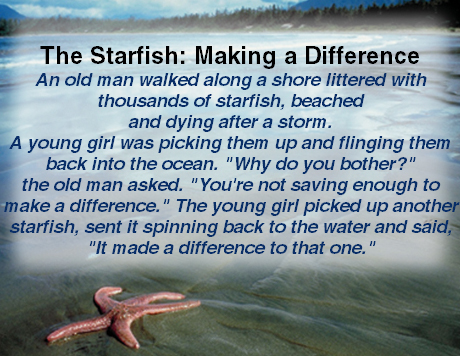
Making a Difference?

Starfish

Day before yesterday, as I was driving on Bardstown Rd, I saw a man standing by the side of the road with a sign that read “Hungry, please help.” My son and I had talked about this, if we saw something like this, what we’d do. And we had come to the conclusion that we would take a person with a sign like this to an eatery and buy them food. With that in my mind, I stopped and parked my car, walked over to the gentleman and said “I saw your sign. Please pick one of the two food places behind us and I will buy you a meal.” He immediately turned around and starting looking at the two places, one was Rally’s and the other one, I don’t remember what it was, but he picked the other one. We went inside, I asked him to pick anything from the menu, and bought him two meals. I gave him, the miraculously in my purse, $20, (I NEVER have cash on me, but this $20 must have had his name on it!) and was about to leave, when I thought it would be a good idea to ask for his phone number so I could give him any job leads I found. While inside, he told me he had worked as a food service worker in fancy restaurants in Louisville, he had also driven a fork lift, and had some experience with computers. He had taken early retirement and was only getting $900/month, recently he had lost both his part time jobs, and had to move because of deplorable conditions in his apartment which the landlord refused to correct. And now, all of a sudden, he found he didn’t have enough money to eat. So I decided to ask my friends to see if anyone knew of something he could do. He told me his name was Alfonzo, and gave me his cell phone number. Yesterday, I asked my friend about any leads for a job for Mr. Alfonzo. My friend gave me a name and number today, when I tried to call Mr. Alfonzo, someone named Larry answered! I asked him if he knew anyone named Alfonzo, but he said no. My heart sank. I had meant to help Alfonzo as much as I could, but now I couldn’t help him at all. Either I’d punched in the wrong number in my phone or he’d given me the wrong one. I looked back at the situation as it was happening, and I remembered how truthful and honest Alfonzo had seemed. How clean and gentlemanly he’d been. I decided I had written down the wrong number, because he did not, not in the least, seem like someone who lied. The first three digits of the number were 345- ####, so I decided to try 435-#### and guess who answered? Yes, Mr. Alfonzo!!! I gave him the job lead and asked him to call the place. I also told him that I had other friends looking out for more leads. He thanked me profusely, as he had done when I bought him the meal. He seems like such a sweet old man, fallen on hard times.

I know this isn’t about me, it is about helping a man who finds himself in unfortunate circumstances. But it was very difficult for me to realize that I didn’t have his number. I am always afraid, terrified, panic stricken at the thought of losing someone, what the heck does that even mean? Yeah, who knows… but I suspect this fear has its roots in having “lost” my father at about 5 years of age, and then having lost my brother, or maybe it’s just a human fear of loss and of being alone. So my heart plummeted when I found myself with the wrong number, I had been afraid of it all along, that I’d written down the wrong number, and in this instance, my worst fear was realized! So what did I do, did I give up? No, I cried for about 2 minutes, then decided to look at the number to see if I’d gotten it wrong and if I could try a few combinations of it and see if I would get the right one. And the very first thing I tried, it worked!

Ok, I know, I’ll be careful. I will not give Mr. Alfonzo my home address, obviously not, I will not meet him anywhere in the dark, and I will not empty out my bank account and give all the money to him, haha. This man is honest, he is in no way a crook or a charlatan, he is simply a man fallen on hard times. And all I’m going to do is help find him a job. And yes, it is only one man I’m helping, not all of humanity, but for this one man, I hope I will be making a difference!

Research identifies biomarkers of suicide across psychiatric disorders

The ability to predict suicidal ideation by looking at the amount of expression of certain genes is quite amazing in and of itself, but what is really amazing is that lithium alters sodium transport and may interfere with ion exchange mechanisms and nerve conduction. Fluid and electrolyte metabolism are believed to be altered in affective disorders and this may be related to the therapeutic action of lithium. SLC4A4 is involved in sodium transport, and it is this protein which is a biomarker for suicidal ideation. Could this also be one of the key proteins involved in mental illness? Why isn’t anyone but me asking this question? Oh my goodness, I’m going to call my psychiatrist and run this by him. These relationships are not random, there is something quite important going on here. Na+ transporter protein predicts chances of suicide, Na+ influx and outflux, possibly the pumps that do this, are affected by lithium which treats bipolar d/o!  Read on please!

Researchers identified biomarkers of suicidal ideation across multiple psychiatric disorders and developed an application to help clinicians accurately screen for suicide risk. These researchers looked at the expression of different genes and changes in their expression between a no suicidal state to a high suicidal state, to see if one of them would signal suicidal ideation in bipolar d/o, major depressive d/o, schizoaffective d/o and schizophrenia. They looked at 217 males with bipolar d/o, major depressive d/o, schizoaffective d/o or schizophrenia.

What they found was that SLC4A4 was the best biomarker for suicidal ideation across all illnesses! This gene encodes a membrane protein transporter which transports sodium bicarbonate across cell membranes. Sodium bicarbonate cotransporters, like SLC4A4, mediate the coupled movement of sodium and bicarbonate ions across the plasma membrane of many cells. This is an electrogenic process with an apparent stoichiometry of 3 bicarbonate ions per sodium ion. SLC4A4 predicted suicidal ideation among participants with bipolar disorder with an area under the curve (AUC) of 93% and future hospitalizations with an AUC of 70%. Using questionnaires such as the simplified affective state scale (SASS) and Convergent Functional Information for Suicide (CFI-S) which measure suicidal ideation along with the biomarker SLC4A4, the AUC was 92% for all psychiatric diagnoses, 98% for bipolar disorder and 94% for future hospitalizations.

http://www.ncbi.nlm.nih.gov/pubmed/26283638

Understanding and predicting suicidality using a combined genomic and clinical risk assessment approach.
Abstract

Worldwide, one person dies every 40 seconds by suicide, a potentially preventable tragedy. A limiting step in our ability to intervene is the lack of objective, reliable predictors. We have previously provided proof of principle for the use of blood gene expression biomarkers to predict future hospitalizations due to suicidality, in male bipolar disorder participants. We now generalize the discovery, prioritization, validation, and testing of such markers across major psychiatric disorders (bipolar disorder, major depressive disorder, schizoaffective disorder, and schizophrenia) in male participants, to understand commonalities and differences. We used a powerful within-participant discovery approach to identify genes that change in expression between no suicidal ideation and high suicidal ideation states (n=37 participants out of a cohort of 217 psychiatric participants followed longitudinally). We then used a convergent functional genomics (CFG) approach with existing prior evidence in the field to prioritize the candidate biomarkers identified in the discovery step. Next, we validated the top biomarkers from the prioritization step for relevance to suicidal behavior, in a demographically matched cohort of suicide completers from the coroner’s office (n=26). The biomarkers for suicidal ideation only are enriched for genes involved in neuronal connectivity and schizophrenia, the biomarkers also validated for suicidal behavior are enriched for genes involved in neuronal activity and mood. The 76 biomarkers that survived Bonferroni correction after validation for suicidal behavior map to biological pathways involved in immune and inflammatory response, mTOR signaling and growth factor regulation. mTOR signaling is necessary for the effects of the rapid-acting antidepressant agent ketamine, providing a novel biological rationale for its possible use in treating acute suicidality. Similarly, MAOB, a target of antidepressant inhibitors, was one of the increased biomarkers for suicidality. We also identified other potential therapeutic targets or biomarkers for drugs known to mitigate suicidality, such as omega-3 fatty acids, lithium and clozapine. Overall, 14% of the top candidate biomarkers also had evidence for involvement in psychological stress response, and 19% for involvement in programmed cell death/cellular suicide (apoptosis). It may be that in the face of adversity (stress), death mechanisms are turned on at a cellular (apoptosis) and organismal level. Finally, we tested the top increased and decreased biomarkers from the discovery for suicidal ideation (CADM1, CLIP4, DTNA, KIF2C), prioritization with CFG for prior evidence (SAT1, SKA2, SLC4A4), and validation for behavior in suicide completers (IL6, MBP, JUN, KLHDC3) steps in a completely independent test cohort of psychiatric participants for prediction of suicidal ideation (n=108), and in a future follow-up cohort of psychiatric participants (n=157) for prediction of psychiatric hospitalizations due to suicidality. The best individual biomarker across psychiatric diagnoses for predicting suicidal ideation was SLC4A4, with a receiver operating characteristic (ROC) area under the curve (AUC) of 72%. For bipolar disorder in particular, SLC4A4 predicted suicidal ideation with an AUC of 93%, and future hospitalizations with an AUC of 70%. SLC4A4 is involved in brain extracellular space pH regulation. Brain pH has been implicated in the pathophysiology of acute panic attacks. We also describe two new clinical information apps, one for affective state (simplified affective state scale, SASS) and one for suicide risk factors (Convergent Functional Information for Suicide, CFI-S), and how well they predict suicidal ideation across psychiatric diagnoses (AUC of 85% for SASS, AUC of 89% for CFI-S). We hypothesized a priori, based on our previous work, that the integration of the top biomarkers and the clinical information into a universal predictive measure (UP-Suicide) would show broad-spectrum predictive ability across psychiatric diagnoses. Indeed, the UP-Suicide was able to predict suicidal ideation across psychiatric diagnoses with an AUC of 92%. For bipolar disorder, it predicted suicidal ideation with an AUC of 98%, and future hospitalizations with an AUC of 94%. Of note, both types of tests we developed (blood biomarkers and clinical information apps) do not require asking the individual assessed if they have thoughts of suicide, as individuals who are truly suicidal often do not share that information with clinicians. We propose that the widespread use of such risk prediction tests as part of routine or targeted healthcare assessments will lead to early disease interception followed by preventive lifestyle modifications and proactive treatment.Molecular Psychiatry advance online publication, 18 August 2015; doi:10.1038/mp.2015.112.

Suicide Prevention Awareness Month. National Suicide Hotline 1-800-273 TALK (8255)

One of the worst things to happen to anyone is to lose a precious, beloved family member to suicide. I know. I lost my 26 year old brother, Farooq, in 1991. It is not something that you ever get over. The loss, the emptiness, the heartache, the guilt, the devastation, they never go away. The “if only I’d …” been there, done this, held on to his hand so he couldn’t have walked away, the if onlys, they never go away. I wasn’t even in Buffalo when it happened. If only I’d been there, I may well have been able to help him. I would still give my right arm to have him here with us, with his beautiful, endearing smile, his goofy jokes, his sweetness, his sensitivity, his love.

September is Suicide prevention month. This article from NAMI is an excellent article, with a great amount of information to help people who are thinking of suicide, hotlines, it also has information for people who are friends or family of someone who is thinking of suicide. I hope my posting this will help people, will prevent this devastating loss from happening to people. Read on.

SuicidePrevention

https://www.nami.org/Get-Involved/Raise-Awareness/Awareness-Events/Suicide-Prevention-Awareness-Month

“September 2015 is also known as National Suicide Prevention Awareness Month which helps promote resources and awareness around the issues of suicide prevention, how you can help others and how to talk about suicide without increasing the risk of harm.

Suicidal thoughts can affect anyone regardless of age, gender or background. Suicide is the third leading cause of death among young people and is often the result of mental health conditions that effect people when they are most vulnerable. Suicidal thoughts and suicide occur too frequently but should not be considered common and can indicate more serious issues. In many cases the individuals, friends and families affected by suicide are left in dark, feeling shame or stigma that prevents talking openly about issues dealing with suicide.

Crisis and Information Resources

  • I’m in crisis or am experiencing difficult or sucidal thoughts: National Suicide Hotline 1-800-273 TALK (8255)
  • I’m looking for more information, referrals or support: NAMI HelpLine 800-950-NAMI (6264)

If you or someone you know is in an emergency, call The National Suicide Prevention Lifeline at 1-800-273-TALK (8255) or call 911 immediately.

If you or someone you know is in an emergency, call The National Suicide Prevention Lifeline at 1-800-273-TALK (8255) or call 911 immediately. – See more at: http://www.nami.org/suicide#sthash.GE2GI37c.dpuf

World Suicide Prevention Day

On September 10, 2015 we observe World Suicide Prevention Day to reach out to those affected by suicide, raise awareness and connect indiviudals with suicidal ideation to treatment services. It is also important to ensure that individuals, friends and families have access to the resources they need to address suicide prevention.

What else can I do?

We believe that these issues are important to address year round. Highlighting these issues during Suicide Prevention Awareness Month and World Suicide Prevention Day provides a time for people to come together and display the passion and strength of those working to improve the lives of the millions of Americans that can benefit from honest discussions about mental health conditions and suicide. In fighting for those living with mental illness there is still much more that needs to be done and more ways to get involved.

If you or someone you know may need a mental health assessment, anonymous online tools are available. Learn more and help yourself or someone you care about.

Awareness Resources

Share the images and graphics below during the month of September to help promote awareness of suicide prevention resources and promote discussion of suicide prevention awareness. You can also use #suicideprevention or #IAmStigmaFree on social media.

Facebook Cover Image and Badge:

Facebook Cover Image 851x315px

Facebook Share Image 1200x1200px

Twitter Cover Image and Badge:

Twitter Cover Image 1500x500px

Twitter Share Image 1012x512px

– See more at: https://www.nami.org/Get-Involved/Raise-Awareness/Awareness-Events/Suicide-Prevention-Awareness-Month#sthash.p0Kv0jNk.dpuf

Worry

Where did she go, the girl I used to be? Self sufficient, calm, observant, fun loving, resourceful? I used to read mystery books by Enid Blyton when I was young, all afternoon long, when everyone else was taking a siesta, in Lahore. I thought of nothing but what I was reading in the books, I worried about nothing, so carefree in my younger days I was. I used to, oh so quietly, sneak into the kitchen and make myself butter and jam sandwiches and then take them to my room and munch on them contentedly as I read my exciting books. I used to go out into the garden, even in the horrid afternoon heat, and talk to the flowers, and watch the butterflies alight on them, butterflies with their gossamer, iridescent wings. Even then, flowers, their brilliant colors and amazing shapes fascinated me. Then when the sun got too hot on my face and head, I would go back up to my cool, peaceful room and resume reading. It was so peaceful, no thoughts, no anxiety, no worries, just being me and doing what I was doing, in the moment. Life was fun, enjoyable, I was present and engaged in it. When and where did all this anxiety, this yearning, this restlessness and sadness come into me? I am constantly anxious about my son. I constantly miss him, worry about him, wonder if he is fine. When I cook dinner, I mourn the fact that he is not here to share it with us. I worry he is not eating right, resting enough, taking care of himself properly. I worry about my aunt, who is very sick. I’m going to visit her in December, booked my ticket already. It may be the last time I will see her, she is so thin and frail, I don’t know how long she’ll last. Yes, I know, I know, she is 75 years old, and has lived as good a life as she could have with her god awful illness. She has been surrounded by her nephew, niece and their families who love her immensely. I know, we all have to go someday, but it is still sad for the ones left behind, or to watch someone become a wraith because of their illness, it is truly a difficult thing.

Obviously, it is uncertainty that makes me anxious. Also worries about my son’s wellbeing make me anxious. Phantom worries, nothing concrete, just what ifs. Dammit, I took my Seroquel a bit ago and now I am getting very drowsy, but I have to finish this. If I wait till tomorrow, the whole timbre and tone of this piece will change.

I just wish I could recall that peaceful time. The time when I just existed and read my mystery books and munched on jam sandwiches. No other thoughts in my head, nothing worrying me, nothing upsetting me. Is it possible? Have I simply developed an anxiety disorder, a biochemical thing, and since it makes me feel anxious, I attach thoughts to the feeling? Possible. In any case, it is not a very good way to live. But I am trying to do something about it, being aware of it at least gives me the chance to address it and hopefully find a solution.

Some Thoughts on the “Nasal spray device for mental illness” Post

I saw the article “Nasal spray device for mental illness” (http://www.neuroscientistnews.com/clinical-updates/nasal-spray-device-mental-illness) article late last night and decided to simply post it because it was so interesting (https://bipolar1blog.wordpress.com/2015/08/28/nasal-spray-device-for-mental-illness/) Somehow, even though I didn’t post it on my FB Bipolar1Blog page, my statistics show that it’s gotten 25 views! That is a huge amount of traffic in less than 12 hours! People are looking for new ways to treat mental illness, obviously, we all are. And here is a novel way, using a nasal spray. Although not so novel if you think about people whose noses are/were rimmed with white powder in rest rooms of fancy restaurants, coming out with glassy eyes and torrential conversations and activity. That would be the first intranasal “therapy” for whatever you thought ailed you. Just something that occurred to me, no disrespect to people with mental illness or old or new or developing treatments for mental illness! Anyway, we’ve known for a long time that substances can reach the brain through the nose, (nose http://www.webmd.com/brain/news/20010222/this-nasal-spray-may-clear-your-brain-not-your-sinuses) There are nerve endings in the nose from two very powerful nerves, the olfactory nerve and the trigeminal nerve. And both these nerves obviously have their roots in the brain. So if substances can travel these nerve “super highways”, they can get directly into the brain without having to go into the bloodstream, thereby avoiding the blood brain barrier. Large molecules such as Oxytocin, cannot cross the blood brain barrier. It is also faster to send molecules to the brain through the nasal route than to have them enter the bloodstream, go to the heart and then be pumped out to the rest of the body and brain.

So these researchers in Oslo decided to look at Oxytocin, a molecule that promotes social interaction, eases pregnancy, childbirth, and milk letdown after the birth of the infant. They observe that people with autism, schizophrenia, and bipolar d/o have poor social functioning, so a dose of Oxytocin will help them be better in social interactions. Since Oxytocin is a large molecule, it wouldn’t pass the blood brain barrier, so they decided to try this nasal route. It helps if you have a big nose, and if you breathe. The Oxytocin goes directly to the brain and “The research showed that only those administered a low dose of oxytocin experienced an effect on how they perceived social signals.”

The researchers say that these effects were seen in only the men who received low doses of Oxytocin intranasally. The effects were not seen in men who received Oxytocin intravenously.

Whatever the effects were, whether Oxytocin can be used as a therapy for mental illness or not, this study is important because it shows that drugs can be delivered intranasally, directly to the brain, avoiding the blood circulation and the blood brain barrier and or GI/stomach problems. More drugs can be tested for intranasal delivery. A quicker and hopefully more effective route into the brain, leading to more effective therapies for treating mental/neurological illnesses.

Nasal spray device for mental illness

http://www.neuroscientistnews.com/clinical-updates/nasal-spray-device-mental-illness

clinical updatesAUGUST 26, 2015


Oxytocin can reach the brain in two ways: indirectly, through blood, or directly, along nerve pathways. A: nasal spray particles B: route C: mucous membrane D: sensory neuron E: blood vessel F: nerve pathway G: nerve. Credit: UiO

Researchers at the University of Oslo (UiO) have tested a new device for delivering hormone treatments for mental illness through the nose. This method was found to deliver medicine to the brain with few side effects.

About one out of every hundred Norwegians develop schizophrenia or autism in the course of their lifetime. Moreover, at any one time some 20,000 people are receiving treatment for these problems. Many psychiatric disorders such as autism, schizophrenia and bipolar disorder are characterized by poor social functioning.
Oxytocin is a hormone that influences social behavior and has shown promise for the treatment of mental illness.
Researchers at UiO have now discovered that low doses of oxytocin may help patients with mental illness to better perceive social signals. As part of this project, they have collaborated with the company OptiNose, who have developed a new device designed to improve medicine delivery to the brain via the nose.
Regulates social behavior
Oxytocin has historically been known to play a crucial role in child rearing as it facilitates pregnancy, birth, and the release of milk during nursing. Further, oxytocin helps regulate cardiac functions and fluid levels. More recent research has revealed the importance of oxytocin for social behavior.
Oxytocin is a neuropeptide and was discovered in 1953. Peptides are a group of molecules that consist of a chain of amino acids. Amino acids are also known as the building blocks of proteins, which we find in all types of cells. Oxytocin is produced in the hypothalamus, which is the brain’s coordinating center for the hormone system.
Medicine through the nose
Because of oxytocin’s role in social behavior, researchers have explored the possibility of administering the hormone for the treatment of mental illness. As oxytocin is a relatively large molecule, it has trouble crossing the barrier between the brain and circulating blood. Thus, researchers have administered oxytocin to patients through the nose as this route offers a direct pathway to the brain that bypasses this barrier.
However, researchers have a poor understanding of how oxytocin reaches and affects the brain. The most effective dose for treatment has also received little research attention.
Professor Ole A. Andreassen and his research team have collaborated with OptiNose on a project that evaluated two different doses of oxytocin and on how they affect the way in which social signals are perceived.
Low doses work best
Sixteen healthy men received two different doses of oxytocin, along with placebo. Volunteers were also given an intravenous dose of oxytocin, for a comparison of the effects of oxytocin in circulating blood. The research showed that only those administered a low dose of oxytocin experienced an effect on how they perceived social signals.
Professor Ole A. Andreassen explains: “The results show that intranasal administration, i.e. introducing oxytocin through the nose, affects the function of the brain.
As no effect was observed after intravenous treatment, this indicates that intranasally administered oxytocin travels directly to the brain, as we have long believed. The fact that we have shown the efficacy of a low dose of oxytocin on social perception is even more important.
A dose that is lower, but that still influences behavior, will entail a lower risk of affecting other regulatory systems in the body. Very high doses of oxytocin could, in fact, have the opposite effect on social behaviour.”
The scientists also discovered that individuals with larger nasal cavities had a stronger response to a low dose of oxytocin.
Breathing helps
OptiNose uses a new technology to distribute medicine to the brain, making use of the user’s breath to propel medicine deep into the nasal cavity.
The device administers oxytocin high up into the patient’s nasal cavity. When the medicine is targeted deep inside the nose, it enables brain delivery along nerve pathways from the uppermost part of the nasal cavity. Conventional nasal spray devices are not suited to consistently deliver medicine high up enough into the nose.
The device also expands the nasal cavity, facilitating nose-to-brain medicine delivery. As the user exhales into the device, this closes the soft palate and prevents the medicine from being lost down the throat.
Since less medicine is lost along the way, patients can take smaller doses and accordingly experience fewer side effects.
May yield new treatments
The next step in the research is to carry out the same tests on people with mental illness.
“We are now running tests in volunteers diagnosed with autism spectrum disorders,” says Dr Quintana.
“We hope that this research project is the first step in the development of a series of new medicines that may be of great help to more people with mental illness,” concludes Professor Andreassen.