Palestine WILL Be Free

eCounseling

Screen Shot 2015-04-10 at 12.20.26 AM

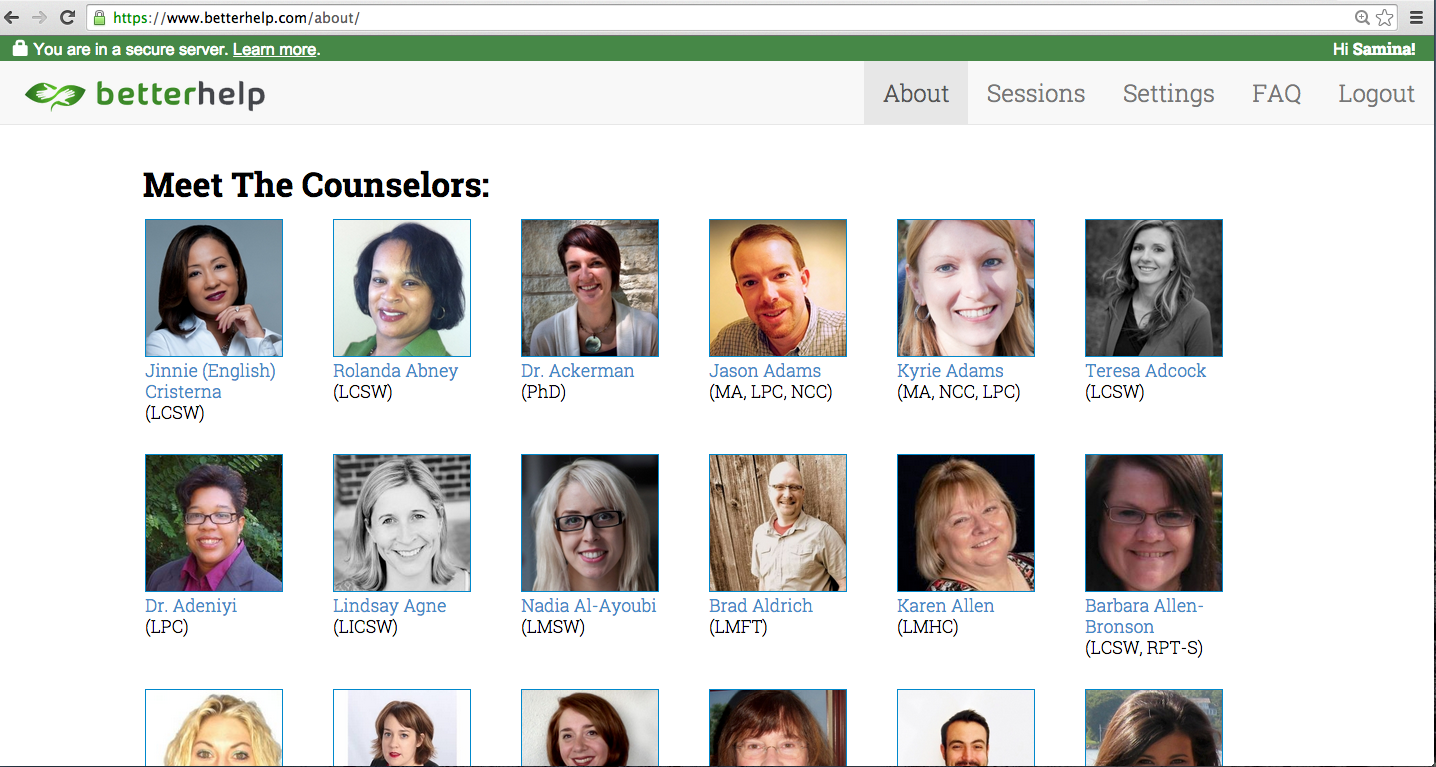
I found a very good ecounselor via this website: https://www.betterhelp.com/ She was insightful, easily understood what I was telling her, and reframed many of the things I told her as an obsessive worrier, and made positives out of my negative thinking. I am so glad I set up my account and was fortunate enough to have been matched with this smart, helpful, insightful lady.

I actually found this website advertised on, what else, Facebook! I asked my psychiatrist if ecouseling was a legitimate and helpful thing. He said that in studies that were done to determine exactly that, no difference was found between ecouseling and conventional (you go to the counselor’s office) counseling. So I decided to try it and I am very, very happy that I did.

I made an account with all my info. The first week is free as a tryout. Then you get charged $35/month. This includes one hour long phone session (additional phone sessions are $20/hour) and unlimited texting with the counselor who has been matched with you.They have literally 100’s of counselors and if you don’t like the one with whom you were matched, you can request a change.

They matched mine to me very well. Really happy that I did this and I will be setting up more appointments with her, for sure.

Words

IMG_1318

Some words that have the power to change your thinking, the power to pull you up by your bootstraps, the power to pull you out of the seemingly bottomless hole that is depression and anxiety:

RESILIENCE, that is what we have, what we are to recover over and over again from black depressions, from the mean reds. We get up over and over again and brush ourselves off and go on! How resilient is our spirit, how resilient are we! I marvel at this ability.

PLASTICITY, this is what our brains do in learning or after any experience. An experience leaves a mark on our brains, good or bad. But this is not permanent. Our brains have the ability to form new connections and lose old ones. This happens between neurons. Once it was thought that an adult brain is like a structure made of stone. There is nothing further from the truth, the brain is undergoing changes all the time, whether it be in repair, or neuronal cell growth or growth of axons and dendrites. This all makes our brain very adaptable and repairable and changeable! So if we have undergone bad experiences, our brain can recover from those through plasticity!

HOPE, well what can I say about this word? This is the little, four letter word my world rests on. It is so powerful that even in the darkest of circumstances, just say it and things will get brighter. Your heart will get lighter. You will breathe easier. Take it away and , oh no I can’t even fathom taking it away. Always have hope, as long as you live and breathe!

STRENGTH, we with mental illnesses all have to be strong. We go through hell so many times that the word hell sort of loses its meaning. My muscles are getting stronger because I have a FaceTime personal trainer and that is just fab. But my mind has to be strong, my heart has to be strong, my will has to strong to withstand this sick disease. We all do. And we all are, that is why we are still here. We are strong for our children, for our friends and loved ones and we are strong for ourselves!

OVERCOME, when I am in a very depressed state or manicky phase, I do have lucid moments when I tell myself that I will overcome this too, just like I have been doing since 1985, yes I will overcome.

and a sentence: THIS TOO SHALL PASS, everything passes, good, bad, indifferent things pass. So of course whatever phase you’re in, it will pass.

Take heart my friends and stand tall and strong, easier times are ahead. I am sure of it!

Still Standing

t 6 t 1 t 2 t3t 4 t 5

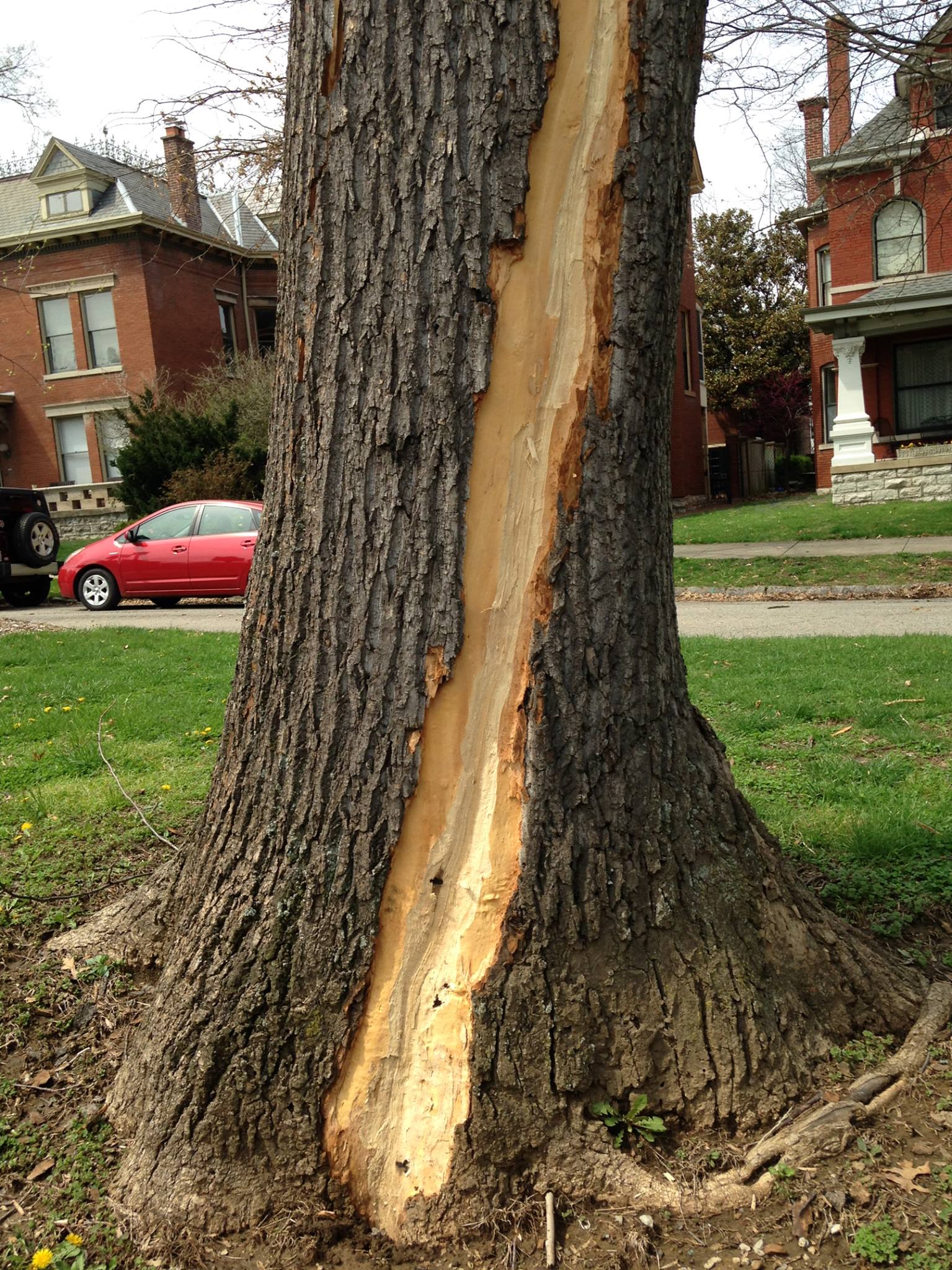
This tree, this beautiful, strong, stalwart, faithful tree, was struck by a powerful flash of lightning. We were in the back of our condo and the sound was so loud, so loud that I swear I’ve never heard such a loud sound before. The tree is about 20 ft. away from our building. Its bark was shattered, splintered and thrown all over the street as well as into our front yard! Yet it stands! This amazing tree still stands. I am in awe of it. I gather strength from it. As you may have noticed, I haven’t been posting too much lately… well… I haven’t been feeling good. But since seeing this tree withstand I don’t know how many joules of electricity with which the lightning struck it, I feel inspired and strengthened. If the tree could do it, and it is a living being, then so can I! If the tree can take a hit and still keep standing, so can I! I love trees. You may even see me giving a tree a hug if you are walking in Cherokee Park. I am so glad that this tree is still here and I hope the wood wide web is giving it the nutrients it needs to heal. Yes there really is a wood wide web and yes the trees in it really do send nutrients to weak trees, here is a link if you’re interested in the wood wide web: http://www.bbc.com/earth/story/20141111-plants-have-a-hidden-internet

Ain’t the world grand!

Well then, here’s a poem I wrote for this heroic tree:

The Tree

It was a flash, it was a powerful flash

You were struck, and it could have undone you

But you are strong. stronger than what life throws at you

You absorbed it, stood strong and grounded

I look at at you and marvel, how did you do it

But there is no “how”, there is only standing tall and proud

My best wishes for this amazing tree and may it live a long and healthy life.

Clint Malarchuk Interview on Soul Luminous Radio

http://www.soul-luminous.com/

Another BRILLIANT interview by Clint Malarchuk, he talks about his injury, his OCD, PTSD, suicide attempts, depression, stigma, and ultimately his SURVIVAL and his thriving and living a great life now! I would listen if I were you 😉

And here is the link to by his book “A Matter of Inches.” http://www.amazon.com/Matter-Inches-Survived-Crease-Beyond/dp/1629370495

Great Tips for Reducing Anxiety from Healthline.com

IMG_2726

http://www.healthline.com/health/bipolar-disorder/guide-stress-anxiety

Since I posted about anxiety, here’s an article which tells you how to lower anxiety levels. Great tips to use when anxiety is troubling you. The link to the article is above and an excerpt from the article is below. I think my favorite is the first one, to invoke the relaxation response when your flight or flight is activated.

Here are some ways to help prevent stress and anxiety in your life:

Use ‘the Relaxation Response’

Dr. Jason Evan Mihalko, a certified psychologist working out of Harvard Square in Cambridge, Mass., said that stress is one of the most manageable things of all.

“Many people know about the fight or flight response—a biological response to stress where our bodies become prepared to either run to safety or fight. What many people don’t know is that we have also designed an antidote to fight or flight: the relaxation response,” he said. “Through simple deep breathing exercises, visualizing a pleasant scene, or soothing ourselves through the five senses, we can induce this relaxation response.”

When we’re able to relax, many things happen, Dr. Mihalko said, including decreased metabolism, slower heartbeat, relaxed muscles, slowed breathing, lowered blood pressure, increased levels of nitiric oxide (an important chemical compound in protecting vital organs and Science’s Molecule of the Year in 1992), and our general sense of well-being and calm increases.

Prioritize

It’s human to feel overwhelmed when there are a million things to do at once—work, school, kids, marriage, friends, family, etc. can all lead to worry. Coupled with the unpredictable nature of bipolar disorder, anxiety can create havoc inside your mind.

The key to preventing stress and anxiety build up—with or without bipolar disorder—is determining which is the most important and what can be done first. We often lose focus of why we’re doing so many things, so concentrating on what’s most important can be an easy way to eliminate clutter in our lives.

It’s important that your therapy for bipolar disorder remains a main priority. You may think you don’t have time for it, but know that if you skip on treatment, you’re only making things worse for yourself.

Lists are a great way to keep track of what you should be doing and what’s the most important thing to do first. Lists are a great way of tackling some of the quick and easy things first, allowing you to cross tasks off your list and gaining a sense of accomplishment.

Here’s an example of what a list might look like:

1. Take medications
2. Email boss about vacation
3. Pick up dry cleaning
4. Meet Shirley for lunch
5. Buy groceries

Limit Yourself

Even super heroes can’t be everywhere at once. You can spend all day, every day attempting to do it all, but that won’t leave you with enough time or energy to stop and enjoy life. Plus, the stress generated by attempting to do it all could only aggravate your mood.

You may want to work full-time, prepare a good dinner every night, volunteer with a local charity, organize events, and do more, but there’s a good chance you’ll only stress yourself out, lose sleep, lose your temper, and create more problems for yourself.

Instead of trying to do everything, focus your energy and attention on doing a few things well. If you can afford it, hire some help around the house to do a little cleaning and the laundry. If you can’t afford it, ask everyone to help pitch in.

Think of your tasks as things you are buying with your time. You can try to buy a 120-bedroom house, but they’re all going to get dirty and broken down without regular maintenance. Besides, you don’t need all that space. You can afford (with your time) a nice two-bedroom house and make it the best one you’ve ever seen. In essence, don’t buy more than you can maintain.

Break Away

No matter your responsibilities, you need time for yourself. You need time to be able to collect your head, think things through, or even let your mind wander. This is especially important if you’re feeling manic and can’t concentrate.

The occasional weekend getaway can do wonders, but even being left alone for a few minutes when you get home can clear your mind. Let people know you need a moment to unwind and clear your head before getting down to business.

Some easy ways to sneak a moment to yourself is going for a walk, reading in a quiet place, going to the park, or just laying down in bed for a minute. No matter how you want to escape, make sure you can when things get to be too much.

Find Support

Friends and family can be the best listeners. They can be your greatest ally against welling stress and anxiety when coupled with bipolar disorder. They also provide a more objective insight into your problems and can help you spot stressful patterns. If all else fails, they can help you get a good laugh in when you need it most.

Therapists are trained listeners, and there’s no shame in seeing someone to help you talk through your problems. There are numerous types of therapy available, and the right one can help you express your emotions in a constructive way.

Take Care of Yourself

Mental health is directly related to physical health. Eating a balanced diet—void of sugary, deep fried, high fat, high sodium, and other harmful foods—can help your body get in shape to handle stress better. If your body is already under stress from harmful substances, it won’t be as ready to handle outside stress as well.

Be wary of tobacco, alcohol, and drugs as a way to relax. They may take the edge off for the time being, but they’ll only create more health problems down the road.

Learn which foods to eat (and avoid) to help your body deal with the stress of anxiety.

Sleep

Sleep is one of the first things to suffer under a busy, stressful schedule, but it should be the first thing that gets attention. We often skip sleep to tackle our to-do lists, but by doing that we’re robbing our body of rest, which leaves it more vulnerable to stress, anxiety, and illness.

Exercise

If your mind won’t rest when it’s time to get some sleep, you should incorporate some exercise into your day. Even if you’re snoring the second your head hits the pillow, exercise is a vital way to not only handle stress, but to keep your body in tune to accept any challenge.

Hitting the gym or going for a run after work is a great way to beat stress, as well as give you time to think. Start incorporating it into your routine and see how quickly you can become addicted to good habits.

Plan

There will always be unforeseen circumstances, but when you plan in advance, you’ll know what’s next and how to prepare for it. A day planner, smart phone, or email reminders are great ways to keep yourself accountable while giving your mind a second to concentrate on something other than what you’re supposed to be doing next.

About Anxiety

Aral's closet Aral's closet

Something I realized about anxiety, it’s the god of small things. When we think about each little, minute detail, and of course in our anxious state, we invariably think every single thing is going to result in disaster, that is anxiety. It is fueled by an anxious mind, reinforced by our anxious, negative thoughts, and so goes the circle, round and round. What I have found gets you out of this anxious spiral is to look at the bigger picture, and then we realize these minute, little details don’t really matter. They are just what our mind is clinging to in our anxious state and it’s a snowball effect. In fact, in the big picture, everything is fine and will be fine. The big picture pulls us out of this anxiety ridden, panic stricken state. For example, my anxiety is ALL about my son. We’ve been through very difficult times with him, as we have generally because of my illness, and the resulting circumstances in my (nuclear) family. But we all made it, my little family is still intact. Of course my son has flown the coop now and I miss him terribly. That’s why I am in Buffalo every month 🙂 He is doing very well, knock on wood. Of course, as is sometimes the case, he is messy, and of course my anxious mind takes it to: He is dysfunctional, that means he is mentally ill (he is not) and all kinds of disasters are going to happen because of this. It doesn’t mean anything of the sort. It just means he is messy, and if that is the worst of it then it’s really nothing to worry about! That’s just one example, and now that I have written it down, I know why it is called catastrophizing!!! I do this with hundreds of things everyday. But if I look at the bigger picture, all’s well.

All’s well.

Men & Depression: NHL Goalie, Clint Malarchuck

Clint-Malarchuk-hockey-depression

This is an interview that Clint Malarchuk did for ESPERANZA Hope Magazine. I’ve been looking for it and finally found it. It’s a brilliant interview. Very worth everyone’s time to read.

http://www.hopetocope.com/men-depression-nhl-goalie-clint-malarchuck/

The former hockey goalie shares his story on confronting his depression and anxiety.

By Linda Childers

There was a time when the face mask Clint Malarchuk wore as protection against hurtling hockey pucks mirrored the façade he donned to get through the day. In a rough-and-tumble sport where players are valued for their “manly” ability to get physical and play aggressively, the award-winning goaltender became a master at hiding the inner turmoil of anxiety and depression.

“Goalies are the guy everyone looks to for confidence,” explains Malarchuk, who began his professional hockey career before he turned 21. With his high-pressure job plus the stress of keeping up appearances, he says, “I felt that I had to be twice as strong.”

Over 14 years, Malarchuk tended the crease for the National Hockey League’s Quebec Nordiques, Washington Capitals, and Buffalo Sabres before finishing out his playing days with the Las Vegas Thunder of the International Hockey League. When he was out on the ice, immersed in a game, he was able to find some peace. Off the ice, not so much.

“In the locker room, I was the easygoing clown of the team, yet inside, I felt like my brain was on fire,” he recalls.

From puck drop to final whistle, Malarchuk was focused on “the save”—keeping the puck from entering the net. Nowadays “save” has a different interpretation for him—as in, keeping others who grapple with mental distress from feeling alone and hopeless.

He’s a powerful role model for other men. When he speaks in public, Malarchuk tries to stress that depression isn’t just a “woman’s disease” and how important it is for men to confront their depression and seek out treatment.

“I always knew I was physically tough, but I believed I was mentally weak until I started talking to other men and finding out how many of them also suffered from depression,” he says.

At a recent event, Malarchuk recalls, he was approached by a father and his teenage son.  Malarchuk told the young man something he wished someone had shared with him at an earlier age.

“I emphasized how there’s help … not only in the form of medication, but also in therapy, and in talking openly with others.”

‘COWBOY UP’

Malarchuk, 53, details his own struggles in his new memoir, A Matter of Inches: How I Survived in the Crease and Beyond (titled The Crazy Game in Canada). Take that “survived” literally: In a horrifying 1989 incident—witnessed by a nation of TV viewers tuned in to a Buffalo Sabres game—Malarchuk nearly lost his life when a skate blade slashed his neck.

The accident left Malarchuk with post-traumatic stress disorder—although it wasn’t diagnosed until years later—and deepened an emotional maelstrom that began during his difficult boyhood. He got a very different message then from the one he now promotes.

“From childhood, I was taught to cowboy up and move on,” says Malarchuk, who was raised on a ranch in Edmonton, Alberta.

His mask was already in place as he struggled through school and spent restless nights at the mercy of his anxiety and fear. “I remember thinking I was the only person on the planet who felt like their head was always spinning,” he says.

When he was skating, hockey stick in hand, the spinning stopped. The ice was his refuge, and the ebb and flow of the game would override his troubled thoughts. Malarchuk threw himself into the sport—and into obsessive conditioning. He would run 12 to 20 miles each day, lift weights, and box.

The “man up” message also drove Malarchuk to less healthy ways of coping: drinking heavily and erupting in anger.

“I don’t get angry anymore, but in the past, my drinking would often lead to me picking fights and being verbally abusive. I wasn’t even aware of some of the things I said when I lashed out,” Malarchuk recalls. “When I relapsed, I was angry at myself for not being strong enough to control the feelings I thought I had put behind me.”

After working with the team’s doctors and then a psychiatrist who diagnosed his obsessive-compulsive disorder and depression, Malarchuk finally found medication “that helped tremendously.” It also helped with shame and self-doubt when the psychiatrist “compared taking antidepressants to a diabetic needing insulin,” he recalls. “The doctor was the first to explain that my OCD and depression were the result of a chemical imbalance.”

While medication didn’t erase all Malarchuk’s symptoms, it did serve to quiet his mind. He continued his hockey career as a goalie and, after hanging up his jersey in 1996, as a coach.

BETTER TOOLS

Learning to manage his depression has been an ongoing enterprise. After a serious relapse in 2008, Malarchuk finally sought out talk therapy. He was challenged to face unresolved emotions related to his traumatic neck injury years earlier.

“In therapy, I had to … cry, and to acknowledge my feelings,” he admits.

He also learned more about overall mental wellness.

“I’ve tried to change my habits and focus on staying in the right emotional, mental and spiritual state,” he says.

Malarchuk relapsed again while writing his memoir, turning back to old coping methods as old anguish resurfaced. He was goaltender coach for the Calgary Flames at the time, and team administrators offered to send him to a treatment center. Part of the month-long rehab involved targeting the underlying causes of his alcohol use.

Malarchuk says he learned more about tools like self-talk, personal time-outs, problem-solving and relaxation techniques.

Last summer, Malarchuk began a new chapter in his life. He retired from hockey to live full-time on his ranch in Nevada, where he’s been raising emus for years. He is devoting himself to a second career as an equine chiropractor and dentist.

Malarchuk is living the dream, part 2. As a teen, he worked as a ranch hand during summers and thought about becoming a veterinarian. Throughout his hockey years—the dream, part 1—he maintained a love for horses, ranching, and rodeo. (Thus his nickname “the cowboy goalie.”)

“Being around horses comforts me,” Malarchuk says. “The smell of the barn and the horses, even watching them eat calms me.”

(He also gets some animal therapy from one of the house dogs, a Yorkie, “who senses when I’m anxious or upset,” Malarchuk says. “He’ll come up to me and want to nuzzle close to my neck and offer comfort.”)

FAMILY MAN

Where playing hockey was once his escape, now the barn is Malarchuk’s refuge. His office is there, and a gym space where he lifts weights and works out every day he’s home.

“Sometimes when I start to feel down or anxious, I’ll tell my wife, Joanie that I need to take some time out and go to the barn to meditate,” Malarchuk says. “Joanie has been very supportive and is great about encouraging me to do whatever I need to, in order to stay healthy mentally.”

A father of three, with one teenage daughter still in the nest, Malarchuk tries to be open with his children about his depression. He recalls one occasion last winter when depressive symptoms arose and he began to cry. Instead of hiding away, he asked his daughter to come sit with him.

“I asked if she had ever felt depressed, and I told her that no matter what she was going through, that she could always talk to me,” he explains.
Malarchuk hopes he can be there for his own children the way his mom, Jean, has been there for him.

“My mom and I are very close,” he says. “She has always supported me through good and bad, and I don’t know what I would do without her and Joanie in my life.”

In recent months, Malarchuk and his wife have been traveling across North America to promote his book. At book signings and in emails, other men often thank him for “being honest about my feelings because it has helped them to be more open and to better manage their own depression,” Malarchuk says. “I also get e-mails from women who thank me for helping their husband or their son realize that depression is a true illness.”

In the past, Malarchuk’s honesty has opened him up to attacks that he’s somehow weak. He’s heard taunts—“Hey, Malarchuk, pop another pill.” He recognizes that depression can be hard to understand for someone who hasn’t been through it. That’s partly why he’s so passionate about speaking out.

“I used to think my purpose in life was being in the NHL as a player and then a coach,” Malarchuk says. “I realize now that playing hockey gave me the platform for my real purpose—to raise awareness of mental illness, and to help reduce the stigma surrounding depression and anxiety so that no one has to feel alone.”

Sidebar: How Clint copes

By looking outward: Malarchuk has learned that focusing his energy on helping others is an antidote for his own depression, whether it’s caring for horses or answering e-mails from people who write him about their struggles.

By looking inward: Malarchuk practices his own form of meditation. “I lay down and read a book of daily reflections, and I meditate on the reflection,” he says. “I also use this time to pray about the things in my life that I have control over, and that I can take charge of, while releasing the things that are beyond my control to a higher power.”

By looking beyond: When Malarchuk begins to feel anxious or depressed, he searches for the root cause. He was experiencing symptoms after a recent trip and determined that he hadn’t been sleeping enough while traveling. “I’ve learned that it’s important for me to get 8 to 10 hours of sleep each night in order to feel my best,” he notes.

“Claims About Andreas Lubitz’s Mental Health Further Stigmatize Mental Illnesses” from The Blog HuffPost

http://www.huffingtonpost.com/muffy-walker/claims-about-andreas-lubi_b_6963932.html

Sensationalizing this tragic news story about Andreas Lubitz crashing the Germanwings jetliner into the Alps and saying things like “Crazed rookie pilot murdered 149, Madman in the Cockpit.” as The Sun (United Kingdom) did when really nothing is known about the reason the pilot did this is further stigmatizing mental illness. Stigma stops mentally ill people from reaching out for the help they desperately need. Perhaps, if Lubitz did have problems with mental illness, stigma is the exact thing that stopped him from getting help!  So why? Why print sensational and irresponsible headlines about this event, why create more stigma? Why say things that have no basis in fact? Why not be responsible and present the facts as they unfold? If it is found out that it was mental illness that caused the pilot to commit this awful act, then by all means say it was. But until then, don’t make up headlines out of incomplete data. Yes I know headlines sell newspapers, but sensationalizing and making up stories when all the information is not known, well, that’s just bad journalism.

Here’s a wonderful list of things to do and don’t do from the Huff Post article (link above):

“Here are some specific do’s and don’t’s:

  • Share your experience with mental disorder. Your story can convey to others that having a mental disorder is nothing to be embarrassed about.
  • Help people with mental disorder reenter society. Support their efforts to obtain housing and jobs.
  • Watch the language you use:
  • don’t use generic labels: “retarded,” “our mentally ill”
  • don’t use psychiatric diagnoses as metaphors: “schizophrenic situation”
  • don’t use offensive words: “psycho,” “loony,” “crazy,” “wacko,” “slow,” “crackpot”
  • don’t refer to a person as a diagnosis: “he’s bipolar,” instead say, “he has bipolar disorder”
  • Document stigma in the media whenever possible
  • The media also offers our best hope for eradicating stigma because of its power to educate and influence public opinion, so remember to thank journalists when they get it right.
  • Send letters, make phone calls, or e-mail the offending parties
  • Ask your local, regional, and national leaders to take a stand
  • Support efforts to actively expose stigma in the media
  • Educate yourself – the elimination of stigma begins with you
  • Volunteer, join an anti-stigma campaign”

These are helpful, what The Sun is doing is not!

5035 Views of Bipolar1Blog!

Screen Shot 2015-03-30 at 3.30.08 PM

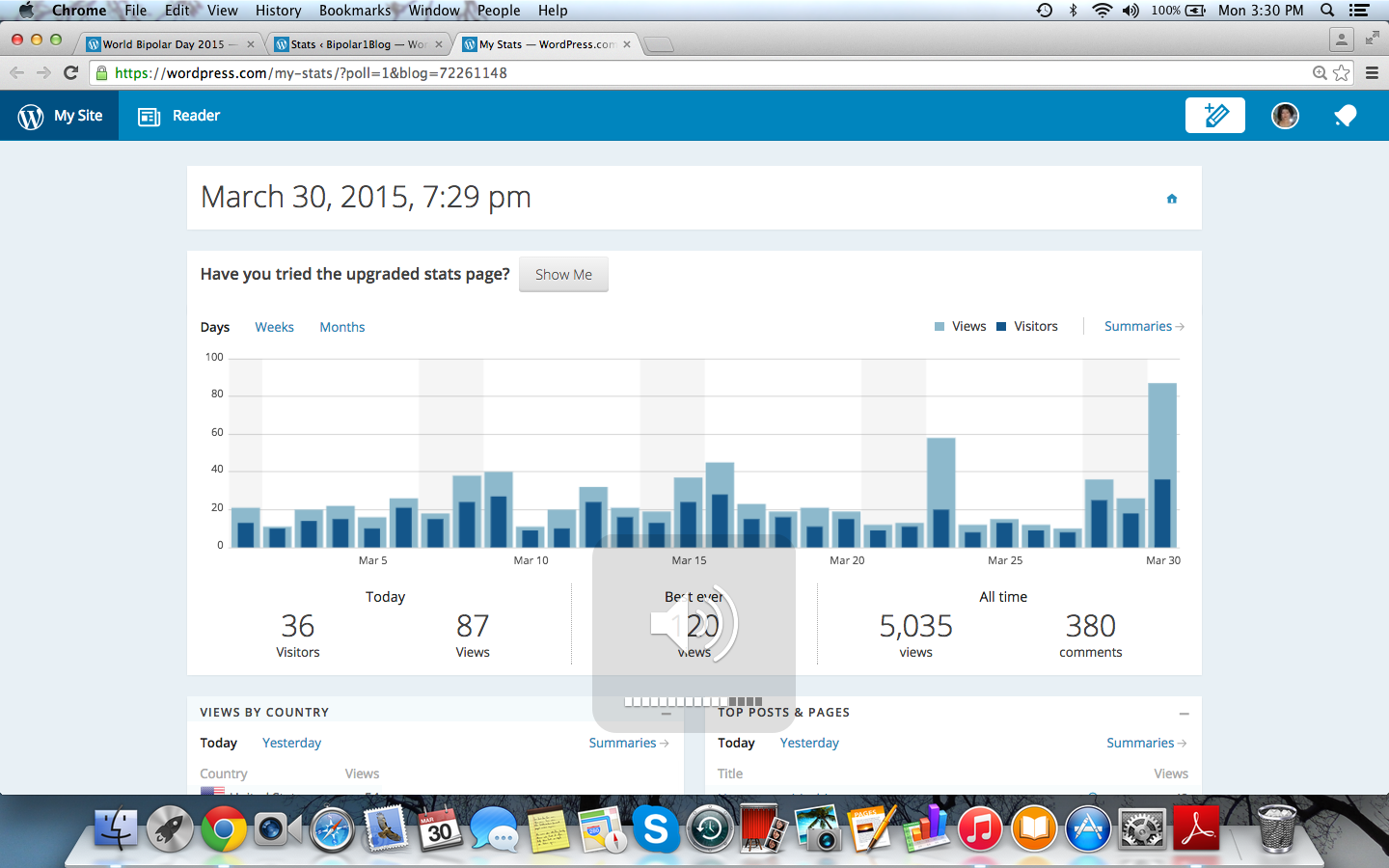
Today I reached over 5000 views on this blog. Woohoo! I started this blog because I wanted to tell my story, because I was tired of semi hiding the fact that I had bipolar d/o. And most importantly, I started this blog so that other people who have mental illnesses might read my posts and find some comfort in them, find some help in them, some solace and strength. Thank you viewers, readers and friends for reading Bipolar1Blog!