I’m here, in Providence, RI. Just got here today. Yesterday, after hearing the horrific news of my dearest cousin’s son, I immediately made reservations to come here. He fell from a structure 35 ft high, broke 10 ribs, 6 other bones and perforated a lung. He is in the ICU, he is young and is slated to make a full recovery. I am so happy about that. I came here for my cousin. We grew up together, spent every summer vacation together. Played, quarreled, made up, grew up together, like sisters. I couldn’t bear for her to live through this near catastrophe by herself, so I jumped in a plane and got here as quickly as I could. Saw my nephew in the ICU, obviously not anything I wanted to have ever seen. But he will recover. He was on top of this structure in downtown Providence, filming a video for his friends’ band when he lost his footing. Luckily, oh so luckily, his friends called 911 and he was taken to the hospital. Were they drinking? Probably. Was it an incredibly stupid thing to do? Absolutely! Is my cousin terrified? Yes. It’s not this incident, it’s worrying from now on, a mother’s anxiety about her son’s safety. I know this well, so I came to help her with all of it. And to drum it in her head that yes, bad things can happen, but there is recovery, and better times ahead. I hope my nephew has learnt a valuable lesson, to never be so careless with himself, with his own safety. When he is not in so much pain, I will gently talk to him. And I hope his parents will talk to him and make him promise to be infinitely more careful! No more death defying feats, as my brother said, it’s been defied. Now only a promise, one, I hope and pray for my cousin, his mother’s sake, that my nephew will keep.
Posts
New Pilot Study Finds the Fisher Wallace Stimulator® Effective in Treating Bipolar Depression
http://www.fisherwallace.com/pages/safety-and-efficacy-of-cranial-electrotherapy-stimulation
A pilot study conducted at Mount Sinai Beth Israel and published in the Journal of Nervous and Mental Disease shows that Bipolar II Depression (BD II) patients who received daily treatment with the Fisher Wallace Stimulator® experienced significant reduction in self-reported depression symptoms compared to patients using a placebo device. No side effects or adverse events were experienced by patients in the study.
The double-blind, placebo-controlled study investigated the safety and effectiveness of the Fisher Wallace Stimulator®, the leading brand of cranial electrotherapy stimulation device, for the treatment of Bipolar II Depression (BD II). After randomization, the active group received 2 mA of cranial electrotherapy stimulation for 20 minutes on a daily basis, five days a week for two weeks, whereas the placebo group had the placebo device turned on and off. Symptom nonremitters from both groups received an additional 2 weeks of open-label active treatment. Active treatment but not placebo treatment was associated with a significant decrease in the Beck Depression Inventory (BDI) scores from baseline to the second week maintaining significance until week 4.
Chip Fisher, President of Fisher Wallace Laboratories, said: “We are very grateful to the world-class team at Mount Sinai, led by Dr. Igor Galynker, that performed this research and statistical analysis with a level of integrity that is unimpeachable. The emergence of our device as a low-risk treatment option for bipolar depression will profoundly improve outcomes for millions of patients.”
Designed to be used at home for 20 minutes on a daily basis, the device works by gently stimulating the brain to produce serotonin and other neurotransmitters that improve mood and sleep, and there is evidence that it improves the brain’s ability to regulate the limbic system. The Fisher Wallace Stimulator® has been proven to be safe and effective in multiple published studies and causes no serious side effects.
Kelly Roman, CMO of Fisher Wallace Laboratories, said: “Today is a milestone in the evolution of wearable technology. Patients who suffer from bipolar depression can start using this device today, and psychiatrists can feel confident about it from a risk benefit perspective.”
Fisher Wallace Laboratories manufactures and markets the Fisher Wallace Stimulator®, a patented cranial electrotherapy stimulation device that was cleared by the FDA in 1991 for the treatment of depression, anxiety and insomnia. The Fisher Wallace Stimulator® is also approved by Health Canada for over-the-counter treatment of insomnia and chronic pain, and by the European Union for over-the-counter treatment of depression, anxiety and insomnia. To purchase or rent a device, patients may visit http://www.fisherwallace.com.
The Richard and Cynthia Zirinsky Center for Bipolar Disorder at Mount Sinai Beth Israel, formerly the Family Center for Bipolar Disorder, is one of the nation’s leading research institutions and clinics that focuses on the treatment of bipolar disorder. Director Igor Galynker, MD, PhD, is also Professor of Psychiatry and Associate Chairman for Research, Icahn School of Medicine.
Event at Healthline.com in Philadelphia

Amazng! Reconstruction and Simulation of Neocortical Microcircuitry (digitally building a slice of a rat neocortex)
Digitally reconstructing a slice (just a slice) of the rat neocortex allowed these scientists to study many slices of neocortex (using supercomputers) under different conditions such as sleep and when the brain is under stress! Then they saw that changing just one parameter, such as Ca++ ion concentration, can change the state of the brain. Then they theorized what if, in illness, the brain is stuck is the “wrong” mode! For example, when the fight or flight response is initiated through adrenocorticotrophic hormone, how do tunnel vision and aggression occur as a result of that? This is AMAZING! And this could be a valuable, valuable tool in studying mental illness. Imagine if they took a slice of my brain and reconstructed it digitally, then even a comparison to someone’s brain who doesn’t have bipolar d/o (BPD) would be enormously valuable. Also studying how my neurons fire, what are the ionic levels, how do these differ than “normal” neurons? How can we treat my neurons to better resemble normal neurons? This is an AMAZING technology that has been developed! Please, someone, start studying BPD with this and who knows, a cure may be imminent! I know people say “the sky’s the limit” all the time, but in this case, the sky really is the limit, in fact beyond the sky is the limit! Genius work, hope it affords us some tangible help and treatment options, and soon!
Summary: Scientists digitally reconstructed a slice of juvenile rat brain. This digital slice has over 31,000 neurons, 55 layers of cells and 207 different neuron subtypes. They have discovered nearly 40 million synapses and over 2,000 connections between each brain cell type. Wow!
The scientists then used super computers to see how these virtual brain slices work during sleep or when under stress! The principal scientist, Henry Markram said “It paves the way for predicting the location, numbers, and even the amount of ion currents flowing through all 40 million synapses.”
Once the reconstruction was complete, the investigators used powerful supercomputers to simulate the behavior of neurons under different conditions. Remarkably, the researchers found that, by slightly adjusting just one parameter, the level of calcium ions, they could produce broader patterns of circuit-level activity that could not be predicted based on features of the individual neurons. For instance, slow synchronous waves of neuronal activity, which have been observed in the brain during sleep, were triggered in their simulations, suggesting that neural circuits may be able to switch into different “states” that could underlie important behaviors.
“An analogy would be a computer processer that can reconfigure to focus on certain tasks,” Markram says. “The experiments suggest the existence of a spectrum of states, so this raises new types of questions, such as ‘what if you’re stuck in the wrong state?'” For instance, Markram suggests that the findings may open up new avenues for explaining how initiating the fight-or-flight response through the adrenocorticotropic hormone yields tunnel vision and aggression.
Article reference and part of article below: http://www.cell.com/cell/abstract/S0092-8674(15)01191-5?_returnURL=http%3A%2F%2Flinkinghub.elsevier.com%2Fretrieve%2Fpii%2FS0092867415011915%3Fshowall%3Dtrue
Reconstruction and Simulation of Neocortical Microcircuitry Introduction
Since Santiago Ramón y Cajal’s seminal work on the neocortex (DeFelipe and Jones, 1988, Ramón y Cajal, 1909, 1911), a vast number of studies have attempted to unravel its multiple levels of anatomical organization (types of neurons, synaptic connections, layering, afferent and efferent projections within and between neocortical regions, etc.) and functional properties (neuronal response characteristics, synaptic responses and plasticity, receptive fields, functional neocortical columns, emergent activity maps, interactions between neocortical regions, etc.). However, there are still large gaps in our knowledge, especially concerning the anatomical and physiological organization of the neocortex at the cellular and synaptic levels.
Specifically, while neurons have been classified in terms of their electrophysiological behaviors (Connors and Gutnick, 1990, Kasper et al., 1994,McCormick et al., 1985), expression of different calcium-binding proteins and neuropeptides (Celio, 1986, DeFelipe, 1993, Gonchar and Burkhalter, 1997,Kawaguchi and Kubota, 1997, Toledo-Rodriguez et al., 2005) and morphological features (Kisvárday et al., 1985, Larkman, 1991a, Tamás et al., 1998, Wang et al., 2002), there is still no consensus on an objective and comprehensive classification of neuron types. Although the distribution of protein and genetic markers for different neurons (Grange et al., 2014, Hendry et al., 1989,Kawaguchi and Kubota, 1997, Meyer et al., 2002, Toledo-Rodriguez et al., 2004) and the relative proportions of some morphologically and electrically classified neurons (Beaulieu and Colonnier, 1983, Cauli et al., 1997, Hendry et al., 1984,Meyer et al., 2010a, Rudy et al., 2011) have been described, we lack a comprehensive view of the number of each type of neuron in each layer. Since the advent of paired recording techniques, several studies have characterized the anatomical and physiological properties of synaptic connections between some types of neurons (Cobb et al., 1997, Feldmeyer et al., 1999, Frick et al., 2008,Gupta et al., 2000, Mason et al., 1991, Reyes et al., 1998, Thomson et al., 1993), but a large proportion have yet to be studied. Although labeling with retrograde and anterograde tracers and trans-synaptic viral vectors, imaging with array tomography, and saturated reconstruction with electron microscopy have made it possible to begin mapping pre- and postsynaptic neurons for individual neocortical neurons (Boyd and Matsubara, 1991, Callaway, 2008, Glenn et al., 1982, Kasthuri et al., 2015, Killackey et al., 1983, Micheva and Smith, 2007,Micheva et al., 2010, Wickersham et al., 2007), we know neither the numbers and types of the pre- and postsynaptic neurons associated with any specific neuron type nor the numbers and locations of the synapses that they form with their immediate neighbors.
At a functional level, there have been many investigations of emergent behavior in neocortical slices (Cunningham et al., 2004, Mao et al., 2001, McCormick et al., 2003, Sanchez-Vives and McCormick, 2000, Yuste et al., 1997), correlated activity (Hasenstaub et al., 2005, Livingstone, 1996, Salinas and Sejnowski, 2001, Shu et al., 2003, Silberberg et al., 2004, Singer, 1993), and the functional impact of individual neurons across cortical layers (Sakata and Harris, 2009,Schroeder and Foxe, 2002, Silva et al., 1991, Steriade et al., 1993), as well as in vivo activity in somatosensory and other cortical areas (Chen et al., 2015,Klausberger et al., 2003, Leinekugel et al., 2002, Luczak et al., 2007, Reyes-Puerta et al., 2015, Wilson et al., 2012), However, we still lack an understanding of the cellular and synaptic mechanisms and the role of the different layers in the simplest of behaviors, such as correlated and uncorrelated single-neuron activity and, more generally, synchronous and asynchronous population activity. For example, it is known that different types of neurons are connected through synapses with different dynamics and strengths, strategically positioned at different locations on the neurons’ dendrites, somata, and axons, but the functional significance of this organization remains unclear. Computational approaches that abstract away this level of biological detail have not been able to explain the functional significance of such intricate cellular and synaptic organization. Although future experimental research will undoubtedly advance our knowledge, it is debatable whether experimental mapping alone can provide enough data to answer these questions.
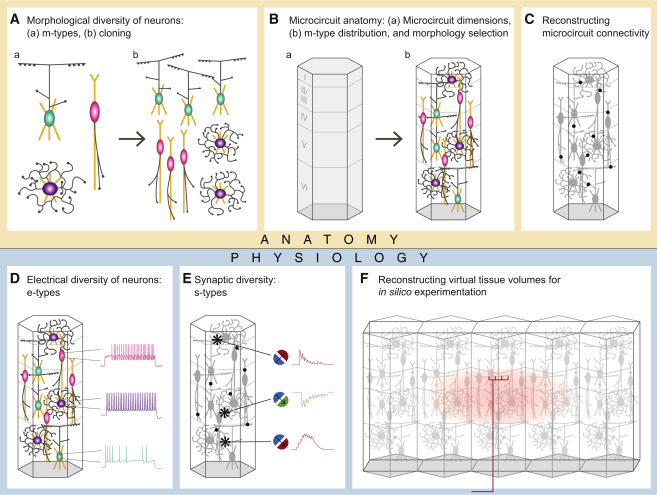
Here, we present a complementary algorithmic approach that reconstructs neuronal microcircuitry across all layers using available sparse data and that leverages biological principles and interdependencies between datasets to predict missing biological data. As a test case, we digitally reconstructed a small volume of tissue from layers 1 to 6 of the hind-limb somatosensory cortex of 2-week-old Wistar (Han) rat. This model system was chosen not only because it is one of the most comprehensively characterized in the neocortex, but also because experimental data on its cellular and synaptic organization are readily available and validation experiments are relatively easy to perform. In brief, we recorded and digitally reconstructed neurons from in vitro brain slices and classified the neurons in terms of well-established morphological types (m-types;Figure 1A), positioned the neurons in a digital volume of objectively defined dimensions according to experimentally based estimates of their layer specific densities (Figure 1B), and reconstructed the connectivity between the neurons (Figure 1C). Neurons were then classified into electrical types (e-types), using an extended version of the classification proposed in the Petilla convention (Ascoli et al., 2008), and models were produced that captured the characteristic electrical behavior of each type. (Figure 1D); similarly, synapses were modeled to capture the characteristic synaptic dynamics and kinetics of particular synapse types (s-types; Figure 1E). Finally, we constructed a virtual slice and reconstructed thalamic input using experimental data (Figure 1F; Meyer et al., 2010b).
This approach yielded a first-draft digital reconstruction of the microcircuitry, which was validated against a multitude of experimental datasets not used in the reconstruction. The results suggest that it is possible to obtain dense maps of neural microcircuitry without measuring every conceivable biological parameter and point to minimal datasets required, i.e., strategic data. Integrating complementary, albeit sparse, datasets also makes it possible to reconcile discrepancies in the literature, at least partially addressing the problem of data quality and reproducibility. Simulations exploring some of the emergent behaviors of the reconstructed microcircuitry reproduce a number of previous in vitro and in vivo findings and provide insights into the design and functioning of neocortical microcircuitry. The experimental data, the digital reconstruction, and the simulation results are available at the Neocortical Microcircuit Collaboration Portal (NMC Portal; https://bbp.epfl.ch/nmc-portal; see Ramaswamy et al., 2015).
One man is trying to help the mentally ill and stop the horrific way in which they are treated in West Africa
This is so horrific. Mentally ill people chained to trees, outdoors, living in their own filth. Just prayers being used to cure them. I had trouble watching the video. Thank goodness, one man is trying to help mentally ill people with diagnosis and medical treatment.
Healthline.com Bipolar disorder Fact Sheet

Wow, this is the reason why elephants don’t get cancer!!

We have genes called tumor suppressor genes, such as p53, these genes make proteins that can repair damage to our DNA or they can kill cells on their way to becoming cancer cells. We have two copies of this gene, just as we have two copies of all genes. People who have a mutation in one copy of p53, meaning they only have one good copy, these people are prone to many different kinds of cancer.
And elephants, what about elephants? Well they have 40 copies of p53!!!! No wonder they don’t get cancer!
http://blogs.discovermagazine.com/d-brief/2015/10/08/elephants-cancer-genes/#.VhnxjDf3bCR​
Intense and Extreme


 Thank you Blahpolar for the inspiration! Those two words are very apt adjectives for people with mood disorders. We are very intensely emotional and very extreme in our viewpoints. Is that right? Or am I just projecting my own traits onto everyone with a mood disorder? Well, at any rate, I am very intense and I have been known to have views that may be judged to be quite extreme. In some ways, I see things as black and white and sometimes fail to notice the shades of gray in between. People, in my estimation are either good as gold, or demonically evil. Sometimes, I do realize that a bit of both can exist in the same person.
What’s an interesting question to me is are all people with mood disorders like that? It makes sense that it should be so. We are creatures of high emotions and labile moods. I am vehement in my opinions, not moderate, not calm. I try to be calm, but my emotions are strong, and they don’t overpower me as much I am swept away by them. Things MEAN a lot me. The health of my loved ones, the welfare of my friends, the state of the world and all the injustices in it. Cruelty to humans, or especially helpless animals… Phew… don’t even get me started on that. Images haunt me for years after I’ve seen them. I live in the past and mourn the bad things that happened in it, my heart breaks that I could not give my son the perfect life I wanted to give him when he was a child. I miss my home at 36 Plumwood. I miss it terribly. That is the one place I’ve ever lived, that I will always think of as home. See, all emotions, pure emotions. But why always sadness, despair, heartbreak? Why not happy emotions, like joy, happiness, optimism? Is that a trait of my illness or is it because of my shattered childhood, that my brain got programmed to be negative and live in anxiety and fear and despair? I don’t know. I’ll never know. I just know that I’ve been where I’ve been and who knows where it is I’m going, but I am here. I am. And somehow, that has to be enough. When I’m at the end of my life, will it all have been enough? Will it have been good enough? Play the cards you’re dealt, Samina. That was my mother’s motto. Mine was: In the end, only kindness matters.

World Mental Health Day
Today is World Mental Health Day. And that’s all I have to say about that. Well actually I have this to say as well: take your medications, see your psychiatrist regularly, talk to a therapist, go to support groups, do meditation, relaxation and yoga, have a wide circle of good friend with whom you get together regularly, have something meaningful to do in your life, have meaningful relationships with significant others, raise your children well, pets are good if you don’t kill them, and viola! You will have oodles of mental health. Oh yes physical exercise, don’t forget physical exercise. And if you still end up in a psych ward in some hospital, well then you just get better and do all those things all over again. But, truly, if you do all of the things above, chances are slim to none that you will ever be an inpatient in a psych ward. Good luck to all of us with mental illnesses on this World Mental Health Day.
Fluffin is feeling better :-)



 Yesterday I took Fluffin to the vet to have her nails trimmed. While at the vet, I asked them to do a blood test just to make sure she was doing well, just like we’d done every time she went for a checkup. Well… She is 20 years old! And it was not a good idea, considering her age. She got so stressed from having her blood drawn that she stopped eating or drinking water for a day and a half. All 8 lbs of her. I got tuna fish and tried to make her eat that. I put some tuna juice in her water to get her to drink. I put some baby food on my fingers and she licked it off, she had half a jar of baby food like that. I bought all her favorite foods and catnip. She’s finally getting over the stress I stupidly, unwittingly caused her. She is so precious to me, and I am so upset with myself. If you’ve never had pets, you won’t understand. If you have, this post will make the utmost sense to you. One thing’s for sure, never, ever again any blood tests. Never.
She’s doing well today, she ate some cat food, and drank water and is sleeping in her fall residence today.
Gosh, the road to hell really is paved with good intentions. People, be careful of what you do with your senior cats, and dogs for that matter. They are a lot more fragile and cannot stand what they could when they were young. Just please take care of these precious beings. I’m so glad my Fluff is getting better, and I will not expose her to any more unnecessary stress.

