Two videos I made live on Facebook, backstage at “Jockey Jim” at the Henry Clay. Just for fun!
https://www.facebook.com/samina.raza/videos/10153682639542711/
https://www.facebook.com/samina.raza/videos/10153682772222711/
Two videos I made live on Facebook, backstage at “Jockey Jim” at the Henry Clay. Just for fun!
https://www.facebook.com/samina.raza/videos/10153682639542711/
https://www.facebook.com/samina.raza/videos/10153682772222711/


I’m in a play called “Jockey Jim” by Larry Muhammad, and I must share Jimmy Winkfield’s extraordinary story with you. He was an extraordinary man, an African American man, born in 1882, in a family of 17 brothers and sisters, in rural Kentucky. He went from earning $8/month to commanding $1000 per race! He became one of the greatest African American jockeys ever. He started racing in 1898. And won two straight Kentucky Derbies, in 1901 and 1902. And in the next two Derbies, he came second and third!
In the early 1900’s, he was blacklisted because he “changed his mind” about riding a horse. As well, there was intimidation by the Ku Klux Klan, violence by white jockeys, and the involvement of big money, not conditions conducive for African American jockeys to race. So he accepted an invitation to race in Russia for Czar Nicholas II and became a big star in Russia. He regularly rode winners in Russia, Poland, France, Austria, Hungary, England, Spain and Italy! But by 1917, with the Bolshevik revolution and the rise of the Communists, racing in Russia was done.
He then led 250 top tier thoroughbreds on a 1,100 mile journey from Russia to Warsaw. He resurrected his career in France in 1922. Also marrying a Russian Baroness named Lydia de Minkiwitz. They lived in a farm near Maison Lafitte, 11 miles outside of Paris. They lived like royalty, hobnobbed with the likes of Josephine Baker, Paul Robeson, Bing Crosby, and Ernest Hemingway!
He earned $100,000, which at the time was an enormous amount of money!
After he retired from horse racing at 48 years of age, he became a celebrated horse trainer in France.
As a result of the Nazis coming into power, he and Lyddy moved back to the USA in 1941.
Back to segregation, discrimination, back to a time when blacks were called darkies, and much worse. He had to become a hired hand on a horse ranch and Lyddy had to clean people’s houses. They lived through it.
They moved back to Maison Lafitte in 1953 and they operated one of the most successful racing stables till the 1960’s.
Lyddy died in 1958, and Jimmy in 1974 at age 92.
What a dashing and debonair man, what a gifted horseman! And to what success he and his wife rose and to what depths did they sink in racist America. And then again rose up in Europe!
Jimmy (and Lyddy) had to be an amazingly strong person to have withstood all that life threw his way and to come out of it victorious and on top. I respect this man so much, and by the end of the play, when Lyddy and Jimmy walk into the Brown Hotel, I am almost crying, even though I am playing Lyddy and am not supposed to cry, but it is such an emotional moment! And Gary Brice who plays Jimmy, plays him to the nines! Perfect in his understated acting and emotions. Understated, something I don’t do so well, garners a lot of pathos. If Jimmy Winkfield were here today, I would certainly tell him how much I admired his strength, his intelligence and his resilience. And that I am so proud to be doing this play about his life!
Me melodramatic?!? Never!!!
http://arts-louisville.com/2016/05/02/rediscovering-the-past/
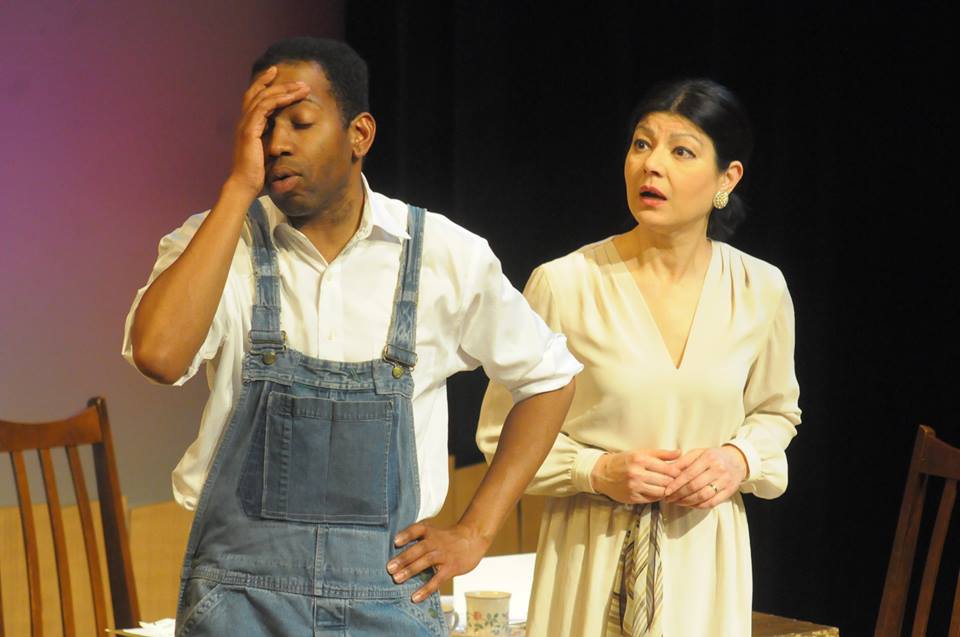
Gary Brice & Samina Raza in Jockey Jim.
Photo by Bud Dorsey.
By Larry Muhammad
Directed by William P. Bradford II
Reviewed by Keith Waits
Entire contents copyright © 2016 by Keith Waits. All rights reserved.
When the Kentucky Derby rolls around, most theatres in the Louisville area close up shop, the assumption being that audiences will be otherwise occupied with Derby Festival events. So Kentucky Black Repertory bucks the odds with a new production of Jockey Jim, a play that ties into the history of “The Greatest Two Minutes in Sports.”
Jimmy Winkfield (1882 – 1974) was one of the great jockeys in thoroughbred racing, winning two consecutive Kentucky Derbies in 1901 and 1902. It is his journey after those victories, however, that is the compelling story of Larry Muhammad’s script: a lucrative career in Russia before and during the Bolshevik Revolution; a rich life in Paris with his wife, Lydie de Minkwitz; and an ignoble return to the United States, confronting Jim Crow segregation.
The structure of the play is roughly chronological, although some nonlinear juxtaposition early on felt confusing and seemed to lack any real purpose. The real draw of Winkfield’s story is that a sharecropper’s son became such a cosmopolitan figure, hobnobbing with celebrities and living on the periphery of pivotal moments in 20th century history. It is especially intriguing that Muhammad shows Winkfield on somewhat agreeable terms with Communists and Nazis without calling into question his loyalty as an American. Much is made of the contrast in attitude toward Negroes in Europe as opposed to America, although the Nazis are openly racist, just highly pragmatic about Winkfield’s usefulness.
The scenes that play best find Winkfield struggling with the latter part of his life in the United States. As the title character, Gary Brice is a young actor playing the aging horse expert with notable grace and care. He sidesteps cliché with wisdom and observation and establishes the character’s dignity with confidence. As Lydie, Samina Raza lends the Russian heiress a melodramatic quality that pushes the envelope a bit, but it is a quality that speaks to the character’s background and how emblematic it is of the peaks in Winkfield’s life in Europe.
Ernie Adams gives Winkfield’s employer, the casually racist Beauchamp, an easy, vile authority that still allows for some small but significant shifts in the audience’s perception of his character. Marcus Orton and Joe Monroe provide scene-stealing comic energy as two of Jimmy’s buddies — ne’er-do-well knuckleheads who do little to develop the plot but inject worthwhile color into the mostly sober-minded material. Francisco Juarez does a fine job as Milo, the Hispanic jockey who rides Winkfield’s horse in the 1950s. In its inclusion and treatment of this character, Muhammad’s text is fully aware of yet another shift in opportunities for minorities in thoroughbred racing.
Winkfield’s European adventures are generally more serious in tone, with a host of supporting characters who are notably less developed. Francis Whitaker and Spencer Korcz are professional as Russian compatriots, two limited roles that never rise above narrative necessity in the text. Better impact comes from a charismatic Sidney Edwards and Tyler Madden as Josephine Baker and Paul Robeson. These characters exist only as brief thumbnails of the iconic figures from Winkfield’s Paris life, but the actors occupy that territory with the presence and glamour befitting the two famed entertainers. In the same mold, Patrick Alred is miscast as an avuncular Bing Crosby, but he does yeoman’s work in this and other small roles. Tom Pettey wisely underplays Von Oppenheim, the German officer who is Winkfield’s contact, proving it is best to not push too hard when wearing a swastika on your arm. Tom Luce, Owen Kane, and Tim Stone fill out the ensemble with skill.
Jimmy Winkfield’s story is certainly worth exploring, and Mr. Muhammad works hard to investigate its social ramifications. Winkfield’s position as a man without a country is effectively mined to investigate the subversion of African-American history in the 20th century. Jockey Jim restores Winkfield to his rightful place in history.
Jockey Jim
| April 30, May 1-6, 8:00 pmTickets: $20 cash at the door |
Kentucky Black Repertory
at the Henry Clay Theatre
604 South Third Street
Louisville, KY 40203
502-727-7972
KYBlackRep@gmail.com
Opening night is tonight! Going to read my lines, take a shower and relax till then. 🙂








Really liked this. You must go to the original article, there are beautiful pictures there.
http://themighty.com/2016/01/12-myths-people-with-bipolar-disorder-want-to-see-busted/Sarah Schuster
Bipolar Disorder
If you’ve ever heard someone say, “The weather is so bipolar!” you know there’s a lot of misconception about what bipolar is, what it isn’t and what it’s like for the 3 percent of American adults who live with it each year. To clear some things up, The Mighty teamed up with the International Bipolar Foundation and asked people with bipolar disorder what myths they’d like to see busted.
Here’s what they had to say:
Myth #1: Mania is the “good part” of bipolar disorder.
“There’s a myth that mania just feels all happy. Actually, it’s frantic and nerve-wracking. It can cause intense anger and anxiety. It can feel like I want to jump out of my own skin. Both sides of the coin can be hell.” — Pressley Kieran Fields
Myth #2: People with bipolar disorder are just “moody.”
“Just because you had a bad day or had a high-energy day doesn’t mean you’re bipolar.” — Dana C Hutchins
Myth #3: Everyone with bipolar is violent.
“The only time you hear about bipolar disorder in the media is when someone committed a crime. Not when a person is dealing with their bipolar successfully and being productive in society. We need to all come forward.” — Heidi Long
Myth #4: If you have bipolar, you’re “crazy.”
“It’s not a synonym for ‘crazy.’ Nor is it a word to be thrown around about things that change constantly (i.e. ‘The weather is like, bipolar or something.’).” — Lacey H-l K
Myth #5: People with bipolar disorder cannot maintain healthy relationships.
” My best friend is bipolar. With patience and understanding, it’s possible. You have to be willing to learn and ask questions as I did. When we first met I asked, ‘What can I do to better understand you? Tell me what I can do to support you.’” — Belinda Heflin
Myth #6: You can’t be a good spouse or parent with bipolar disorder.
“My husband had bipolar disorder. He was brilliant and the kindest, most unselfish man I have ever known. I was married to him for 49 happy, happy years. Sure, there were bad times because he had bipolar. But because I understood he had no choice in it, we were able to have a wonderful marriage.” — Glenda Austin Thompson
Myth #7: Every bad day is an episode.
“Having bipolar disorder doesn’t mean you can’t experience regular emotions — negative and positive; any emotional response to something isn’t always linked to your mental illness.” — Nikki Fox
Myth #8: People with bipolar disorder are weak because they can’t “control their emotions.”
“Even people who are inherently strong can have bipolar disorder. Every day can be a challenge. We can look outwardly normal, while going through immense internal struggles.” — Shilpa Ugrankar Caldeira
Myth #9: People with bipolar disorder are just being dramatic.
“‘You are overreacting. Just stop being that way.’ Um, no. We try our best to control our emotions. We cant help the way we feel sometimes. We just want support and to not be judged.” — Lauren Eubanks
Myth #10: Having bipolar disorder means you have a “split personality.”
“I beg to differ. I feel more like two extremes of the same person.” — Jamilla Casteel
Myth #11: When you start taking medication for bipolar disorder, you’re “cured.”
“It’s never going away. It’s the medication that makes us feel better. It helps me to live. To work. To lead an almost ‘normal’ life. And I would not have it any other way. Medication is not bad. It’s my lifeline.” — Suzie Lang
Myth #12: People with bipolar disorder can’t be successful.
“Heck, I have bipolar 2 and I graduated as valedictorian of my high school and I graduated summa cum laude from a private university. It does not mean I haven’t been successful in life.” — Jenna Renee Gillit
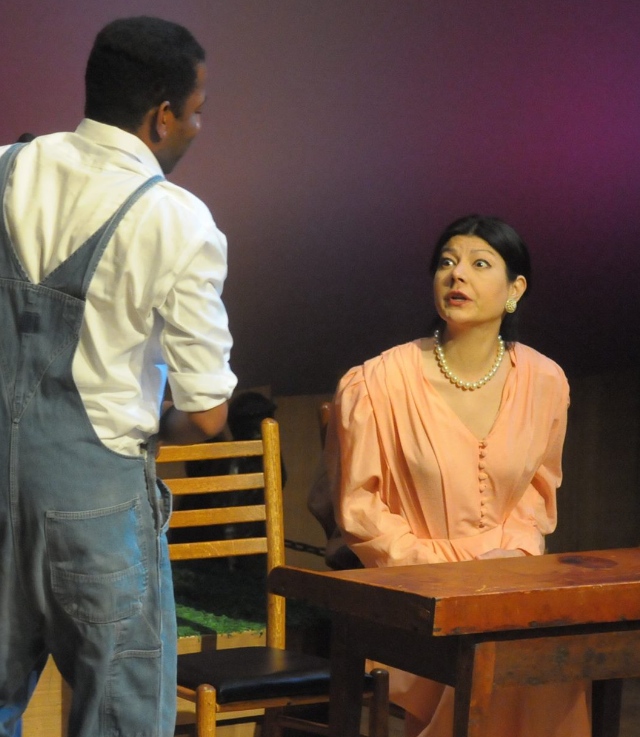
Seems like all I’ve been doing is learning my lines for “Jockey Jim”or going to rehearsal at the Henry Clay. This play is written by my friend and great playwright Larry Muhammad, (https://insiderlouisville.com/lifestyle_culture/larry-muhammad-play-highlights-the-fascinating-story-of-black-jockey-jimmy-winkfield/ and https://www.power2give.org/campaigns/376) I have the female lead, Lydia de Minkiwitz, James Winkfield’s wife who was a Russian baroness, so I have my share of lines, and I have learned them, YES! And I’m saying them all with a Russian accent, ha! I have five costume changes, below is a picture of my favorite costume, haha, you guessed it, it’s glam!
(See more about the truly amazing Jimmy Winkfield here: http://www.aaregistry.org/historic_events/view/jimmy-winkfield-horse-racing-legend)
We’re in tech and dress rehearsal week, which means 5+ hour long rehearsals everyday this week. We open on Saturday. It is amazing to see how far we’ve come, from “No way. This is never going to get done!” to “Hey we’re doing it!” to “No (ok, not many) problem, we’ve got this!” This happens every time a play is put on, every time I’ve been in a play I’ve started with “Are you kidding me?! How many lines do you want me to learn? Yeah right!” and ended with “Wow, I learned ALL the lines!” And all the stage directions, and all the smiles, and hugs, tears, pouts, and champagne toasts (we’re actually doing all that in Jockey Jim.) And so it is with “Jockey Jim.”
Annoying, exhilarating, amazing, heart in your throat process, that finally yields one hell of a performance and one hell of a good play. We’re getting there, it’s all coming together. Today we had our first dress rehearsal, and from now on, they’re all dress rehearsals. Tomorrow, we add makeup and hair too. I have to wear a gray wig for the older scenes, oh well…
My character’s age goes from 30’s – 70’s. Difficult for me to do aged, struggling with that. I keep forgetting I’m supposed to be 65 years old, oops… hope I don’t give the director a conniption…
I hope all my Louisville friends come to see us, it’s going to be one fine play!


In the dressing room, with my favorite costume, of course! 🙂

This brilliant young man, suffered from depression for 12 years. Finally he got so tired of keeping the depression a secret that he decided to tell everyone he knew in one fell swoop, by making a video (below) and posting it on Facebook! The video went viral! He has been asked to speak on talk shows and radio shows in Ireland. He is an eloquent spokesman for people who suffer from depression, or any mental illness. I was fortunate enough to speak with him and recorded this interview.
Samina: Hi Doug, so wonderful to be speaking with you! Just wanted to get your okay. I’m going to post your interview, this interview on my blog bipolar1blog and on the HuffPost blog I am now blogging on. Is that fine?
Doug: Yes. Brilliant!
1) Samina: Great! After suffering from depression for 10 years, what made you make your video and put it on FB?
Doug: I suppose for me, it was a weight off my shoulders. I was living two different lives, and no one knew what I was going through. That alone was hard, having a secret for so long, without your best friends or your extended family to know, that’s a hard thing to do, even my best friend. I just wanted to let everybody know, it scared the hell out of me! I thought it would be easier if I put it on Facebook. I work in social media and marketing, so I thought I’d make a video and put it online. For me, telling everyone was harder than making a video, and putting it on line. It was easy to make the video, tell my story, press post, close the laptop and walk away. So then I told everyone, my friends knew, colleagues I’d met online, everybody, people I’ve met throughout the years, various clubs and teams, everybody! It was an easy way for me to tell everybody. That’s why I did it, I needed to get the weight off my shoulders, I needed to tell everybody, not just a handful of people! It was easier, I felt better that everybody knew, not just my close friends!
Samina: Right, you told the whole world, basically, literally the whole world! Everyone knows now!
Doug: Yeah. Yeah, that’s scary, but it’s also amazing, that message reached everyone! That the message traveled from Ireland to America to Canada, to Australia, wherever, basically everywhere.
Samina: Yes, amazing, everywhere!
Doug: Yes, that people have taken comfort in it, that was a great thing, that it may have helped others. It took one video for four minutes to help somebody else, then that’s amazing as well.
2) Samina: Were you feeling better at the time when you made the video?
Doug: Ummm, no, I’m still on antidepressants everyday. And today I went to see my psychologist. And I’m still with him, I’m seeing him again in two weeks, and two weeks after that. This is a journey for me. I wasn’t feeling better but I was feeling more comfortable and somewhat confident in myself, that I knew that this was the right thing to do for me and it was my next step. It may not be the right thing for other people, but I feel it can’t make it any worse to talk about it, so I hope that’s the case. So I’m not better, the video has made me, maybe, better, and it’s my next step, and I’ve taken that step. Now, I am discovering what my trigger points are that bring me down and being more confident within myself and kind of accepting myself for who I am. I’m so happy I did this because I needed to move forward and help myself.
3) Samina: It’s sometimes the case that young men have a hard time accepting that they are sick because it means admitting weakness. I had a little brother who couldn’t accept that he had bipolar disorder and eventually he got so depressed that he committed suicide. Huge, giant loss in our lives, he was 26 years old. Young men have a difficult time admitting they are sick, or ill, or imperfect. It is a time when you are supposed to be young and strong. Evolution has sort of imprinted that on your brain, society accepts it of you, and now, because of your video, it’s going to make it easier for other young men to come out and talk about their mental health issues and seek help. You’ve become a role model. How does that make you feel?
Doug: Yeah if that happens, that’s amazing! That’s such a hard won feeling. But it’s not just young men, and you’re right what you say about young men and evolution, we are meant to be young and strong, we are meant to show a strong exterior. It’s not ok to not be ok. I just think women are so much braver than men in this regard, to open up like they do. Their friendships are so much deeper. They get more from their friendships than men, men just don’t talk to other men. I went 12 years without talking. I can’t be the one preaching but… But if it helps men, that’s brilliant!
And regarding your brother, it’s so sad to hear, 26 years old. In Ireland they say and you said it yourself, I don’t like the expression “commit suicide,” you commit a crime, and what your brother was going through, you just don’t know, feeling so much pain, and fear. And it’s just something that, some people refer to it as a selfish act, it’s not! You’re not thinking about anybody else, you can’t think about anybody else! You’re thinking the world will be better without you. It’s just such a horrible place to be! And I just think, as hard as it is, we need to talk about it, because if we talk about it, we’ll find out, it’ll help. It may not help everyone, but it’ll help. I just don’t think it can make it worse.
Samina: Talking definitely helps! All my friends have always known that I have bipolar 1 disorder and like you said, we’ve always talked about it.
Doug: That’s an amazing thing. Such a brave thing!
Samina: Now I have a blog so everyone knows (laughing.)
Doug: My friend, Éanna Walsh, has a blog about bipolar, I shared it on Facebook. He started blogging without two or three years after being diagnosed, I told him he is so brave!
Samina: Oh good, I’ll have to take a look.
Doug: Yes, my friend’s a great hulking Irish guy, he’s in phenomenal shape, he’s so intelligent, just so brave. It’s so amazing that so many more people around the world, like yourself, are writing about your feelings and putting it out there.
Samina: Yes, you know I never wanted to be the spokesperson for this illness, but that’s just what happened…
Doug: Yes, that’s amazing! I’m not the poster boy or spokesperson for this illness, but if it helps… I just hope this helps.
Samina: I think you are now, you sort of unintentionally made yourself the spokesperson for young men, and it’s a good thing, a very good thing!
4) Samina: You said you’d been suffering from depression for 10 years. Can you tell me how it began? And if you don’t want to answer this one, if it’ll take you to a bad spot, you don’t have to answer it.
Doug: No, I’ve left myself open for the last two weeks. I don’t mind answering any questions, I would have told you if I did. When I was 15, I developed an eating disorder and I lost about 6 stone (84 lbs!!!) in 5-6 months. Then my parents became aware of it, and I went to the doctors and nutritionists, then I went to a psychiatrist, from that point on I started seeing a psychiatrist weekly and found out that this was a little deeper than just an eating disorder. One thing about having body dysmorphia was I was going through something I couldn’t explain. I was in a dark place, I didn’t like myself. I had an amazing family, I had everything I ever needed. I felt really privileged. Plus for me, depression isn’t when things aren’t going fine, it’s when everything is well but I just couldn’t see that. A lot of people said what depression, you’re great at school, or you’ve got great friends and family, and I play sports, and I’m sociable and I’m popular, whatever. But, that doesn’t come into play for a lot of people, it certainly didn’t come into play for me. Just having a hard time, kind of pushing myself into a corner, alone and it’s dark and you just don’t want to get out of bed or meet your friends, it’s just a battle. And the last ten years it just got worse, wondering when you’re in that corner, there’s only one way out. That way will really scares you. But it’s a solution. And I just had to shake myself off, pull myself out of that dark, dark place, and I had a moment that I have to ring my doctor, that I’m not ok anymore.
Samina: Good for you! You realized it! And also when you have the flu and you feel bad, people don’t say: Oh why do you feel bad, you have a beautiful home, you have a beautiful wife/husband/children, you have a wonderful job. Just look at how many wonderful things you have, why do you feel bad? Well it’s because you have the flu! And the same thing goes for when your have depression, you feel bad because you have an illness called depression, all those wonderful things don’t take away the effects of the illness!
5) Samina: It must have been so difficult. How did you cope with it as a teenager? As an adult? Did you have a support system? Did you confide in anyone at all? Were you seeing a doctor? You know you might have even lost weight because you were in a depression, people lose weigh because they don’t have an appetite.
Doug: No, I had an appetite, I just didn’t keep my food down (laughing.) Yes I had the support of my mom, and my dad and my sister. They knew I was feeling depressed, they took me to the doctor. So I had great support. That was amazing to have such great support.
Samina: That’s great, some people don’t have that.
6) Samina: It is being discovered that the immune system may be intimately involved in the development and the continuance of mental illness. Are there any autoimmune illnesses in you or your family?
Doug: Yes. I’ve been diagnosed in 2012 with something called Crohn’s disease.
Samina: Wow! The intestines and your brain are so connected!
Doug: I don’t know much about it, but my father had asthma when he was a child.
7) Samina: What would you say to a young man who is suffering from depression now, but who is afraid to talk about it?
Doug: I’d tell him firstly not to be ashamed, don’t have any kind of shame. It’s ok not to feel ok (!) And if you’re not talking to someone, I’d highly recommend either some family or a friend, or someone they work with or maybe even someone they don’t know that well and see occasionally. Just to talk about it and seeking professional help will help. In America or anywhere where they have health organizations, I just think it is so important for young males and females to talk about it.
8) Samina: How does it feel to be open about your illness, with all your friends and family? How have most people reacted?
Doug: It feels amazing! I don’t regret it for one second! It’s such a weight off my shoulders. Everybody’s reacted so positively! The response has been overwhelming at times, but so heartwarming that I don’t have to hide from my friends and family and can talk to my friends and especially mom and dad. My mom and dad were there for all the 12 years, but now they can kind of see the light at the end of the tunnel is on! Now that everybody knows, we’re not alone anymore. We can help each other and we know what each person is going through. Feel the support and the love.
9) Samina: You have automatically become a mental health advocate, do you realize that?
Doug: (Laughs) No not really! But it’s ok if people see me as that.
Samina: So, where do you go from here? A book? A blog? A movie?
Doug: (Laughing) Yeah, a movie would be great! From here, it’s about me, about getting through this, and getting stronger every single day, and in the meantime. on my journey, being contacted by people doing TV, or speeches, or radio, or speaking on the News. Well that’s amazing because if I can help myself while helping other, well, that’s what I want to do.
10) Samina: Physical exercise, good nutrition, meditation, therapy, good friends, and of course medication all help with depression and mental illness generally. Phew! It’s a full time job! How many of these are you in favor of doing?
Doug: Everyday I take medication, I do a lot of exercise, it helps me, it might help others or it might not, but it definitely helps me! Going for that run, or going to the gym, lifting weights, relieves pressure, or if you’re down or anxious or mad about something, going to the gym and letting off some steam really helps. And medication, for me it helps, but it’s not for everybody, it’s sort of trial and error, some of them affected me badly, some didn’t help me and some did help me. And some people don’t agree with medication at all, But for me it’s definitely helped.
Samina: Yes, medication is good, of course, and yes it may take some trial and error, but the right medication helps a lot!
Doug: And nutrition, if you eat well, you feel well and that’s going to help.
Samina: And do you meditate at all?
Doug: I use an App called Mindfulness, I think it’s called Mindfulness, that’s the name that came to mind, if it’s not, I’ll get back to you. It’s a mediation App, it takes 5 minutes a day, 10 minutes a day, I use it a couple of times a week, and it’s good.
Samina: I use an App called Headspace.
Doug: Oh Headspace, Headspace, Headspace, Headspace, that’s it!!! I don’t know where I got Mindfulness from!
(We laughed and laughed and laughed.)
Samina: And those are all my questions. Would you like to add anything.
Doug: No, I think that covered it all.
Samina: Thank you so much. It was so lovely to talk to you. I’ll post this on my blog, send it to the Huffington Post, and post it on your Facebook page.
Doug: Cheers, brilliant!
Doug’s Facebook Video.
30,000 views! Pretty Amazing!
 Palestine WILL Be Free