Noninvasive brain stimulator may ease parkinson’s symptoms in a patient’s homeParkinson’s disease

Master’s students have developed a new portable device to inhibit neuronal firing in critical regions of the brains of people with Parkinson’s disease to stop the tremors associated with that disease. This device is a helmet, which the patient can control, it sends electrical stimulation to the patient’s brain, however the level and duration of the stimulation is controlled by a physician.

The wonderful part about this is that it is portable and under the patient’s control. My father in law had Parkinson’s disease, he was a solid, strong, silent man, and this disease brought him down like tissue paper fluttering from the sky. I’m sure at least some of his symptoms and problems would have been alleviated by this portable helmet!

Article and reference below.

http://www.neuroscientistnews.com/clinical-updates/noninvasive-brain-stimulator-may-ease-parkinson-s-symptoms-patient-s-home

Parkinson’s disease patients whose symptoms such as tremor, muscle stiffness and slowed movement make it tough to hold an eating utensil steady have few options for relief outside of a hospital or clinic. Medication can help, but over time it tends to become less effective. To give these patients another in-home option, Johns Hopkins graduate students have invented a headband-shaped device to deliver noninvasive brain stimulation to help tamp down the symptoms.

The students’ prototype, developed during a yearlong biomedical engineering master’s degree program, has not yet been tested on humans, but it is viewed as a promising first step toward helping Parkinson’s patients safely relieve their own symptoms at home or elsewhere without going to a hospital or doctor’s office. The design has already received recognition at several prominent competitions. On June 9, it won the $5,000 second-place prize in VentureWell’s BMEidea national design contest for biomedical and bioengineering students. In May, the invention earned first-place honors in the People’s Choice Award competition at Johns Hopkins’ Biomedical Engineering Design Day 2015. Earlier, it was a finalist in the Rice University Business Plan Competition.

The five student team members were inspired to build the new device last summer after observing neurosurgery being performed on Parkinson’s patients at Johns Hopkins Hospital. Parkinson’s is an incurable neurodegenerative disorder that affects 1 million people in the United States and 7 million worldwide.

Tremtex team members
From left, the Tremtex team members are Ian Graham, Melody Tan, Erin Reisfeld, Shruthi Rajan and David Blumenstyk. Credit: Will Kirk, Johns Hopkins University

For patients in advanced stages, one treatment option is deep brain stimulation. In this procedure, a surgeon implants thin electrical leads into the region of the brain that controls movement. The leads are connected to a pulse generator—similar to a pacemaker for the heart—that is placed under the skin below the collarbone. This implant sends electrical signals to the brain to help curb some symptoms caused by Parkinson’s.

“We saw that this procedure is really invasive and can take 10 to 15 hours to complete,” said Shruthi Rajan, a team member from Charlotte, North Carolina. “It’s also very expensive, and not all patients qualify for the surgery. We asked if there was a way to provide the same treatment in a less invasive way that doesn’t require brain surgery.”

The students were referred to Yousef Salimpour, a Johns Hopkins Medicine postdoctoral research associate who has been studying a noninvasive Parkinson’s therapy called transcranial direct current stimulation. In this painless treatment, low-level current is passed through two electrodes placed over the head to tweak the electrical activity in specific areas of the brain. The technique can be used to excite or inhibit these nerve cells. The treatment is still considered experimental, but it has attracted much attention because it does not require surgery and is inexpensive, safe and relatively easy to administer without any side effects.

The biomedical engineering students met with Salimpour to learn about the research he conducts in a clinical setting. “We told him we had an idea for a portable home version of this equipment,” Rajan said. “But we planned to add safety measures to make sure the patient used it properly without a doctor or nurse being present.”

The students aimed for a prototype that would enable a patient to activate the battery-powered treatment by touching a large easy-to-press button. With patient safety in mind, the students designed their prototype to deliver current for only 20 minutes daily and only at a doctor-prescribed level.

To help fine-tune their design, the students met with dozens of Parkinson’s patients over a four-month period. Although the students did not administer the actual brain treatment, the patients help them craft the critical headband component so that it would be easy to put on, comfortable to wear and positioned so that the electrodes would remain stable and properly target the motor cortices areas of the brain.

“For a comfortable fit, we put an elastic band in the back and told the patients to put it on like a baseball cap,” said team member Ian Graham, from Old Saybrook, Conn. “The interaction with the patients was really helpful. In our usual college classes, we’re just given a textbook problem to solve. In this program, being able to find a real-life biomedical problem and figure out how to address it was huge. And we even received letters of encouragement from some of the patients we met.”

The other members of the student design team were David Blumenstyk, Erin Reisfeld and Melody Tan.

In addition to the assistance from neuroengineer Salimpour, the student inventors received guidance from other members of an interdisciplinary team of Johns Hopkins medical researchers that includes neurologist Zoltan Mari, neurosurgeon William Anderson and neuroscientist Reza Shadmehr.

“Our group is working on the idea of using noninvasive brain stimulation for Parkinson’s disease symptom control as a new clinical treatment,” Salimpour said. “Our preliminary results were promising. Patients keep asking us for more of this treatment. But we couldn’t provide the treatment for them because there is no portable and FDA-approved device like this for Parkinson’s patients that is on the market at this time. The biomedical engineering students then approached us with the idea of designing the home-based treatment device. They did a great job, and made a fascinating prototype. We hope that based on their preliminary work, Parkinson’s patients will receive the benefit of this new technique at home very soon.”

With help from the Johns Hopkins Technology Ventures staff, the student inventors obtained provisional patents covering the design of the device, dubbed the STIMband. Another Johns Hopkins student team is slated to take over the project in September to further enhance the design and move it closer to patient availability. One addition may be a wireless connection to allow a doctor to adjust a home patient’s treatment level from a remote location.


– See more at: http://www.neuroscientistnews.com/clinical-updates/noninvasive-brain-stimulator-may-ease-parkinson-s-symptoms-patient-s-home#sthash.1LZh448E.dpuf

Antihistamine Decreases Schizophrenia Symptoms (!!!)

change in sx

This is major, in a study in Finland, (link below) giving 200 mg of an antihistamine called famotidine  to patients with treatment resistant schizophrenia reported decreased symptoms in a week and in a month had statistically significant decreases in their symptoms!

The drug penetrated the blood brain barrier and effectively blocked histamine from binding the H2 receptors, and this drug affected signaling molecules shown to be involved in schizophrenia.

If this works for all people with schizophrenia, it will be a godsend! Then the awful antipsychotic medications, with their awful, awful, side effects, may not have to be used, or may be used in reduced doses.

This may also work for people with bipolar d/o, when they are in a psychotic (out of touch with reality) phase.

This is so amazing! That something so mundane as an antihistamine can actually treat a complicated and awful disease such as schizophrenia! This shows the power of biological/medical research, how discoveries can change treatment of horrible diseases for the better and improve the quality of life of people who suffer from such diseases.

http://www.eurekalert.org/pub_releases/2013-07/uoh-ntf070113.php

Study on nematode model of ALS offers new treatment hope

Stephen Hawking

This is amazing! It has been found that in amyotrophic lateral sclerosis (ALS), the disease that Stephen Hawking has, the immune system system attacks and kills motor neurons. They used a worm called Caenorhabditis elegans (C. elegans) and introduced a mutated human gene (TDP-43 or FUS) into C. elegans, a nematode worm widely used for genetic experiments. The worms became paralyzed within about 10 days. Then in an effort to save the worm, they introduced a mutated immune gene gene called tir-1.  “Worms with an immune deficit resulting from the tir-1 gene’s mutation were in better health and suffered far less paralysis.”

So a mutation in an immune gene that leads to less immune function leads to less killing of motor neurons and far more healthy and less paralyzed worms! Amazing!

In my humble opinion, the immune system is involved in FAR MORE diseases than we know. I believe the immune system is involved in mental illnesses as well. That is why I am always keeping an eye on Immunological involvement in Neurological and or Mental illnesses.

http://www.neuroscientistnews.com/research-news/study-nematode-model-als-offers-new-treatment-hope

And what about dog lovers? Well…

They have more one night stands! Hahaha!

http://www.torontosun.com/2013/08/12/dog-lovers-more-likely-to-have-one-night-stands-survey

Many cat lovers play hard to get and dog owners often have friends with benefits, but pet-free Canadians are the saddest among us when it comes romance, a new survey has found.

The survey of Canadians on Match.com examines the dating behaviour of people based on their pet preferences.

Cat lovers, it found, are frugal, shelling out just $5 to $20 on a first date. Dog owners, meanwhile, are more generous, spending an average of $40 to $50.

Cat lovers are also quite aloof, with 34% waiting for the other person to make contact after a first date.

At 55%, dog people are the most likely to have had a one-night stand. They are also the most likely to have dated a friend, 51% compared 47% of cat lovers.

But it’s the pet-free Canadians who lack that romantic spark. At 68%, they are the least likely to believe in soulmates and true love, compared to 77% of dog lovers and 76% of cat lovers.

The survey of 1,054 Canadian singles was conducted Aug. 29-Sept. 1, 2012.

I Don’t Understand

I Don’t Understand

Why do young men with more melanin in their skin get killed, by police, by each other

I Don’t Understand

Why there is less opportunity for “people of color”

I Don’t Understand

Are we not all of the same human race?

Why this discrimination, why this disgrace?

I Don’t Understand

Why are women raped?

Are we not your sisters, your mothers, your daughters?

How, then, on us, can you lay a hand?

I Don’t Understand

People are starving, they have nothing to eat

While others gorge themselves till they are obese?

The earth is dying, we don’t give a care

Temperatures increasing, icebergs decreasing, deforestation, species elimination

I Don’t Understand

Oh, animal abuse, I can’t even talk about it

These innocent beings, cats, dogs, horses, others, can’t even talk about it

I Don’t Understand

Can we not live in a gentler world?

Where resources are shared and the earth is not raped?

Where we live as brothers and sisters and cooperate?

Where the color of our skin gives us no advantages or disadvantages?

Where no one has to say “Black Lives Matter”, and 2000 girls in Nigeria live safe and sound

And the only thing Isis signifies is the name of the Goddess who was the daughter of the Earth and the sky

Tell me why this world cannot be?

If each of us tries, if each of us thinks, if each of us acts

I Don’t Understand

Why it can’t

STIGMA…?

I have to write about stigma, I hear this word often in conjunction with mental illness, any kind of mental illness. People are afraid of stigma, so they won’t get treatment, they won’t take medication, they won’t see a therapist, they won’t disclose that they have a mental illness to their boss, they won’t tell anyone because people will call them crazy, people will be afraid of them. Yes, this is all the case. But why does stigma exist? Why are people called crazy? Why are others afraid of them? Why won’t they disclose that they have a mental illness? Well, when we are ill, in a severe phase of a mental illness, when we are out of touch with reality, we are indeed “crazy”. I don’t mean to offend anyone, but I know that I have thought that a witch with black magic powers was trying to literally destroy my heart, and this witch lived in Eastern Europe. Yes I really did think that in the midst of a severe, full blown manic phase. I would now consider this sort of crazy… ummm…sorry but I would. So there’s that stigma, sort of correctly placed on the severely mentally ill. Also why do people fear us? Well, we are capable of doing some truly awful things in the throes of mental illness, see Adam Lanza in Sandy Hook. Of course most mentally ill people do not commit any crimes and are not violent, and most crimes and violence is committed by “normal” people, that being said, people are still not sure what to expect of people with mental illness, and uncertainty can be frightening. So there it is, the reasons for stigma.

So how do we combat stigma? We get treatment from a psychiatrist and psychologist. We take our medication, faithfully. We do all the things we know keep us in the healthy zone like exercise, yoga, meditation. We stay normal. We don’t visit the crazy place, we don’t go there, we stay away from it. And then if we tell people we have bipolar d/o or depression, or anxiety, they see that we are “normal” and they have nothing to fear from us, or be uncomfortable about. And voila! The end of stigma, at least the beginning of the end.

Study links brain inflammation triggered by chronic pain to anxiety and depression

Brain inflammation caused by chronic nerve pain alters activity in regions that regulate mood and motivation, suggesting for the first time that a direct biophysical link exists between long-term pain and the depression, anxiety and substance abuse seen in more than half of these patients, University of California (UC), Irvine and UCLA researchers report.

This breakthrough finding also points to new approaches for treating chronic pain, which is second only to bipolar disorder among illness-related causes of suicide. About a quarter of Americans suffer from chronic pain, making it the most common form of enduring illness for those under the age of 60. The Institute of Medicine estimates that this costs our society more than $635 billion per year.

In work with rodents, Catherine Cahill, associate professor of anesthesiology & perioperative care at UCI, Christopher Evans of UCLA’s Brain Research Institute, and colleagues discovered that pain-derived brain inflammation causes the accelerated growth and activation of immune cells called microglia. These cells trigger chemical signals within neurons that restrict the release of dopamine, a neurotransmitter that helps control the brain’s reward and pleasure centers.

The study also reveals why opioid drugs such as morphine can be ineffective against chronic pain. Morphine and its derivatives normally stimulate the release of dopamine. But in research on mice and rats in chronic pain, Cahill and her colleagues learned that these drugs failed to stimulate a dopamine response, resulting in impaired reward-motivated behavior.

Treating these animals in chronic pain with a drug that inhibits microglial activation restored dopamine release and reward-motivated behavior, Cahill said.

‘For over 20 years, scientists have been trying to unlock the mechanisms at work that connect opioid use, pain relief, depression and addiction,’ she added. ‘Our findings represent a paradigm shift which has broad implications that are not restricted to the problem of pain and may translate to other disorders.’

The results of the five-year study appear online in the Journal of Neuroscience.

Next, Cahill and her team aim to establish that pain-derived changes in human brain circuitry can account for mood disorders. “We have a drug compound that has the potential to normalize reward-like behavior,” she said, “and subsequent clinical research could then employ imaging studies to identify how the same disruption in reward circuitry found in rodents occurs in chronic pain patients.”

http://neuroscientistnews.com/research-news/study-links-brain-inflammation-triggered-chronic-pain-anxiety-and-depression

Missing link found between brain, immune system — with major disease implications –

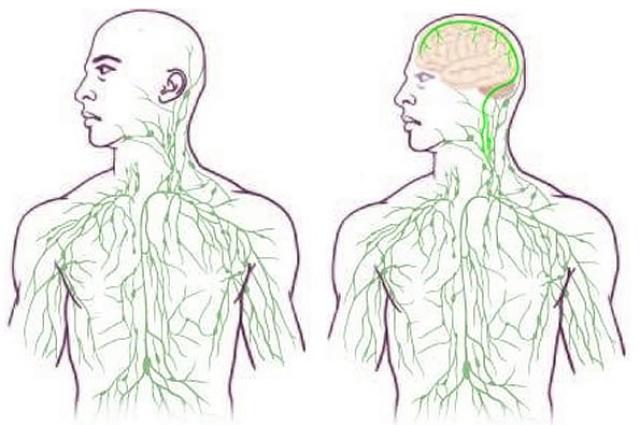
Brain lymph network

Until now, no one knew that lymphatic vessels existed in the brain. That is why the announcement from the University of Virginia School of Medicine is stunning! People in Professor Kipris’ lab have found that there are indeed lymphatic vessels. This is the missing link between the brain and the immune system. This means that the brain is connected directly to the immune system. The true significance of this discovery lies in the effect it will have on the treatment of neurological diseases. In the article below, they only talk about neurological diseases, such as Alzheimer’s, multiple sclerosis, and autism. I would add mental illness to those illnesses above. After all mental illness is also a neurological disease. There are many immune symptoms associated with mental illness. People who have mental illness also, many times, have auto immune diseases like lupus, rheumatoid arthritis, Hashimoto’s thyroiditis. There is some sort of an immune component in mental illness. The finding of these lymph vessels directly in the brain may shed light on not only neurological illnesses, but mental illnesses as well. Amazing that it took this long to discover such an important discovery as the brain has lymph vessels.

The brain actually has it’s own immune cells, the microglia, which are the resident macrophages of the brain (they clean up cellular debris if there is a brain injury or illness) and astrorocytes which secrete neutrotrophic factors after a brain injury to help neurons grow and recover and survive.

The lymphatic system is a network of tissues and organs made up of lymph vessels, lymph nodes and lymph that drain lymph fluid (a fluid containing white blood cells, water, proteins, salts and lipids) from all over the body. This fluid is then returned to the bloodstream.

Until this article came out, no one knew lymph vessels existed in the brain. Now that we know they do, it can be studied as to how they work and exactly what their function is. It can also be studied whether they are involved in diseases such as Alzheimer’s. A very exciting time, the beginning. It always is 🙂

http://www.neuroscientistnews.com/research-news/missing-link-found-between-brain-immune-system-major-disease-implications

Food and bipolar d/o

IMG_2981

I have been having problems with food allergies for a few years now. Actually, these are not the full fledged anaphylactic reaction (where your throat closes up and without an epinephrine shot, you have danger of dying) kind of allergies, I suppose my allergies would be better described as food sensitivities. My symptoms are not the typical gastrointestinal ones, but rather are joint pains and fatigue. A few years ago, I was tested for food allergies using an IgG test, by a rather unconventional doctor. My tests came out positive for many food, including bananas, beef, corn, wheat, rice, casein (a milk protein). I stayed off those foods for a year and then tried to add them in, unfortunately, it didn’t really help. Then when I moved to Louisville, I went to a doctor in Cincinnati, an extremely unconventional doctor, to the point of charlatanism. He offered to cure my bipolar disorder! That’s when I stopped seeing him. Now I am seeing an allergist, he has done IgE food allergy testing and found I am allergic to about 12 foods. I’ve been avoiding those foods for two months. A few days ago, I added dairy back in and started having knee pain and fatigue. Darn! I love ice cream, and whipped cream, and butter and Flan! Now I will have to go off dairy for a year.

Considering my food allergies and my having bipolar disorder (BPD), I decided to do a search about food and bipolar d/o. Below is an article I found about the five so called worst foods for bipolar d/o. In my experience, caffeine is only bad when I am not on Lithium, when my mood is controlled on Lithium, I can have 5 cups of coffee and I will not get jittery, hyper, neither will my muscles start trembling, all the case if I am not on Lithium. I once asked my doctor, a long time ago, if Caffeine can push someone with BPD into mania, because I had felt the “upness” after having coffee. He didn’t really have an answer for me. Now I believe it can, if your mood is not managed wit Lithium (for me) or another mood stabilizer.

Alcohol, definitely reacts badly with the medications used for BPD. The meds potentiate the effect of alcohol, which means a very little amount of alcohol can have quite a big effect. I drink one glass of wine and my dead starts swimming, although it does make me really happy 🙂 It says below that people with BPD can become addicted to alcohol easily, may well be the case, but not in my experience.

Sugar can of course. spike your blood sugar, and the ensuing elevation in Insulin can make your blood sugar levels drop. Not so good for people with mood disorders. Stability, evenness, and steadiness are the most coveted states, in sugar levels and moods for any one with BPD!

Salt can interfere with Lithium metabolism and of course, water metabolism. When one is on Lithium, one has to stay very well hydrated as Lithium is a diuretic as well as a mood stabilizer. Also salt can be dehydrating, with Lithium, that is not a good idea. I find that I crave salt when I’m on 900 mg of Lithium. I don’t eat too much salt, but neither do I restrict my salt intake. And my doctor told me to eat more salt if my side effects such as fine muscle tremors (mostly in my right hand) get to be too bothersome. I suppose the extra salt lowering Lithium levels to stop the tremors.

Fat, I don’t understand why fat is on the list below… Good fats such as nuts, olive oil, coconut oil, omega 3 and 6 fatty acids are actually quite beneficial for the brain. The cell membranes of neurons, as well as glia are made of fat, so this one, I don’t know. I would leave fat off the list of the five worst foods for BPD.

http://www.everydayhealth.com/bipolar-disorder/the-five-worst-foods-for-bipolar-disorder.aspx

The Five Worst Foods for Bipolar Disorder

  • Caffeine. “Stimulants can trigger mania and should be avoided,” Fiedorowicz says. “Caffeine is an under-appreciated trigger and can additionally impair sleep,” and sleep deprivation is a notorious trigger for bipolar mood swings and mania. Caffeine can also worsen anxiety, which tends to go hand in hand with bipolar disorder and, if you’re taking antipsychotic medications, might also affect how those drugs work. Fiedorowicz adds that some over-the-counter medications — such as pseudoephedrine, found in some cough and cold medications, for instance — have stimulant properties similar to caffeine and can also trigger bipolar mood swings.
  • Alcohol. Bottom line, alcohol and bipolar disorder make a bad combination. Alcohol can negatively affect bipolar mood swings and also may interact negatively with medications. People with bipolar disorder are also more likely to become addicted to alcohol and other substances.
  • Sugar. People with bipolar disorder are at risk for metabolic syndrome, a pre-diabetes condition that may make it hard to manage blood sugar levels. Furthermore, the highs and lows that come with the sugar roller coaster could just add to bipolar mood swings, particularly mania. If you really want a sweet treat, reach for fruit.
  • Salt. If you’re on lithium, moderating salt intake can be tricky because a change in salt intake, either an increase or a sudden decrease, can affect lithium levels. Talk to your doctor about how to safely manage the salt in your diet to stay within a healthy range, often between 1,500 and 2,300 milligrams a day. Equally important when taking lithium is to make sure to drink enough fluids — dehydration could cause dangerous side effects, Fiedorowicz cautions.
  • Fat. Fiedorowicz suggests following the recommendations of the American Heart Association for a healthy diet in order to limit saturated fat and trans fat in your diet. That means opting for lean protein and low-fat dairy products when choosing animal products. You might have heard that the fat in foods could alter the way your body uses medications. Generally, your medications will still be effective, but eating a lot of fried, fatty foods just isn’t good for your heart.

Over 7000 Views! Thank You Readers!

Over 7000

Thrilled, happy and excited! Thank you all my readers! How amazing, from that first view of my first post, to more than 7000 views! I am absolutely floored, and will continue to write to the best of my ability and provide you all with more reading material.

Love and hugs to all.