 I am a Mom, a Molecular Biologist, I have an MSEd. I act in plays, I love to take pictures. I also have bipolar disorder type 1. Yes this disease has taken a toll on me, my life and my loved ones. But I fight it daily. I will never let it win. I am stronger than this illness. I did not choose to have this disease, but I do choose to never let it vanquish me. I choose to live my life with as little interference from this illness as possible. And I want to tell everyone with mental illnesses that if I can try and succeed, not totally, but to a large extent, then so can YOU!
Posts
Germanwings 9525: More news

Well they found out that the German airline copilot was having vision problems as well as unspecified psychiatric problems. Both of which he had hidden from the airlines. And he locked the Captain out of the cockpit, and according to French authorities, purposely crashed the plane into the Alps. Still nothing definitive, but the pieces are being put together and it looks like he did crash the plane on purpose. Dismayed and upset beyond belief over this. Why did he not get the help he needed? If he was going to a psychiatrist and had voiced any of his plans, why were the aviation authorities not notified? Or perhaps he didn’t say anything to anyone. He had a girlfriend, did she know anything? How can such a disaster be prevented? Mental illness questionnaires for pilots and co pilots? He was 27 years old, he had his whole life ahead of him, he was apparently a good pilot who loved flying. What would make someone like that do something like this? And taking 149 people with him, that is the most unconscionable part for me. I mean to end your own life is horrendous enough, but to take 149 people to their death with you? I don’t understand. Mental illness is difficult enough to tolerate on a personal level, but when it happens like this in a horrible public way and to people who are innocent bystanders, it is very hard to accept. And of course, then, people’s fear of mentally ill people increases. And so the stigma increases leading to less honesty and possibly even treatment for the mentally ill.
We take medications, we go to psychiatrists. Sometimes these very medications can make people psychotic (out of touch with reality, not a good thing), sometimes the doctors can put us on wrong medications or the wrong doses. Sometimes the doctors can be sexually, physically, verbally abusive or harassing towards their patients. Yes these are among the difficulties of having a mental illness. But none of these explains or excuses what happened with the Germanwings airliner. That was bad, just plain bad. I hope there is some way found that can prevent these sorts of things. I hope there are better treatments and screenings also found so these things can be prevented. I hope that stigma is also banished. This would make it easier for people to be truthful about their mental illness, and not hide or not get treatment.
Just some of my thoughts, I’m having trouble with this awful thing that happened.
German Co Pilot. Cringeworthy. Stigma. Even Though Most People With Mental Illness are NOT Violent.

“Co-Pilot in Germanwings Crash Hid Mental Illness From Employer, Authorities Say” from NYTimes.com see link to article below.
It is possible that the co pilot, Andreas Lubitz, at the controls of the Germanwings jetliner that recently crashed into the Alps had undisclosed mental illness. The authorities found notes in his apartment from several doctors that said he was too ill to work, including a note from the day of the crash. He had been seen at a German hospital and they released a statement saying he was there for diagnostic purposes. No one really knows what the nature of his illness was, but now everyone is speculating. If it was mental illness, was it depression? No suicide note was found. I suppose it is logical to assume that he did this because of his illness, and suppose that this illness was mental illness. But nothing has yet been found to completely support these ideas. If he did, indeed, do this because he wanted to commit suicide because he was in a depression, how awful! In so many ways. Of course, it’s tragic for the passengers’ families and the co pilot’s family as well. Then it is also really bad for the German airlines, perhaps all airlines, that they hired this man who apparently hid his medical records from them. After that, it is really bad for us, who have mental illnesses. Yes sadly this is possible, it can happen that a person with mental illness would do this sort of thing. This is the kind of thing that reinforces the stigma against people with mental illnesses. That mentally ill people are dangerous and violent and frightening. Yes, some are. But the vast majority of violent crimes are perpetrated by people who are NOT mentally ill.
See: http://depts.washington.edu/mhreport/facts_violence.php
In fact look at the whole google search I did here: https://www.google.com/webhp?sourceid=chrome-instant&ion=1&espv=2&ie=UTF-8#q=what%20percentage%20of%20mentally%20ill%20are%20dangerous
I understand other people’s fears. I understand that they are afraid of mental illness. But I also am a person with a mental illness, and know others who have it and I can’t think of anyone who has committed a violent crime. Yes, I know, it’s only anecdotal evidence, but please look at the google search I did to see that it really is true, that most mentally ill people are not violent, and also that most violent crimes are committed by people who are NOT mentally.
Aaah, this is cringeworthy indeed. I would be the happiest person on this earth if all mental illness was cured. But until that happens, please wait and see what the facts are before jumping to the conclusion, and it may well be true, that the pilot killed himself due to depression and took a 149 people with him. Heinous no matter why he did it.
Why Don’t Animals Get Schizophrenia (and How Come We Do)? Article in Scientific American

Short answer: Because their brains aren’t as complex as human brains. Unfortunately that’s the price we people with prefrontal cortexes pay. In bipolar disorder, as in schizophrenia, people with these illnesses can become out of touch with reality. This is called psychosis, or being psychotic. Auditory hallucinations happen to 90% of people with schizophrenia, i.e. they hear voices, this also happens up to 80% of people with bipolar d/o. There are also visual hallucinations (seeing things), even olfactory hallucinations, where you may smell something that isn’t there! (Luckily for me, I have never had auditory hallucinations, I am forever grateful for this! Interestingly enough, I have had olfactory hallucinations, I smelled the scent of Camay soap once when it was nowhere to be found.)
Let’s get back to the point of this article from Scientific American. It basically says that schizophrenia 9and I assume bipolar d/o in psychosis) are the price we pay for a much more complex brain. It is a defect of the gamma amino butyric acid (GABA) system. This is an inhibitory neurotransmitter, meaning it inhibits neurons from firing, in part by suppressing dopamine in certain parts of the brain. So when there is a problem with this system, then neurons that wouldn’t normally be firing are firing, and dopamine is also not suppressed, and this is happening in the prefrontal cortex (PFC). This leads to hallucinations. See quote below.
Yes the psychotic brain, whether in schizophrenia or bipolar d/o runs amok. And it can run so crazily amok because it is so complicated. So complicated that when things go wrong, they go wrong in a big way. Hence hallucinations.
http://www.scientificamerican.com/article/why-don-t-animals-get-schizophrenia-and-how-come-we-do/
“They also found that these culprit genes are involved in various essential human neurological functions within the PFC, including the synaptic transmission of the neurotransmitter GABA. GABA serves as an inhibitor or regulator of neuronal activity, in part by suppressing dopamine in certain parts of the brain, and it’s impaired transmission is thought to be involved in schizophrenia. If GABA malfunctions, dopamine runs wild, contributing to the hallucinations, delusions and disorganized thinking common to psychosis. In other words, the schizophrenic brain lacks restraint.”
My Short Video For The Healthline.com “You’ve Got This” Series.
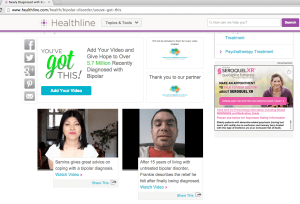
I made this video for Healthline.com (link below.) It’s a series called “You’ve Got This!” and it’s meant to be a positive inspirational message for people who have been newly diagnosed with bipolar d/o. Here’s the link to the video I made. It was quite an emotional experience, even though it’s short, it brought up a lot of emotions about when I found out I had bipolar d/o and when my brother was diagnosed with it, he was the first one in my family to start showing symptoms of this illness. Sort of a hellish time. We didn’t know what to expect, what was going to happen to my brother. Then I was diagnosed with it. A time of upheaval and terror, really. So I am so happy to be able to offer reassurances to people who are newly diagnosed that things will be fine. It is imperative that they stay in touch with their doctor and follow the doctor’s advice. And their lives will be their own again.
Oh Please Catch On!

This is exactly the kind of thing I have talked about for years! When I didn’t feel well, manic mostly, sometimes depressed, but it wasn’t to the degree that I needed hospitalization, these “Living Rooms” would have been perfect! There have been PLENTY of times when I have been super anxious, manicky, dysfunctional, and a burden to my husband and friends 😦 but not sick enough to be hospitalized. In those times, the Living room would have been perfect. Also my experience at the Comprehensive Psychiatric Emergency Program (CPEP) at Columbia Presbyterian Hospital in New York City was traumatic to say the least. I was out of touch with reality, but only periodically, yes, I was. And I was in no danger of hurting myself. I knew that full well. The doctor in the ER did not believe me and they kept me there against my will for at least 24 hours in a sort of dungeon like environment (CPEP) until a bed opened up and I could move up to the regular psychiatric floor. Being kept there against my will, being dispossessed of all my clothing, my purse, makeup, jewelry, everything I had on me, was so extremely depersonalizing and traumatizing. It brought my stress levels exponentially higher than when I had walked into the emergency room. I obviously felt imprisoned, trapped, felt that all my rights had been taken away, and I was, frankly, afraid of the big burly guards in the “dungeon.”
Now contrast my experience with walking into a place where the staff welcome you with open arms, offer you (soft) drinks, and try to make you feel absolutely at home and Voila, you have the Living Rooms that are now open in Illinois and paid for by the state. They also make arrangements for longer term care if you are in need of it.
Oh boy, if I could have gone there instead of to the dungeon, that would have been amazing! And I and my friends (who don’t have any mental illness, but know my history and my plight intimately) have talked about just such a place as the Living Room, where you can go and just chill out if you need to or get more comprehensive care if that is what is needed.
That sounds like a dream!
Below is the whole article and another link to a Psychology Today article, read and enjoy.
Why the U.S. Mental Health Care System Needs More Places for People to Just Chill Out
 By Theresa Fisher February 05, 2015
Kessler’s lack of control over his own mental state scared him, as did preparing for a six-story free-fall. But the scariest part of that night came later, when he voluntarily went to the emergency room. The prospect of going to the psych ward, to join the real crazy people, Kessler recalls, terrified him more than deliberating suicide.
“I still had the basic idea of a psych ward from TV,” he said. “But when I got there, the other people were a lot like me, just experiencing too much stress without the right coping mechanisms.”
In the end, he was glad he went. While the process of handing over his personal belongings and donning a hospital gown was by no means pleasant, Kessler knew he needed to get out of his dorm room and put his fate in someone else’s hands. In fact, he credits his two-night stay in the psychiatric ward with saving his life. Today, as a suicide prevention specialist, Kessler urges teenagers and young adults who find themselves in a dark place to go get help, even if that means checking in somewhere so they don’t check out.
Note: Kessler talks about his suicide attempt in the video below.
But Kessler ended up at the hospital because he didn’t see another option. Emergency rooms are designed to revive trauma victims and pump stomachs, not address mental health crises. Patients who need immediate psychiatric care endure a drawn-out intake process that often involves repeatedly explaining why they’re at the ER and waiting hours for beds to free up in a psych unit. It’s re-traumatizing, ineffective and expensive. That’s why Illinois created Living Rooms, state-funded, alternative ER centers for mental health crises.
The U.S. has radically shifted its approach to psychiatric care a number of times. During the second half of the 20th century, a policy of deinstitutionalization resulted in the discharge of thousands of mentally ill and developmentally disabled Americans from psychiatric hospitals, many of which subsequently shut down. The policy, though well-intentioned, received criticism for leaving former in-patients to flounder.
Similar criticism resurfaced recently, when studies revealed just how many incarcerated Americans suffer from severe mental illness. At least 15% of state prison inmates have a psychotic disorder. Some argue that the U.S. just shifted the burden — jails are the new mental hospitals. We haven’t quite figured out a system of comprehensive mental health care that doesn’t infringe on people’s basic civil rights.
More Living Rooms may be part of the solution.
Illinois opened the first of its five Living Rooms in 2011 as a non-clinical crisis center for people in the throes of a mental health meltdown. People can drop in to get immediate help and access to resources for longer-term care. A mental health crisis, to use the same definition as The Living Room does, is “a state in which an individual becomes overwhelmed and their usual coping mechanisms are not adequate, which leave them with disorganized thoughts and life processes … if a crisis state is not properly treated, the condition can quickly escalate, leading to a mental health emergency.”
As the name suggests, the centers are supposed to feel more like homes than hospitals. When guests walk into the Living Room, according to a 2014 study published in the journal Issues in Mental Health Nursing, staff members greet them “with open arms” and offer beverages — anything to make them feel at home, supported and in control of their own treatment.
It’s really a disarmingly simple idea: Normalize the practice of seeking help and offer people a place to chill out when they feel bad.
Within the mental health field, the Living Room is thought to be a creative approach, according to Ken Duckworth, medical director at the National Alliance for the Mentally Ill.
In addition to keeping doctors and psychiatric nurses on staff, the centers employ peer counselors who have been through, and emerged from, mental health crises themselves. Their presence has proven to be a strength of the Living Room model, according to Living Room coordinator Peter Robichaux. The stubborn stigma surrounding mental illness often makes people hesitant to seek treatment and uncomfortable when they do. Peer counselors get it; they’ve been there too. As one peer counselor said in the Issues in Mental Health Nursing study, “We’re not going to judge you because we are you.”
Kessler, who works at the Campbell Center, a D.C.-based nonprofit, says that peer support is a resource in hospitals too. As important as high-quality doctors are, young adults benefit when relatable liaisons enter the picture.
The Living Room model of care jibes with psychiatrist Patrick Corrigan’s theory of destigmatization. Corrigan, a researcher at the Illinois Institute of Technology, believes that destigmatizing mental illness hinges on more people coming out as mentally ill. We can learn about the causes and rates of various mood disorders, but living and working alongside people who’ve openly battled schizophrenia or bipolar disease is ultimately the way to change public perception. Corrigan looks to the gay rights movement for comparison. The movement really took off, he pointed out, when non-straight people became more visible in everyday life.
The Living Room model also helps stretch the state’s health care budget. During its first year, the original Living Room had 228 visits from 87 guests, most of them diverted from the ER, which saved upwards of $500,000.

It’s really a disarmingly simple idea: Normalize the practice of seeking help and offer people a place to chill out when they feel bad. And while Illinois’ Living Rooms stand out in the U.S., non-clinical mental health care centers are the norm in Australia. In 2006, the Australian government launched Headspace, a national network of fully funded health care centers where Australians between the ages of 12 and 25 go when they’re having a tough time. People can stop in whether they’re battling ongoing mental illness or just feeling stressed and lonely.
The Living Room approach may be catching on stateside too. Over the past few months, mental health urgent care centers have popped up on both coasts. Los Angeles County officials opened one such center in late 2014 to relieve pressure from county hospitals and jails running low on psychiatric beds. In January, Rhode Island opened its first walk-in mental health urgent care center for similar reasons, according to an AP story. Both facilities seem to skew more clinical than the Living Room, but they fill the same broad purpose: to be there for people who need help and provide services specifically tailored to mental illness. One county supervisor who led the effort in LA,Kaiser Health News reported, described the center as a more humane approach than traditional hospitalization.
It’s hard to say that any single service will fix our mental health care system, but based on history, we’re willing to make big changes. The Living Room model shows that small changes — a place to go, people to talk to — may be just as important.
World Bipolar Day Is March 30th, Van Gogh’s Birthday

http://www.isbd.org/advocacy-and-patient-resources/world-bipolar-day
World Bipolar Day (WBD) will be celebrated each year on March 30th, the birthday of Vincent Van Gogh, who was posthumously diagnosed as probably having bipolar disorder. The vision of WBD is to bring world awareness to bipolar disorders and eliminate social stigma. Through international collaboration the goal of World Bipolar Day is to bring the world population information about bipolar disorders that will educate and improve sensitivity towards the illness.
Bipolar Disorder is a mental illness that represents a significant challenge to patients, health care workers, family members and our communities. While growing acceptance of bipolar disorder as a medical condition, like diabetes and heart disease, has taken hold in some parts of the world, unfortunately the stigma associated with the illness is a barrier to care and continues to impede early diagnosis and effective treatment. In order to address the disparity in how bipolar disorder is viewed in different parts of the world, the Asian Network of Bipolar Disorder (ANBD),the International Bipolar Foundation (IBPF), and the International Society for Bipolar Disorders (ISBD) came together to work on the concept of a world bipolar day.
Willem Nolen, Immediate Past President of the ISBD, shares his enthusiasm about this initiative
“When the ANBD, who came up with the idea, approached the ISBD we immediately decided that we should support it actively. The initiative helps to achieve our goals to improve the lives of bipolar patients and their relatives. We immediately invited the IBPF to join in the initiative and are excited to work with such a great group of organizations. I am confident that World Bipolar Day will grow in the upcoming years and will help reduce stigma.”
Muffy Walker, Founder and President of IBPF, said the following when asked why she felt it important to be involved with WBD,
“As Martin Luther King once said, I have a dream that one day our nations will rise up and create all men equal. And I have a dream that my son, who has lived most of his life with bipolar disorder, will one day live in a nation where he will not be judged by his illness, but rather by the content of his character. I believe that World Bipolar Day will help bring my dream to fruition.”
Manuel Sanchez de Carmona, ISBD President, believes that
“WBD is an excellent opportunity for us [ISBD members] to reach out to patients, families and advocacy groups to invite them to work together on this global project to sensitize and bring awareness to bipolar disorders. WBD is a platform to think global and act local – our vision will be attained with a motivated and strong local effort.”
It is estimated that the global prevalence of bipolar disorder is between 1 and 2% and has been said to be as high as 5% and, according to the World Health Organization, is the 6th leading cause of disability in the world. In order to address this global problem, we need a global solution. With support from leading experts from around the world, groups like ANBD, IBPF, and ISBD are supporting efforts to investigate biological causes, targets for drug treatment, better treatments, better methods of diagnosis, the genetic components of the illness, and strategies for living well with bipolar disorder and this is just the beginning. Collaborations between research and advocacy groups are continuing to grow, and WBD is a tribute to the success of this strategy.
Christine Saenz, a patient and blogger, explains,
“I am so excited about this project and its message. It is so important to educate the world and fight the stigma that is associated with mental illness. Bipolar does not have to be scary. I am the face of Bipolar. I am just like everyone else. With the right treatment plan, I am able to live a stable and happy life.”
As the day draws near we encourage you to organize and publicize local events, which can be shared with the world through distribution on the WBD Facebook page (www.facebook.com/worldbipolarday). While a permanent home on the web has not yet been established, in the interim, ISBD will host your announcements on a special section of our website devoted to WBD. The WBD page will ultimately host press releases for these events, as well as provide a place to post photos, stories and share inspiration with others who share the vision of WBD.
For more information about WBD, or for any questions, comments, or event announcements, please contact Jill Olds at jillo@isbd.org
The WBD logo and its derivations must be used in a manner consistent with the spirit of World Bipolar Day, and would naturally be expected to exclude:
1. Activities whose principle purpose is to generate income
2. Activities that exclude anyone on the basis of race, religion, gender, etc.
3. Activities that may further harmful stereotypes or otherwise contribute to further stigmatization of bipolar illness
4. Activities that do not relate to bipolar disorder in some way
5. Activities or messages that contain “hate speech”
6. Use of the logo in conjunction with pharmaceutical support
Questions I answered by mistake…
I thought these were the questions I was supposed to answer for the Leibster Award, but they weren’t. They were the questions that Moze Pray at http://mozepray.com/ answered, she nominated me for the award. I’m posting them anyway!
1.Which is your favourite room in your house/apartment?
My favorite room is my Master Bathroom lol! It’s recently been gutted and redone and I picked white marble, espresso (dark brown) wood vanity and medicine cabinet and mint green walls and accents. It’s really amazing! The rain shower has a window in it!! The second favorite room is my kitchen, also totally gutted and redone, more on that later haha.
2. Who made the greatest difference in your life – good or bad?
This has to be three people for me: my grandmother who gave me unconditional and loads and loads of love, which is what saved me from rack and ruin! My husband who is my rock and has been with me for more than half my life and continues to support me through it all. And my son, who taught me how to love unconditionally and who is a BRILLIANT, handsome, charismatic Law student. And I’m not biased, I’m a very objective mama (haha.)
3. What is the meaning of life?
The meaning of life is to be surrounded with the ones you love and playing in the white sand beaches of a turquoise ocean with an azure blue sky! Also being with all your loved ones in a bright airy house on the outskirts of a forest with hummingbirds by the dozen, morrphing in and out of thin air, and all of us cooking, playing games and talking. 🙂
4.When you grow up, who do you want to be like?
I’m 54, so I must have grown up by now. And I’m pretty sure I’m decidedly me. If I wasn’t me, I would like to be hmmmmm have to think about that one…
5. Name the single most irritating thing that happens to you regularly.
When I get awful letters in Scrabble online, like A O O I I I E, dad nabbit that really annoys me!
6. What would you never change about yourself, even if you could?
I would never change the family I come from. Even though there is an INCREDIBLE amount of mental illness in my family (see ” History of mental illness in my family, quite extensive” at: https://bipolar1blog.wordpress.com/2014/10/17/251/) There have been and are extremely intelligent, compassionate, brilliant, loving, creative, innocent people in my family and I wouldn’t give them up for the world.
7. Do you like Jell -O?
I sort of do. Although I don’t like artificial colors and flavors. Jell-O is so much fun that I like it.
8. What are your thoughts on capitalism? (make it short or write a separate post if you have that many thoughts on it)
Well Capitalism, like Communism, seems to be engineering its own downfall. As the difference in incomes of the obscenely rich and the poverty stricken increases and as the wealth of the country gets concentrated more and more in the top 0.1% , (see: US wealth inequality – top 0.1% worth as much as the bottom 90% at: http://www.theguardian.com/business/2014/nov/13/us-wealth-inequality-top-01-worth-as-much-as-the-bottom-90) I don’t think this is supportable in a society that purports to be a Democracy, I think the Capitalist system is preparing for its own downfall.
9.Who is your favourite musician/band/musical artist?
Well, for Classical music, it’s definitely Mozart. And for pop music, it’s Madonna, Bruno Mars haha and I like Pitbull and 50 Cent as well, haha sorry but I do 🙂 Oh and Kathleen Battle has a miraculous voice! (see: https://www.youtube.com/watch?v=ma_Y91u05Lw)
10. Having done all this work, would you ever accept another award?
Absolutely, I really like nominating bloggers for this award and bringing attention to their blogs. And I also liked being asked my opinion on things, it’s nice to be able to voice your opinion!
I have been nominated for the Leibster Award :-)))

I am nominating You for the Leibster Award because I think you have an amazing blog! Please accept if you’d like and read directions below. ❤ ❤
I have been nominated for the Leibster Award by Moze Pray http://mozepray.com/ I am honored and I thank you so very much!
The rules of this award are:
Here are the rules:
Each nominee must have under 200 followers
Thank and link to the nominating blog
Answer their 10 questions and propose 10 new ones for your nominees
Nominate 10 blogs and tell them that they’ve been nominated
Write a post containing the questions
Include these rules in the post.
Here are the questions Moze Pray sent me and my answers.
1. What would you like to accomplish with your blog?
I would like for other people with mental illness to know that you can survive, live and even have wonderful moments in your life even if you do have a mental illness. Also I want to categorically remove the stigma that exists about mental illness by sharing my stories and bringing them into the light. I want to remove the stigma by not cowering in shame in the dark!
2. How often do you post to your blog?
Almost every day, sometimes less.
3. Do you still read the newspaper?
I don’t read the paper as in paper printed with ink, but I do read the New York Times, and others online.
4. What’s your stance on fighting stigma regarding mental illness?
I absolutely want to fight stigma. I know mental illness can be scary and difficult to understand by people, it is so for us, people who have mental illness as well. But mental illness is really a physical illness of the brain and as such should be talked about, given due consideration, such as sick leave, and people should realize that a person who has mental illness has an illness of the brain. Also for us, the people who have these god awful illnesses, it should not be about being ashamed. Do people who have heart disease or cancer feel ashamed?
5. What is one place you would like to travel to in the world?
Bali. I’ve seen those dome shaped grass pavilions that stand in the ocean. Oh so amazing!
6. Name something odd about yourself that you do.
I stay up till all hours of the night and have a LOT of trouble waking up 😦
7. Do you like photography?
Funny you should ask! I love, love, love to take pictures. Always have my camera with me. In fact my friend was just telling me that for my wake they will pose me with my camera, ready to take pictures, a la New Orleans (they pose deceased people doing their favorite things haha.)
8. Do you have any pets?
I have a cat who is 19.75 years old. She mostly sleeps now but in her heyday, she was a warrior, a hunter, an acrobat and the most loving, protective cat ever!!! Her sister passed away at 18.5 years of age!!! My most beloved Fluffin and Puffin.
9. Mac or Windows?
Oh definitely Mac! I am typing on a MacBook Air right now, while my iPhone and iPad are right beside me on the table 🙂
10. Why did you start a blog?
I wanted to tell my story. I wanted to help others with mental illnesses see that we don’t have to be ashamed. If we tell our stories in the open light of day, then the shame, the stigma, maybe even the dread goes out of them. And we as well as others begin to accept our stories. We help each other with our stories. They give us courage and determination and acceptance and a community.
Here are my 10 questions for the bloggers I nominated:
1) Do you like to read and if so what genre?
2) What is a/the story you’d like to tell?
3) What is your history of mental illness?
4) What is a perfect day for you?
5) What is the hardest thing you’ve done?
6) Do you have kids?
7) What advice would you give to your younger self and what would you say to your older self if you were sitting next to them?
8) Do you like to cook?
9) City or suburbs?
10) Did you go to college and if so what did you study?
I nominate these 10 Bloggers:
https://proudlybipolar.wordpress.com/
https://bipolardyke.wordpress.com/
https://tiffnvb.wordpress.com/
https://sexyschizo.wordpress.com/
Just for fun: DNA

Ok, DNA is made up of deoxyribonuleic acid and is in the shape of a double helix, like those helical staircases we sometimes see in modern houses, we had one in my house when I was a young adult. DNA is composed of a deoxyribose (a sugar) backbone and it has four bases (Adenine, Thymine, Cytosine, Guanine) that form the rungs of the double helical stairs. Adenine only binds to Thymine, and Guanine only binds to Cytosine. So these bases are said to be complementary to each other. There are 2 meters of DNA in every nucleus of every cell in our bodies. Stretch out all the DNA in all our cells, it can go to the sun and back 50 times! Sort of unfathomable! Now the nucleus is only 3-10 micrometers in size! That’s 3-10 x 10 -6 meters!!! Fitting that much DNA in a cell nucleus (average width: 5 micrometers) is like fitting a string the length of the Empire State building underneath your fingernail! How does all this DNA (2 meters) fit into this tiny nucleus? One word: Chromatin. Chromatin is DNA coiled around itself and then coiled around eight proteins called histones. The DNA wrapped around Histones is called an octamer and is repeated over and over again the length of the DNA. Acetylation, phosphorylation and methylation of histones, known as epigenetic changes, because they are not changes to the sequence of the DNA, but changes to molecules associated with the DNA, these epigenetic changes alter how tightly the DNA binds to the histones. This also changes how active the associated gene is. If a histone is bound very tightly to the DNA, the enzymes that need to transcribe a gene (RNA Polymerases) can’t get to the gene. If the RNA Polymerase can’t get to the gene, then it cannot transcribe a copy of the gene into RNA. This then cannot be translated into a protein. So this gene is not active. Now if the histone were acetylated, it wouldn’t be so tightly bound to the gene, then the RNA Polymerase would have no problem transcribing the gene into a messenger RNA, which would then be translated into a protein by ribosomes. Now this gene is active.
The way genes act is, as I said above, first RNA Polymerase, which is an enzyme, makes a very faithful copy of the DNA gene into a messenger RNA, then the messenger RNA leaves the nucleus and goes to the cytoplasm, there it is used as the template to make a protein by these organelles (little organs haha) called ribosomes. So the end result is that the gene which is DNA, is finally translated into a protein. If this is a skin cell for example, the DNA will have melanin genes and they will be transcribed into RNA and translated into Melanin in your skin. This is how genes exert their effect. This is why we are what our genes make us. There is so much complexity inside the cell and inside the nucleus of a cell. Researchers have found that there are loops in DNA, areas of DNA normally far apart, brought together through loop formation! The genes in the loop are activated. Different regions of the chromosomes come together when loops are formed and these affect how active these gene are!
It’s endlessly fascinating and complex.
 Palestine WILL Be Free