You Aren’t at the Mercy of Your Emotions – Your Brain Creates Them

How interesting for people with a mood disorder who constantly feels at the mercy of their emotions!

I would love to be able to construct my emotions and definitely try to be responsible for them. Well, just watch the video and let me know what you think.

I transcribed some of it and I’m writing it below in bold. It’s a very interesting video and worth listening to in its entirety.

She says at the end: “You have more control over your emotional suffering than you might imagine and you have the capacity to turn down the dial on emotional suffering and it’s consequences for your life by learning how to construct your expressions differently. All of us can do this and be good at it. More control means more responsibility. If you’re not at the mercy of some mythical emotion circuits buried deep in your brain somewhere and which trigger automatically then who’s responsible when you behave badly? You are! Not because you’re culpable for your emotions but because the actions and experiences you make today become your brain’s predictions for tomorrow.

Sometimes we are responsible for something not because we’re to blame but because we are the only ones who can change it.

Emotions are built not built in.We are responsible for our own emotions.

Embrace the responsibility because it is a path to a healthier body and a more Just and informed legal system, a more flexible and more potent  emotional life.”

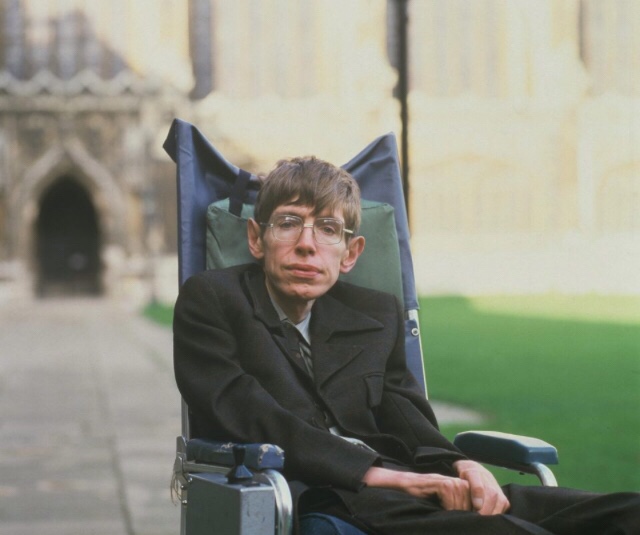
Stephen Hawking January 8, 1942-March 13, 2018

He was brilliant, arguably the most intelligent man alive. He was only supposed to live to about 23 years of age, because of being diagnosed with ALS in 1963, yet he lived into his 76th year. And the irony of the man with the most brilliant brain having no control of his body is not lost here. Yet he did not let that defeat him! He lived and breathed and theorized and studied and went on with his life. He studied black holes and his most well known theory was that black holes didn’t swallow up everything, they actually released radiation (!) which is now known as Hawking radiation.

Of course, he was beyond brilliant, he was also personable and funny, making many appearances on shows such as the Big Bang Theory and the Simpsons. He wrote a book called “A Brief History of Time ” which has sold over 10 million copies! He also knew and extolled the power of not giving up, he knew perseverance, he told us not to look at our feet but look at the stars. Here is his direct quote: “Remember to look up at the stars and not down at your feet. Try to make sense of what you see and wonder about what makes the universe exist. Be curious. And however difficult life may seem, there is always something you can do and succeed at. It matters that you don’t just give up.”

For more of his brilliant and insightful quotes, see here: https://www.google.com/amp/s/amp.theguardian.com/science/2018/mar/14/best-stephen-hawking-quotes-quotations

He was amazing, his brain was beyond brilliant.

What do you say when the most intelligent man on earth, literally the most intelligent man is gone? We were so lucky to have him. We will miss him so very much.

Nantucket Blues

img_5221Yes, feeling blue. Fighting it. Must start taking L-methyl folate, since I lack the enzyme (methylenetetrahydrofolate reductase MTHFR for short haha) which is necessary to convert it from folate. This will help my mood. I can’t take SSRI’s because they make me cycle too much. Going to start taking it immediately as well as vitamin D2 because my levels are abysmal and hope this down, dark, drab, dull, dreary, dismal, depressed mood goes away. Visiting worthlessness, meaninglessness, tiredness all of a sudden. Get blindsided every time. Fighting it though. And as always, I will win!

This is what happens to your brain when you stop exercising (!)

And I’m telling you it’s nothing good! Don’t stop exercising! It’s not only good for your body, it’s really good for your brain as well !

Depression, anxiety, bipolar disorder more prevalent among patients with RA

Again! Another immunological link to mental illness. Rheumatoid Arthritis (RA) is an autoimmune disease, meaning your own immune system attacks your joints and connective tissue, and people who have RA have a higher prevalence of anxiety, depression and bipolar disorder. My family is a prime example, my grandmother had RA, my mother had Lupus and RA, I have food sensitivities, all of these are due to the immune system, and my mother had major depression, I have bipolar 1 disorder and my grandmother, although not formally diagnosed, may have had a few mental health conditions. I know this is only one family but please look at the article below. The link between the immune system and mental illness is real. I hope there will be a better understanding and better therapies due to this understanding soon!

https://www.healio.com/rheumatology/rheumatoid-arthritis/news/online/%7Bf090255e-accf-4562-9b0b-93864c35c4e4%7D/depression-anxiety-bipolar-disorder-more-prevalent-among-patients-with-ra

Depression, anxiety, bipolar disorder more prevalent among patients with RA

To determine the incidence and prevalence of various psychiatric disorders and conditions among patients with RA compared with those without RA in the general population, the researchers studied health data from Manitoba. They identified 10,206 cases of incident RA between 1989 and 2012, as well as a general-population cohort of 50,960 individuals, and matched the two groups 5:1 based on birth year, sex and region.

Researchers found that psychiatric disorders, such as depression, anxiety and bipolar disorder, were more common among patients with rheumatoid arthritis compared with the general population.
Source: Shutterstock

In addition, the researchers used validated algorithms for depression, anxiety, bipolar disorder and schizophrenia to find the annual incidence of these conditions following an RA diagnosis, as well as their lifetime and annual prevalence..

According to the researchers, after adjusting for age, sex, region, number of physician visits and year, patients with a diagnosis of RA demonstrated a greater incidence of depression throughout the study period (IRR = 1.46; 95% CI, 1.35-1.58). Patients with RA also had great incidences of anxiety (IRR = 1.24; 95% CI, 1.15-1.34) and bipolar disorder (IRR = 1.21; 95% CI, 1-1.47). However, schizophrenia incidence did not differ between the two groups. Lifetime and annual prevalence of depression and anxiety were also greater among patients with RA, compared with the general-population cohort.

“Over a lifetime, more than one-third of persons with rheumatoid arthritis are likely to experience depression, and 45% are likely to experience an anxiety disorder,” Marrie said. “Given the very high prevalence of psychiatric disorders in rheumatoid arthritis, clinicians need to be proactive about identifying and treating these conditions appropriately. Clinicians should be aware that women, and those of lower socioeconomic status are at particularly increased risk of these disorders.” – by Jason Laday

Finally, proof: opioids are no better than Tylenol for treating some chronic pain – Vox

Wow! It says at a year, patients actually have more pain if they’re on opioids! If this is really true then the whole opioid addiction crisis could have been avoided! Sad.

www.vox.com/science-and-health/2018/3/6/17082590/opioids-tylenol-chronic-pain-study

A first-of-its-kind study compared opioids to non-opioid drugs in patients with persistent back pain or hip or knee osteoarthritis. Its results are devastating.

Why nutritional psychiatry is the future of mental health treatment

Blueberries

Very interesting and may be so helpful.

Below is a direct quote from the article below. I wonder why we are not told to add vitamin and mineral as well as OTC anti-inflammatory supplementation to out diets and medicine regimen? It would be worth it to try it, if it doesn’t help, ok, but imagine it does help! I am going to ask my psychiatrist about all of these and if they have any adverse reactions with the medications I’m on. That’s would be the best way to go here. Wishing us all the best of physical and mental health.

“It is now known that many mental health conditions are caused by inflammation in the brain which ultimately causes our brain cells to die. This inflammatory response starts in our gut and is associated with a lack of nutrients from our food such as magnesium, omega-3 fatty acids, probiotics, vitamins and minerals that are all essential for the optimum functioning of our bodies. Recent research has shown that food supplements such as zinc, magnesium, omega 3, and vitamins B and D3 can help improve people’s mood, relieve anxiety and depression and improve the mental capacity of people with Alzheimer’s. Magnesium is one of most important minerals for optimal health, yet many people are lacking in it. One study found that a daily magnesium citrate supplement led to a significant improvement in depression and anxiety, regardless of age, gender or severity of depression. Improvement did not continue when the supplement was stopped. Omega-3 fatty acids are another nutrient that is critical for the development and function of the central nervous system – and a lack has been associated with low mood, cognitive decline and poor comprehension. Research has shown that supplements like zinc, magnesium and vitamins B and D can improve the mental capacity of people with Alzheimer’s. Shutterstock The role of probiotics – the beneficial live bacteria in your digestive system – in improving mental health has also been explored by psychiatrists and nutritionists, who found that taking them daily was associated with a significant reduction in depression and anxiety. Vitamin B complex and zinc are other supplements found to reduce the symptoms of anxiety and depression. Hope for the future? These over-the-counter” supplements are widely available in supermarkets, chemists and online health food stores, although the cost and quality may vary. For people who have not responded to prescription drugs or who cannot tolerate the side effects, nutritional intervention can offer hope for the future. There is currently much debate over the effectiveness of antidepressants. The use of food supplements offer an alternative approach that has the potential to make a significant difference to the mental health of all age groups.”


http://theconversation.com/why-nutritional-psychiatry-is-the-future-of-mental-health-treatment-92545

A lack of essential nutrients is known to contribute to the onset of poor mental health in people suffering from anxiety and depression, bipolar disorder, schizophrenia and ADHD. Nutritional psychiatry is a growing discipline that focuses on the use of food and supplements to provide these essential nutrients as part of an integrated or alternative treatment for mental health disorders. But nutritional approaches for these debilitating conditions are not widely accepted by mainstream medicine. Treatment options tend to be limited to official National Institute for Care Excellence (NICE) guidelines which recommend talking therapies and antidepressants. Use of antidepressants Antidepressant use has more than doubled in recent years. In England 64.7m prescriptions were issued for antidepressants in 2016 at a cost of £266.6m. This is an increase of 3.7m on the number of items prescribed in 2015 and more than double than the 31m issued in 2006. A recent Oxford University study found that antidepressants were more effective in treating depression than placebo. The study was led by Dr Andrea Cipriani who claimed that depression is under treated. Cipriani maintains that antidepressants are effective and a further 1m prescriptions should be issued to people in the UK. This approach suggests that poor mental health caused by social conditions is viewed as easily treated by simply dispensing drugs. But antidepressants are shunned by people whom they could help because of the social stigma associated with mental ill-health which leads to discrimination and exclusion. Prescriptions for 64.7m items of antidepressants were dispensed in England in 2016, the highest level recorded by the NHS. Shutterstock More worrying is the increase in the use of antidepressants by children and young people. In Scotland, 5,572 children under 18 were prescribed antidepressants for anxiety and depression in 2016. This figure has more than doubled since 2009/2010. But according to British psychopharmacologist Professor David Healy, 29 clinical trials of antidepressant use in young people found no benefits at all. These trials revealed that instead of relieving symptoms of anxiety and depression, antidepressants caused children and young people to feel suicidal. Healy also challenges their safety and effectiveness in adults. He believes that antidepressants are over-prescribed and that there is little evidence that they are safe for long-term use. Antidepressants are said to create dependency, have unpleasant side effects and cannot be relied upon to always relieve symptoms. Nutrition and poor mental health In developed countries such as the UK we eat a greater variety of foodstuffs than ever before – but it doesn’t follow that we are well nourished. In fact, many people do not eat enough nutrients that are essential for good brain health, opting for a diet of heavily processed food containing artificial additives and sugar. The link between poor mental health and nutritional deficiencies has long been recognised by nutritionists working in the complementary health sector. However, psychiatrists are only now becoming increasingly aware of the benefits of using nutritional approaches to mental health, calling for their peers to support and research this new field of treatment. It is now known that many mental health conditions are caused by inflammation in the brain which ultimately causes our brain cells to die. This inflammatory response starts in our gut and is associated with a lack of nutrients from our food such as magnesium, omega-3 fatty acids, probiotics, vitamins and minerals that are all essential for the optimum functioning of our bodies. Recent research has shown that food supplements such as zinc, magnesium, omega 3, and vitamins B and D3 can help improve people’s mood, relieve anxiety and depression and improve the mental capacity of people with Alzheimer’s. Magnesium is one of most important minerals for optimal health, yet many people are lacking in it. One study found that a daily magnesium citrate supplement led to a significant improvement in depression and anxiety, regardless of age, gender or severity of depression. Improvement did not continue when the supplement was stopped. Omega-3 fatty acids are another nutrient that is critical for the development and function of the central nervous system – and a lack has been associated with low mood, cognitive decline and poor comprehension. Research has shown that supplements like zinc, magnesium and vitamins B and D can improve the mental capacity of people with Alzheimer’s. Shutterstock The role of probiotics – the beneficial live bacteria in your digestive system – in improving mental health has also been explored by psychiatrists and nutritionists, who found that taking them daily was associated with a significant reduction in depression and anxiety. Vitamin B complex and zinc are other supplements found to reduce the symptoms of anxiety and depression. Hope for the future? These over-the-counter” supplements are widely available in supermarkets, chemists and online health food stores, although the cost and quality may vary. For people who have not responded to prescription drugs or who cannot tolerate the side effects, nutritional intervention can offer hope for the future. There is currently much debate over the effectiveness of antidepressants. The use of food supplements offer an alternative approach that has the potential to make a significant difference to the mental health of all age groups. The emerging scientific evidence suggests that there should be a bigger role for nutritional psychiatry in mental health within conventional health services. If the burden of mental ill health is to be reduced, GPs and psychiatrists need to be aware of the connection between food, inflammation and mental illness. Medical education has traditionally excluded nutritional knowledge and its association with disease. This has led to a situation where very few doctors in the UK have a proper understanding of the importance of nutrition. Nutritional interventions are thought to have little evidence to support their use to prevent or maintain well-being and so are left to dietitians, rather than doctors, to advise on. But as the evidence mounts up, it is time for medical education to take nutrition seriously so that GPs and psychiatrists of the future know as much about its role in good health as they do about anatomy and physiology. The state of our mental health could depend on it.

People with depression use language differently – here’s how to spot it

I think we already know that people with depression use more negative emotion words. We/they also use more first person pronouns, ruminate more about issues, and so much more. This is a detailed article about the communication style of people with depression. Very interesting.

http://theconversation.com/people-with-depression-use-language-differently-heres-how-to-spot-it-90877

Mohammed Al-Mosaiwi

Kurt Cobain’s song lyrics were loved by many. Maia Valenzuela/Flickr, CC BY-SA

From the way you move and sleep, to how you interact with people around you, depression changes just about everything. It is even noticeable in the way you speak and express yourself in writing. Sometimes this “language of depression” can have a powerful effect on others. Just consider the impact of the poetry and song lyrics of Sylvia Plath and Kurt Cobain, who both killed themselves after suffering from depression.

Scientists have long tried to pin down the exact relationship between depression and language, and technology is helping us get closer to a full picture. Our new study, published in Clinical Psychological Science, has now unveiled a class of words that can help accurately predict whether someone is suffering from depression.

Traditionally, linguistic analyses in this field have been carried out by researchers reading and taking notes. Nowadays, computerised text analysis methods allow the processing of extremely large data banks in minutes. This can help spot linguistic features which humans may miss, calculating the percentage prevalence of words and classes of words, lexical diversity, average sentence length, grammatical patterns and many other metrics.

So far, personal essays and diary entries by depressed people have been useful, as has the work of well-known artists such as Cobain and Plath. For the spoken word, snippets of natural language of people with depression have also provided insight. Taken together, the findings from such research reveal clear and consistent differences in language between those with and without symptoms of depression.

Content

Language can be separated into two components: content and style. The content relates to what we express – that is, the meaning or subject matter of statements. It will surprise no one to learn that those with symptoms of depression use an excessive amount of words conveying negative emotions, specifically negative adjectives and adverbs – such as “lonely”, “sad” or “miserable”.

More interesting is the use of pronouns. Those with symptoms of depression use significantly more first person singular pronouns – such as “me”, “myself” and “I” – and significantly fewer second and third person pronouns – such as “they”, “them” or “she”. This pattern of pronoun use suggests people with depression are more focused on themselves, and less connected with others. Researchers have reported that pronouns are actually more reliable in identifying depression than negative emotion words.

Negative words and first person pronouns can give a clue. hikrcn/Shutterstock

We know that rumination (dwelling on personal problems) and social isolation are common features of depression. However, we don’t know whether these findings reflect differences in attention or thinking style. Does depression cause people to focus on themselves, or do people who focus on themselves get symptoms of depression?

Style

The style of language relates to how we express ourselves, rather than the content we express. Our lab recently conducted a big data text analysis of 64 different online mental health forums, examining over 6,400 members. “Absolutist words” – which convey absolute magnitudes or probabilities, such as “always”, “nothing” or “completely” – were found to be better markers for mental health forums than either pronouns or negative emotion words.

From the outset, we predicted that those with depression will have a more black and white view of the world, and that this would manifest in their style of language. Compared to 19 different control forums (for example, Mumsnet and StudentRoom), the prevalence of absolutist words is approximately 50% greater in anxiety and depression forums, and approximately 80% greater for suicidal ideation forums.

Pronouns produced a similar distributional pattern as absolutist words across the forums, but the effect was smaller. By contrast, negative emotion words were paradoxically less prevalent in suicidal ideation forums than in anxiety and depression forums.

Our research also included recovery forums, where members who feel they have recovered from a depressive episode write positive and encouraging posts about their recovery. Here we found that negative emotion words were used at comparable levels to control forums, while positive emotion words were elevated by approximately 70%. Nevertheless, the prevalence of absolutist words remained significantly greater than that of controls, but slightly lower than in anxiety and depression forums.

Crucially, those who have previously had depressive symptoms are more likely to have them again. Therefore, their greater tendency for absolutist thinking, even when there are currently no symptoms of depression, is a sign that it may play a role in causing depressive episodes. The same effect is seen in use of pronouns, but not for negative emotion words.

Practical implications

Understanding the language of depression can help us understand the way those with symptoms of depression think, but it also has practical implications. Researchers are combining automated text analysis with machine learning (computers that can learn from experience without being programmed) to classify a variety of mental health conditions from natural language text samples such as blog posts.

Language analysis can help diagnose depression. Dmytro Zinkevych/Shutterstock

Such classification is already outperforming that made by trained therapists. Importantly, machine learning classification will only improve as more data is provided and more sophisticated algorithms are developed. This goes beyond looking at the broad patterns of absolutism, negativity and pronouns already discussed. Work has begun on using computers to accurately identify increasingly specific subcategories of mental health problems – such as perfectionism, self-esteem problems and social anxiety.

That said, it is of course possible to use a language associated with depression without actually being depressed. Ultimately, it is how you feel over time that determines whether you are suffering. But as the World Health Organisation estimates that more than 300m people worldwide are now living with depression, an increase of more than 18% since 2005, having more tools available to spot the condition is certainly important to improve health and prevent tragic suicides such as those of Plath and Cobain.
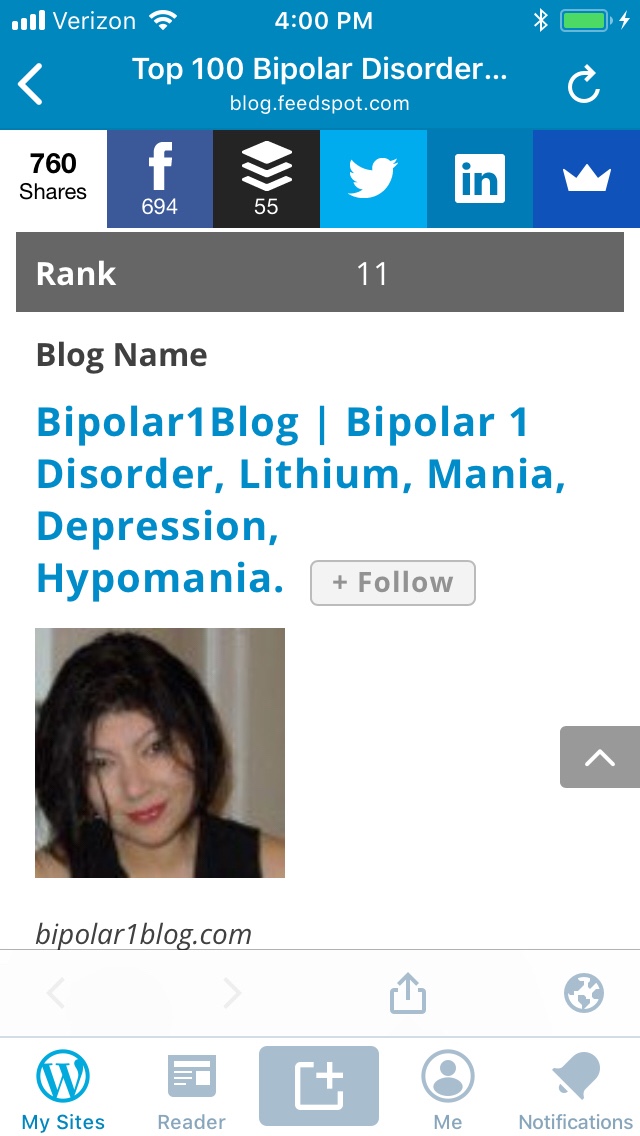
Top 100 blogs for people with bipolar d/o.

Just found this list of top 100 blogs for people with bipolar disorder. Bipolar1blog is number 11 on the list!

Not only is this a pretty exhaustive list, but I am truly honored and happy to be on this list. Thank you so much to the compilers.

https://blog.feedspot.com/bipolar_disorder_blogs/

Fault vs. Responsibility

Brilliant video by Will Smith. This is truer than true. Even though it’s not someone’s fault that they were abused as a child, it’s still their responsibility to take that pain and hurt and suffering and do something with it so they can have a life full of love and laughter and constructiveness. If they continue to play the role of the victim, and believe me I know that any child who is pummeled into a bloody mess is a victim, but if this victimhood is kept alive, then the person will never take responsibility for their own life and move forward. Moving forward can also involve forgiveness, forgiveness can also take away victimhood. Instead of constantly living with hatred and anger, if you forgive your abuser, it can take away their power! You don’t need to be angry, hateful, negative because you’ve already forgiven them. And forgiveness is not for them, it’s for your own self, to get you out of the cycle of remaining a victim, anger, hatred and fear. Yes fear is at the crux of all the negative emotions. So if you can forgive, and take responsibility for your self, you can invite love and purpose and happiness into your heart.

Anyway, just watch the video, it’s brilliant!