3 Reasons Why Complaining Rarely Gets You What You Want


Not amused

Not Amused

Ugh, I’ve totally been guilty of complaining and negative thoughts. I’ve been complaining to my cast mates that I don’t wNt to be in the play. I’ve been complaining to my friends. I’ve been grumbling to myself about it. I said yes to being in this play and more than anything else, I wish I had said NO. I have awful amounts of anxiety, never used to have it, was always rip roaring to go play my part. My stomach churns when I think about how much I don’t want to be in this play. I’m memorizing lines and my head is kicking me in the shins for taking on this role. I am done with plays. I don’t want to do them anymore. I get too anxious now. I had promised myself last time I was in one that I wouldn’t take another role, not ever again. That had been a very unpleasant experience.  And then when this role was offered to me I said yes! Hello, anybody home in my head? Why would I do such a thing? Anyway, the play is going on eight days, so there is nothing to do now except for learn my lines, finish the play and never, and I mean NEVER, accept another part ever again. And stop complaining. Someone tell me it’s not that bad, please!

https://www.psychologytoday.com/blog/smashing-the-brainblocks/201604/3-reasons-why-complaining-rarely-gets-you-what-you-wantThere are many reasons why complaining is a bad habit: It puts you in a bad mood. It keeps you focused on flaws and problems. It makes you sound suspicious and distrustful. It annoys the people who have to listen, or makes them feel that they are incompetent and unhelpful. Overall, complaining makes life feel like an ordeal instead of a gift, for both givers and receivers.

The biggest problem with complaining is that it doesn’t always get to the heart of the matter. In fact, it may distract you from what you really need to be thinking about. Instead, it keeps you busy ruminating about how horrible your life is, blaming others for it, and shutting down any hope for a different future.
Complaining is the verbal expression of negativity, a pervasive, self-imposed, unfavorable view of the world. Complaints fall into three categories—self-pity, judging, and warning. What determines the type of complaining we do depends on whether our negative narrative is focused on ourselves, on other people, or on our fears about the future.
Self-pity. Self-pity involves bemoaning. This type of complaining focuses on how tough, unfair, and unforgiving life has been. Favorite topics for discussion include how disappointed you may be in yourself, how little appreciation and recognition you get for your efforts, and how unlucky you are with anything you try. Feeling misunderstood, unappreciated, and unloved often could put you in a chronically bad mood. Self-pity aims to get you sympathy and validation.
Judging. This type of complaining focuses on criticizing and condemning others and revealing their flaws and shortcomings. Favorite topics include talking about how incompetent, dumb, arrogant, or flaky other people are. Anyone who doesn’t meet your arbitrary standards of excellence could become a target of scorn and ridicule. Sometimes, you deliver your judgments indirectly, as jokes, sarcasm, or even constructive feedback. Negativity, however, is negativity, regardless of how you serve it. Criticizers like agreement. If anyone doesn’t agree with you, there must be something wrong with them.

Warning. This type of complaining involves catastrophizing—reacting excessively to normal events. You are constantly worried about consequences. You tend to make negative predictions. Where other people see safety, you see risk and danger, and you make it your mission to warn and protect them from what they can’t see: Beware! The economy is tanking! Unemployment is soaring! Crime is on the rise! Politicians are corrupt! The most likely reason for engaging in this type of complaining is to find someone to share gloomy prophecies with and be scared together.

The truth is we have all tasted and served all three varieties of negativity. We have all complained in the past and we will do it again in the future. Complaining is robust. It has survived time. And while it is not a good predictor of success, there is one big advantage to complaining.

Whether we complain about ourselves or others, whether the negativity manifests as self-pity, criticism of others, or ominous predictions about the future, the reason why people complain is always the same: We complain when we are not getting what we want. Behind every complaint, then, lies an unfulfilled goal—and that is the key to undoing complaining.
Some people find complaining cathartic. They may enjoy venting about the things that bother them. Nevertheless, when all they do is complain, they have only done half the work. Complaining alone does not change anyone’s life. You have to do something more about it.
Complaining is the beginning of the problem-solving process. It moves the spotlight on the pain points. It prompts you to explore and discover the reason behind the incessant rant. It makes you become aware of your unmet needs, your unfulfilled desires, and your goals that remain unaccomplished.
How can you make complaining work for you? To start, every time you complain about something, ask yourself three questions:
What am I complaining about?
What do I want that I am not getting?

How can I get what I want?

The answers to these questions will give you relief from complaining. They will also help you shift your focus from wallowing in negativity to creating meaningful goals that you can work toward, so you can get what you want. Begin to notice the things that you complain about the most. Discover what the unfulfilled desire behind the complaining might be. What are the things you want and are not getting? And lastly, what can you do to acquire or achieve them?

To learn more about how dreamers become achievers, check out Brainblocks: Overcoming the 7 Hidden Barriers to Success (Penguin, 2015).
If you don’t have time to read an entire book but still want to know how the brainblocks prevent dreamers from becoming achievers, check this out.
And if procrastination is getting in the way of doing either, get a free copy of my ebook Getting Things Done SOONERR™!

Farooq

PalestineWILLbefree's avatarPalestine WILL Be Free

F1F2 copyF3

You left us much too soon.

Did you know how much we loved you?

Didn’t you know how much you had to live for?

It was just an illness.

It was just a thought.

They were only emotions, gone awry.

You were stronger than that, yet for an instant you thought you weren’t.

Do you know how much I wish I had been there.

How much I wish I had held your hand and walked you across the precarious bridge of your darkest thoughts?

That’s all it would have taken, just my hand grasping yours, but I wasn’t there.

It was just one little instant that wrought catastrophe…

We loved you with all our hearts, we still do.

You live in our hearts, you really do.

My son has your eyes, when I look at him, sometimes I see you looking back at me.

Your son and your daughter are…

View original post 34 more words

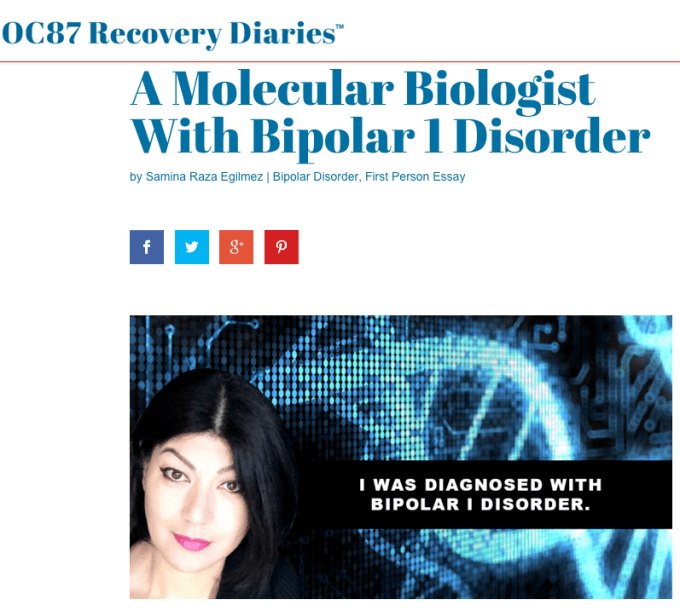
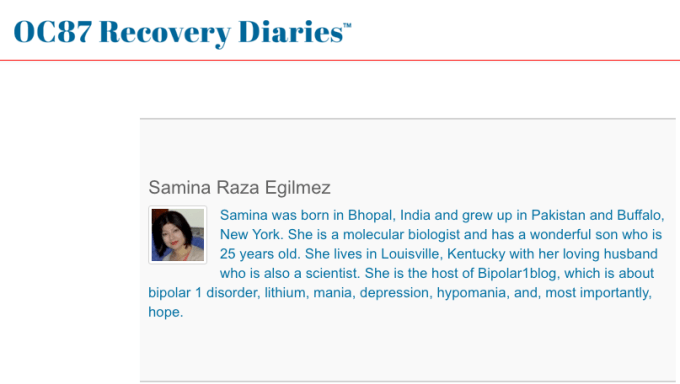
A Molecular Biologist With Bipolar 1 Disorder by Samina Raza | Bipolar Disorder, First Person Essay

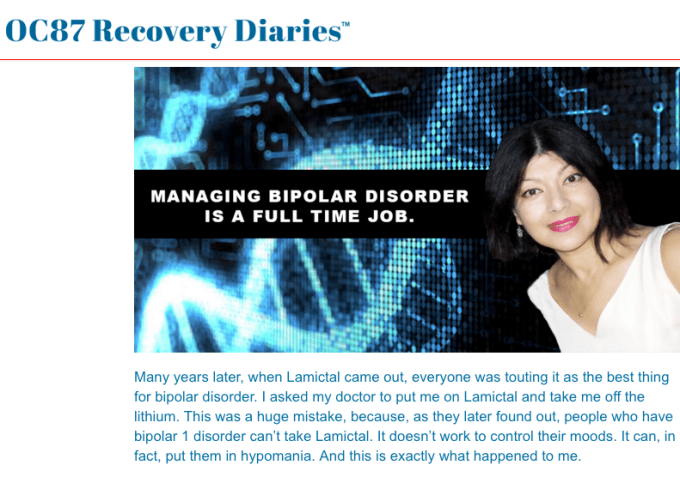
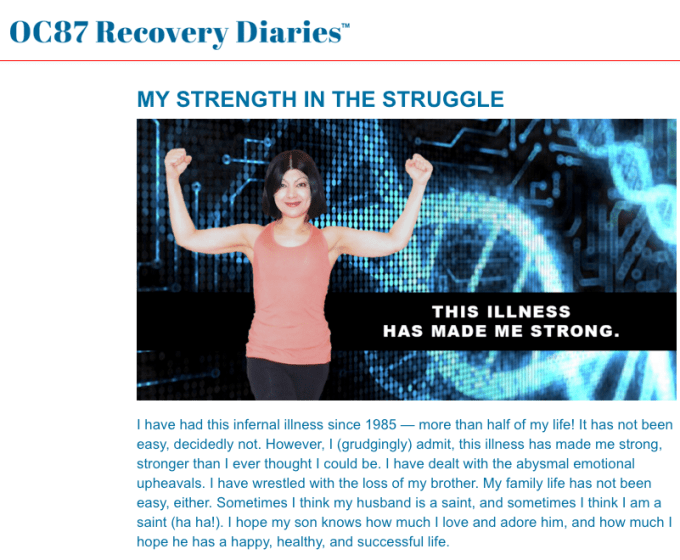
This just got published on OC87 Recovery diaries. I am posting some screenshots, for the whole post, please visit: http://oc87recoverydiaries.com/bipolar-1-disorder/

12345bio


Two More Huffpost Blog Posts!! 😊😊

  
http://m.huffpost.com/us/entry/love-and-other-drugs_b_9717100.html​

  
http://m.huffpost.com/us/entry/abuse-abandonment-bipolar_b_9717000.html

well it’s a bipolar linkdump

Blahpolar is a genius! And thank you for the Huffpost shout out!

blahpolar's avatarblahpolar

Thanks to socialworkerangela for the reminder of this shot straight to the heart mhm… “I think there’s a flaw in my code”. Halsey is bipolar and also genius. Volume UP.

Now go listen to more y’all. Girl got game.

image

The them section coming up is dominated by Patty Duke, which I think is more than fair considering the sheer length of time she was vocal about her stuff. Aw and then she went and gave us lovely Sam Gamgee Sean Astin too. Rest in Peace, warrior woman.

Them:

image

Sean Astin on Mom Patty Duke’s Bipolar Disorder: ‘We Were All in the Storm Together’
ARCHIVAL VIDEO: Patty Duke Seeks to Promote Understanding of Manic Depression in 1989
From the PEOPLE Archive: Patty Duke Opens Up About Her Battle with Bipolar Disorder

10 Celebrities With Depression, Bipolar Disorder, or Both

Don Cheadle: ‘Miles Davis was probably bipolar

Blah F. Polar: yo…

View original post 548 more words

Love and Other Drugs


 So many of us who have been traumatized as children, who were unloved or not loved enough, who were rejected, abandoned, abused, develop addictions later on in life. The trauma that we suffered in our childhood leads to pain, anxiety, emptiness, depression, self hate, and on and on and on. All these feelings are extremely unpleasant and painful to feel, therefore we try to get away from them by using something or someone to mask the pain. This can lead to addictive behavior. Addiction is not only to substances like alcohol, or drugs, you can also be addicted to a person. In the case of alcohol, although a depressant, it increases dopamine in your brain. Dopamine is a neurotransmitter, and one of our feel good chemicals. So initially, alcohol makes us feel good, due to the increase in dopamine. However, its depressant effect takes over soon after, and also one needs to drink more and more to get the mood enhancing effect, all of this can lead to alcohol addiction or alcoholism. Same with drugs, they can alleviate anxiety, make us feel good temporarily, but again, it may take higher doses to achieve the same effects and that can lead to addiction. And people can have the same effect on us, this is known as “love addiction,” one can be addicted to a lover or friend, as this also produces feel good chemicals in our brain.

Love addiction is extremely destructive. You are dependent on a whole other human being for your happiness! Really?! I know, I get it, I’ve been there. The feelings swirling inside of you from your childhood trauma are so painful and heartbreaking, that you, without even knowing it, put the responsibility of your happiness on to someone else’s unsuspecting shoulders!

This is because you do not know how to soothe yourself, so when you are thinking of your “love” interest, you’re not thinking painful thoughts, or you think this person you’re addicted to will do it. And believe me this has nothing to do with love, and everything to do with addiction. You think you can’t live without this person, you get a high when you see this person, it’s all about you. True love is selfless and you care about the person you love more than yourself, ok if not more than, at least as much as… Addiction is different, it’s a fix, it’s something you crave, it’s a very self involved thing. With addiction, most people are trying to reduce their own suffering, unfortunately, they are using self destructive behaviors to accomplish their goal of no suffering. The goal is positive, the methods… perhaps not so much…

It’s because you don’t know how to tamp down your fight or flight from going from 0 to 500 in 5 seconds, you think the presence of the person you’re addicted to will do this.

It’s because no one taught you to love yourself, to value yourself, to forgive yourself, you think the poor person you are addicted to will do it.

Your boundaries were continuously violated, you never learned what a boundary was, so you want to be totally enmeshed with this unfortunate person you are addicted to, and whose boundaries you don’t know how to respect.

The above three are skills that people who grow up in loving, nurturing, normal homes learn when they are young children.

We people, who grew up in abusive, abandoning homes, do not learn these skills when we are children.

Well it’s never too late to learn. Never too late to reparent yourself, or work with your inner child. Meditation can be used to calm your flight or flight response. There are apps for your cell phones such as Headspace (https://www.headspace.com/) that will help you learn meditation. This can take as little as 10 minutes! There are resources that will help you heal from love addiction, here’s a link to a book that helped me a lot; http://www.amazon.com/gp/product/B004HW88LU/ref=dp-kindle-redirect?ie=UTF8&btkr=1

And one last thing, this is very important, we adult survivors of child abuse and abandonment sometimes get so involved in our feelings and feel so sorry for our own selves that we don’t even realize that we are trespassing on other people’s rights. We do it totally unknowingly, however, we do do it. Let me give you an example, the person we’re addicted to, known as “poor person” from hereon in, is busy, hasn’t answered our texts in a few days. Our abandonment issues are extensively triggered by this because we think this poor person has now abandoned us. So we bombard them with every manner of contact we have for them, Facebook messenger, Snapchat, texting, emailing, Whatsapp, and many others in this age of technology, all begging, apologizing, and generally making as big a pest of ourselves as possible. We have no boundaries, we think this is ok. Well it’s not ok. This poor person should not have to put up with this level of, frankly, harassment. If this poor person is our friend, they did not sign on to deal with this. The bottom line is: You and I are responsible for our issues and for healing from them! Some friends will hold our hand and walk with us, and some won’t. But, no one has to. It is wholly our own responsibility to get help, to realize what our issues are and to heal from them. And once the healing has taken place, at least to some degree, we can be friends with anyone, yet be dependent on no one. We’ve won the war of independence, congratulations! This is not to be harsh, but to help us realize what we’re doing is not in anyone’s best interests, including our own. It’s a difficult lesson to learn, but once we learn it, and we (and I am definitely included here) can live our lives without being dependent on anyone else to make us happy, once we own our own lives and become responsible for ourselves, then really and truly, we’ve healed and we have arrived! 🙂

Yours in mental wellness and health,

Samina.

Bipolar1blog

http://m.huffpost.com/us/author/samina-raza

Introducing Yours Truly, a Huff Post Blogger!

I sent my poem to Arianna Huffington on April 7th, asking if she would consider printing it. Then promptly forgot about it. On the 10th, I got a reply in which she said she would love to feature my…

Source: Introducing Yours Truly, a Huff Post Blogger!

Dialogue from my play “Jockey Jim” by Larry Muhammad.

I play Jimmy Winkfield’s wife, Lydia de Minkiwitz, a Russian Baroness! This dialogue is from when we move to the US and are not doing very well. I’m doing my best Russian accent while still trying to be intelligible at the same time hahaha.

James Winkfield was the last of the African American great jockeys, he won the Kentucky Derby in 1901 and 1902! But after his retirement he was largely forgotten. A fascinating story!

http://www.americasbestracing.net/en/the-latest/blogs/2014/9/29/the-epic-journey-of-james-wink-winkfield/

http://www.britannica.com/biography/James-Winkfield

Second Huff Post Blogpost 

http://m.huffpost.com/us/entry/how-you-treat-someone-with-a-mental-illness_b_9704150.html

Here’s the link. Sorry I’m going to post all the links until my excitement wears off. I am just so darn tickled pink!