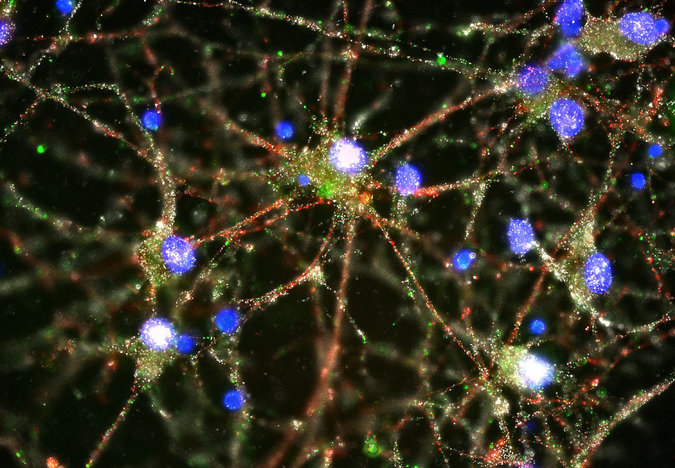
 This is absolutely amazing! Scientists have found out that the cause of schizophrenia is too much synaptic pruning of neurons, “in which the brain sheds weak or redundant connections between neurons as it matures” in the prefrontal cortex. This begins in adolescence and the symptoms of schizophrenia also start in adolescence! “People who carry genes that accelerate or intensify that pruning are at higher risk of developing schizophrenia than those who do not, the new study suggests.”
They knew that the MHC locus was involved in schizophrenia, they pinpointed the exact gene that is involved, the C-4 gene, this is the gene that facilitates the aggressive tagging of connections, thereby accelerating pruning. Wow, this is so amazing! Here it is in a nutshell, why people get schizophrenia! I am totally floored! So floored, I almost forgot to put the reference, but here is is:
http://www.nytimes.com/2016/01/28/health/schizophrenia-cause-synaptic-pruning-brain-psychiatry.html
“Scientists reported on Wednesday that they had taken a significant step toward understanding the cause of schizophrenia, in a landmark study that provides the first rigorously tested insight into the biology behind any common psychiatric disorder.
More than two million Americans have a diagnosis of schizophrenia, which is characterized by delusional thinking and hallucinations. The drugs available to treat it blunt some of its symptoms but do not touch the underlying cause.
The finding, published in the journal Nature, will not lead to new treatments soon, experts said, nor to widely available testing for individual risk. But the results provide researchers with their first biological handle on an ancient disorder whose cause has confounded modern science for generations. The finding also helps explain some other mysteries, including why the disorder often begins in adolescence or young adulthood.
“They did a phenomenal job,” said David B. Goldstein, a professor of genetics at Columbia University who has been critical of previous large-scale projects focused on the genetics of psychiatric disorders. “This paper gives us a foothold, something we can work on, and that’s what we’ve been looking for now, for a long, long time.”
The researchers pieced together the steps by which genes can increase a person’s risk of developing schizophrenia. That risk, they found, is tied to a natural process called synaptic pruning, in which the brain sheds weak or redundant connections between neurons as it matures. During adolescence and early adulthood, this activity takes place primarily in the section of the brain where thinking and planning skills are centered, known as the prefrontal cortex. People who carry genes that accelerate or intensify that pruning are at higher risk of developing schizophrenia than those who do not, the new study suggests.
Some researchers had suspected that the pruning must somehow go awry in people with schizophrenia, because previous studies showed that their prefrontal areas tended to have a diminished number neural connections, compared with those of unaffected people. The new paper not only strongly supports that this is the case, but also describes how the pruning probably goes wrong and why, and identifies the genes responsible: People with schizophrenia have a gene variant that apparently facilitates aggressive “tagging” of connections for pruning, in effect accelerating the process.
Some scientists warned that the history of biological psychiatry stands as a caution against premature optimism. “This work is extremely persuasive,” said Dr. Samuel Barondes, a professor of psychiatry at the University of California, San Francisco, “but any step forward is not only rare and unusual, it’s just one step in a journey of a thousand miles” to improved treatments.
The study, by scientists from Harvard Medical School, Boston Children’s Hospital and the Broad Institute, a research center allied with Harvard and the Massachusetts Institute of Technology, provides a showcase of biomedical investigation at its highest level. The research team began by focusing on a location on the human genome, the MHC, which was most strongly associated with schizophrenia in previous genetic studies. On a bar graph — called a Manhattan plot because it looks like a cluster of skyscrapers — the MHC looms highest.
“The MHC is the Freedom Tower” of the Manhattan plot, said Eric S. Lander, the director of the Broad Institute. “The question was, what’s in there?”
The area is a notoriously dark warren in the genome known to contain genes that facilitate the body’s immune response, for example, by flagging invading bacteria to be destroyed. That property had given rise to speculation that schizophrenia might be a kind of autoimmune condition, in which the body attacked its own cells.
But the research team, led by Steven McCarroll, an associate professor of genetics at Harvard, and by Aswin Sekar, one of his graduate students, found something different. Using advanced statistical methods, the team found that the MHC locus contained four common variants of a gene called C4, and that those variants produced two kinds of proteins, C4-A and C4-B.
The team analyzed the genomes of more than 64,000 people and found that people with schizophrenia were more likely to have the over-active forms of C4-A than control subjects. “C4-A seemed to be the gene driving risk for schizophrenia,” Dr. McCarroll said, “but we had to be sure.”
The researchers turned to Beth Stevens, an assistant professor of neurology at Boston Children’s Hospital and Harvard, who in 2007 was an author of a study showing that the products of MHC genes were involved in synaptic pruning in normal developing brains. But how important was this C4 protein, exactly? Very important, it turned out: Mice bred without the genes that produce C4 showed clear signs that their synaptic pruning had gone awry, Dr. Stevens’s lab showed.
Taken together, Dr. Stevens said in an interview, “the evidence strongly suggested that too much C4-A leads to inappropriate pruning during this critical phase of development.”
In particular, the authors concluded, too much C4-A could mean too much pruning — which would explain not only the thinner prefrontal layers in schizophrenia, but also the reason that the disorder most often shows itself in people’s teenage years or early twenties. “The finding connects all these dots, all these disconnected observations about schizophrenia, and makes them make sense,” Dr. McCarroll said.
Carrying a gene variant that facilitates aggressive pruning is hardly enough to cause schizophrenia; far too many other factors are at work. Having such a variant, Dr. McCarroll estimates, would increase a person’s risk by about 25 percent over the 1 percent base rate of schizophrenia — that is, to 1.25 percent. That is not nearly enough to justify testing in the general population, even if further research confirms the new findings and clarifies the roles of other associated genes.
Yet the equation changes when it comes to young people who are at very high risk of developing the disorder, because they are showing early signs — a sudden slippage in mental acuity and memory, or even internal “voices” that seem oddly real. This ominous period may last a year or more, and often does not lead to to full-blown schizophrenia. The researchers hope that the at-risk genetic profile, once it has been fleshed out more completely, will lead to the discovery of biomarkers that could help clarify a prognosis in these people.
Developing a drug to slow or modulate pruning poses another kind of challenge. If the new study shows anything, it is that synaptic pruning is a delicate, exquisitely timed process, and that it is still poorly understood. The team does not yet know, for example, why C4-A leads to a different rate or kind of pruning than C4-B. Any medication that tampered with that system would be a risky proposition, the authors and outside experts agreed.
“We’re all very excited and proud of this work,” Dr. Lander said. “But I’m not ready to call it a victory until we have something that can help patients.”
 Me: I have a heavy burden, a very fragile one. With broken pieces, jagged pieces. I am tired, I’ve carried it all my life, World, can you help me bear it?
 This is a post by https://borderlinepersonalitydisorder99.wordpress.com
 For some of us, life is fun and games, lightness and happiness, do you know how lucky you are? Very! For some of us, life is a burden, heavy and dismal. Why are some blessed and some cursed? What determines which one you are? Some people are so lucky to be well adjusted and happy, while others struggle and deal with the heartbreakingly intense emotions of failure, and profound sadness. The crazy thing is that it can be as simple as all chance, your parents were sane and didn’t abuse the hell out of you, you are also sane and well adjusted. You were not as lucky, your parents were insane and subjected you to unspeakable abuse, well you are damaged. Is there truly a way to heal yourself? I will see. I am sure going to give it my all.








 This article talks about giving antidepressants to depressed people who actually have bipolar disorder. This is a very dangerous thing to do as you can push someone who has bipolar disorder into full blown mania by giving them antidepressants without a mood stabilizer. The 10% stats are for the UK, but I am sure it’s the same here in the US. In fact, I was just such a “casualty.” I went into a severe depression in the end of 1985, I was then prescribed antidepressants without any mood stabilizer, and in February of 1986, I started becoming manic, not knowing what was happening to me, I didn’t report my symptoms to my doctor. In the end of February, 1986, I started becoming full blown manic, out of touch with reality, and in the beginning of March, I was hospitalized. This was in New Orleans, LA, in Touro Infirmary. I was in the hospital for a month, finally being discharged when my psychotic (out of touch with reality) symptoms were gone. I will wonder forever what would have happened if i had not been put on just antidepressants. What if my doctor had put me on Lithium along with the antidepressants, would I then never have manifested bipolar disorder? What if… can’t live there. Must live in what is in this very moment and live as well as I can, because what ifs are a waste of time. The only thing that matters is the reality of what is happening now and we must come face to face with it and live with it with strength and equanimity. I may never know why somethings happened, and there’s no point in blame or anger… they did, and I simply have to accept that they happened and go on from here to make as good a life as I can for myself.
 Palestine WILL Be Free