I have been feeling useless, like a burden, and generally a mess. But I have decided to tackle these things head on. Instead of wallowing in the misery that these thoughts have brought on, I will look at them another way, a more constructive way. Namely by asking myself what can I do to remedy this situation? Do more, be more… How? Well, I might have been feeling depressed or anxious or a little too up and did not accomplish all I should have. So, from now on, I will do more, not go on spending sprees (nothing major, haven’t bought a Maserati yet, haha) so there is not even the least bit of worry about our finances or bills. Yes, spending sprees are a symptom (sometimes) of my bipolar disorder. Actually, I am just very extravagant, my grandfather was and my grandmother used to berate him for it. I think I inherited it from him! (When in doubt, blame it on your progenitors.) But… and yes there is a but… since I am aware of this, I can surely control it. Right? I think, therefore I am! I, very possibly, need to stop using my illness as an excuse and be more functional, carry the responsibility of mine and my family’s life on my own two shoulders. Instead of feeling bad, I am going to be happy that I have had this insight, and now I am able to do something to remedy the negative things and do more of the positives that I was already doing. Yes, tomorrow is another day! Oh gosh, what would we do without our tomorrows (ok, ok Eckhart, don’t have a fit, I know it’ll be in the now that I will act)? And it is a day to be better than we were yesterday. To be out better selves. To be thankful for what we have in our lives. To be thankful for our loved ones. To not wallow in our misery, but LEARN, learn, learn from our missteps, and live life with responsibility, love and joy, and appreciation for all that is in our lives. Even the negative things, because they are our greatest teachers.
Posts
Depression help
Iris, it means heavenly colors.
Being in a severe depression is one of the most excruciatingly psychically (and even physically) painful experiences any one can ever experience. That’s when the bottom falls out from under you, the rug is yanked out from under your feet and in either case, there is a black, terrifying bottomless abyss into which you fall. At first you claw and scratch to get out, but then as the days go by, you give up. You sit down, you stay put. All hope is gone, you have no energy to fight, your inner voice has maliciously turned against you. It tells you you are worthless, garbage, not worth saving. You don’t want to listen but you have no choice, you have no energy left to fight this. You have no hope of getting better. And anyway, are you sick or is the the way you always were? Useless, hopeless, ugly, stupid, wrong, just plain wrong. Well this kind of depression, a severe depression definitely needs medication. But might someone in this kind of severe depression, or someone in a less severe depression be helped by another technique? My very good friend once told me of their experience with depression and how they cope with it in a very compassionate and positive way, which is to treat yourself like you are your good friend. So, you wake up, you feel so awful that you don’t feel like getting out of bed. Now you are treating yourself as your own good friend, so you say “Hmm, don’t feel like getting out of bed? That’s ok, just rest if you need to.” Then you check in with yourself and ask :How about now? You feelin’ any better?” Then later “Feel like takin’ a shower? No? That’s ok, maybe later.” And you go on like this, treating yourself as you would a good friend. With compassion, love, caring. No name calling, derision, hate. Remember depression is an illness, you are not doing this to yourself, you are suffering from an illness. What if you broke your arm and started calling yourself names and saying hateful things to yourself? You wouldn’t, you’d go to the emergency room, get a cast and NURSE your arm back to health. This takes me to the second thing I wanted to say, my fellow blogger Gentle Kindness just posted a post (http://gentlementalannie.com/2015/02/13/personal-care-and-depression-be-your-own-nurse/) about depression, in this post she describes depression to a tee and then offers the suggestion that when you are in a depression, you should be your own compassionate nurse! Another brilliant idea. Who wouldn’t benefit from a good friend and a compassionate nurse? Lately, I have been feeling the choking, ugly, bony fingers of depression around my throat. Tasks have once again become more difficult to do. There is dread in my heart and tears that spill easily from my eyes, and my heart feels like it’s breaking for things that would not normally phase me. yes, depression, unfortunately, definitely depression.Well, I am going to try an experiment. Instead of saying what I normally do to myself when I’m feeling depressed “You useless, sick, sad excuse for oxygen consumption.” I am going to treat myself with compassion and love, as a sick person deserves. Well it’s already working to lift my mood a little, it’s infinitely better to hear “It’s ok honey, you are sick, take it easy. You’ll feel better, you always do!” than the above dialogue. Be kind, be compassionate, use loving words and have hope and be resilient. You are hope and resilience. Hugs and positive thoughts for all those suffering from depression or other maladies of the mind or body.
Feelings are just visitors
This post is inspired by the graphic above that I saw on my Facebook newsfeed from a site called Recovery 4 All: https://www.facebook.com/recov4all?pnref=story
This seems to be quite genius advice. Feelings come and feelings go. How simple! But… yes there is a but, can people with mood disorders do this? I know I can hang on to feelings for days. It wouldn’t be so bad if the feelings were good ones, but they usually are not. The feelings that hang on to me or to which I hang on are usually negative ones, like anger, fear, anxiety, unease, just bad feelings. I wish I could say to them “You have overstayed your welcome. Please go now.” And sometimes I can. But the majority of times they ARE me, so I cannot ask them to leave. Finally, when I realize that they really are NOT me, then I can ask them to leave. Then they lose their power over me and I gain myself and my life back. I wonder, if I had this made into a bracelet or something very visible to me, if I could stop being the captive of these negative feelings?
I recently learned how negatively stress affects you depends wholly on how you view stress. Link: http://www.ted.com/talks/kelly_mcgonigal_how_to_make_stress_your_friend?language=en This is a quote from the TED lecture: “When you choose to view your stress response as helpful you create the biology of courage. stress gives us access to our hearts, the compassionate heart that finds joy and meaning in connecting with others and yes your pounding physical heart working so hard to give you strength and energy. And when you choose to view stress this way, you’re not just getting better at stress, you’re actually making a pretty profound statement, you’re saying that you can trust yourself to handle life’s challenges and you’re remembering that you don’t have to face them alone.” This is incredible! Your outlook on stress can affect whether you die of a heart attack or thrive and live healthily on. If this can be done with stress, why can we not think our way out of feelings? If we can, then we can have more control over our lives, and we can live the lives we want to live, without anger, fear, anxiety, worry, and unease. I mean, stress is no small thing, and if we can mitigate its effects upon us, then it is possible that we can control our emotions and mitigate their effects upon us. Gives me hope! Hope and resilience, my two best life fellows.
Presidential Proclamation — National Mental Health Awareness Month, 2015
NATIONAL MENTAL HEALTH AWARENESS MONTH, 2015
– – – – – – –
BY THE PRESIDENT OF THE UNITED STATES OF AMERICA
A PROCLAMATION
This year, approximately one in five American adults — our friends, colleagues, and loved ones — will experience a diagnosable mental health condition like depression, anxiety, bipolar disorder, schizophrenia, or post-traumatic stress, and many others will be troubled by significant emotional and psychological distress, especially in times of difficulty. For most of these people, treatment can be effective and recovery is possible. Yet today, millions of Americans still do not receive the care they need. This month, we stand with those who live with mental illness, and we recommit to ensuring all Americans have access to quality, affordable care.
In the past decade, our Nation has made extraordinary progress in recognizing severe psychological distress and diagnosing and treating mental illness, and my Administration is committed to building on that success. The Affordable Care Act extends mental health and substance use disorder benefits and parity protections to over 60 million Americans. Protections under the law also prohibit insurers from denying coverage because of pre-existing conditions like a diagnosis of mental illness and require most insurance plans to cover recommended preventive services without copays, including behavioral assessments for children and depression screenings. As part of the BRAIN Initiative, we are funding innovative research that aims to revolutionize our understanding of conditions that affect the brain, such as mental health disorders, and to improve the lives of all who live with them. And we continue to invest in community health centers, enabling them to expand access to mental health services where they are needed most.
As Americans, we have a sacred obligation to provide those who suffer from the invisible wounds of war with the support they have earned. Earlier this year, I was proud to sign the Clay Hunt SAV Act, which authorized additional steps to address mental health and prevent suicide among veterans. This law will build on my Administration’s ongoing work to bolster mental health services for service members, veterans, and their families. We recently established a new policy that will ensure the continuity of mental health medications during service members’ transitions to care at the Department of Veterans Affairs (VA), and we took action to make certain those receiving mental health care are connected to mental health professionals as they transition to the VA or a community provider. My Administration has also worked to increase the number of counselors available to our veterans and to expand the capacity of the Veterans Crisis Line.
Despite how common it is to experience severe psychological distress, substance use problems, and mental illness, there is still considerable stigma associated with mental health treatment. This month, we must bring mental illness out of the shadows and encourage treatment for those who might benefit; it is our shared responsibility to recognize the signs of psychological and emotional distress and to support those in need. We must strive to remove the stigma around mental illness and its treatment, overcome fear and misunderstanding, and make sure all those dealing with a mental health issue know they are not alone. Asking for help is not a sign of weakness — taking action to help yourself is a sign of strength. If you or someone you know is in need of immediate assistance, call 1-800-662-HELP. The National Suicide Prevention Lifeline also offers immediate assistance for all Americans, including service members and veterans, at 1-800-273-TALK.
NOW, THEREFORE, I, BARACK OBAMA, President of the United States of America, by virtue of the authority vested in me by the Constitution and the laws of the United States, do hereby proclaim May 2015 as National Mental Health Awareness Month. I call upon citizens, government agencies, organizations, health care providers, and research institutions to raise mental health awareness and continue helping Americans live longer, healthier lives.
IN WITNESS WHEREOF, I have hereunto set my hand this thirtieth day of April, in the year of our Lord two thousand fifteen, and of the Independence of the United States of America the two hundred and thirty-ninth.
BARACK OBAMA
In with the old
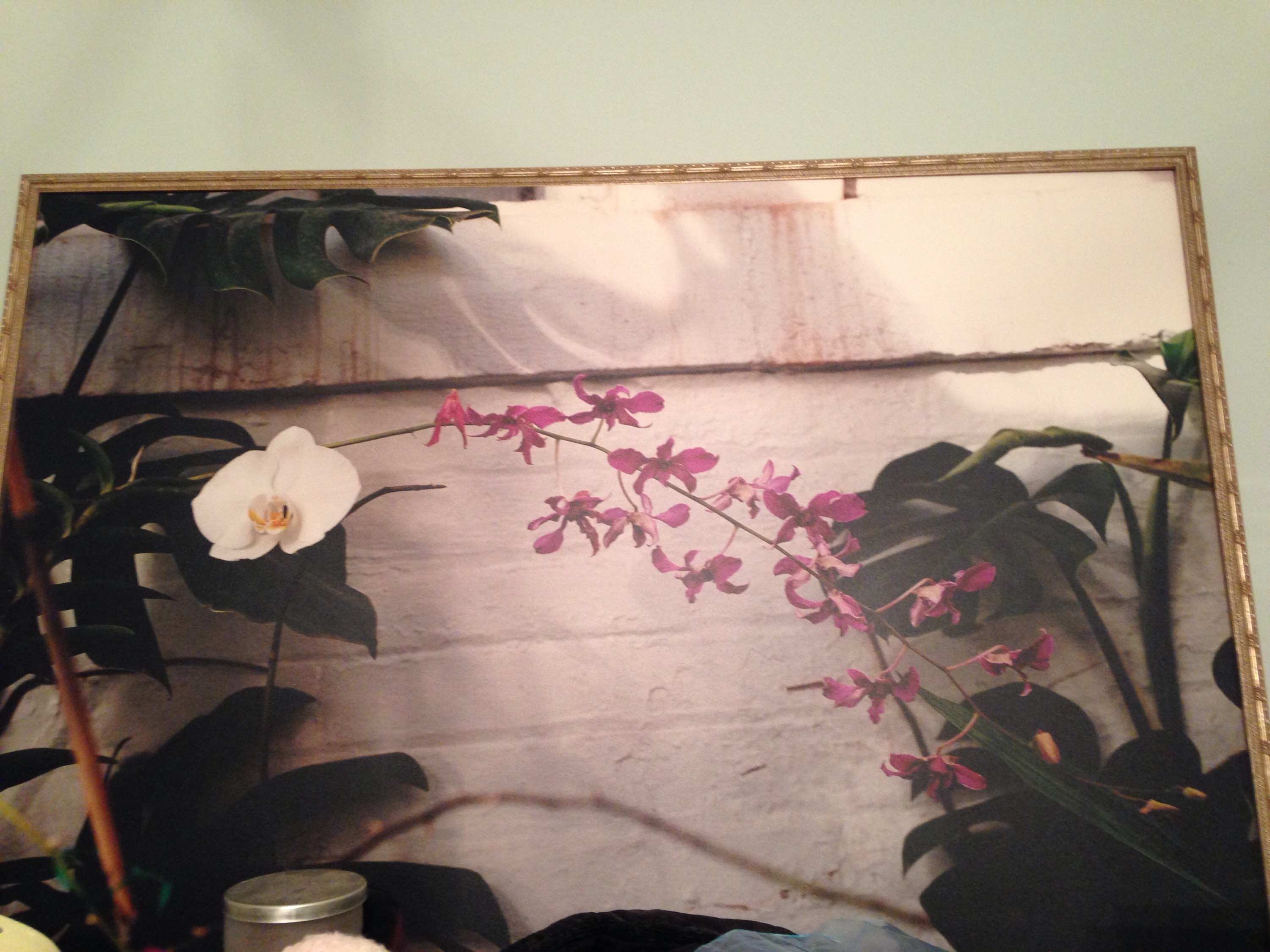
I took this photograph in the Buffalo and Erie County Botanical Gardens. Used to hang in my bedroom in my house in Buffalo NY. 
Eternity by Calvin Klein. My perfume that I wore on my wedding day. It had just come out that year and I’d ordered it directly from Calvin Klein and then I remember waiting very impatiently for it to arrive, and then being really happy when it did arrive. It smelled like tea roses, cloves, and sweet, like cotton candy. Still have the original bottle. I don’t know why I didn’t wear it too much. Now, of course the fragrance molecules are degraded, so it can not be worn. But I still have the bottle. 
This is my mother’s little silk pouch for fennel seeds and betel nut, both of which Indian and Pakistani ladies chew to sweeten their breath. This one still has fennel seeds and cut up pieces of betel nut in it, my mother gave it to me before I moved to Istanbul. I still have the pouch.
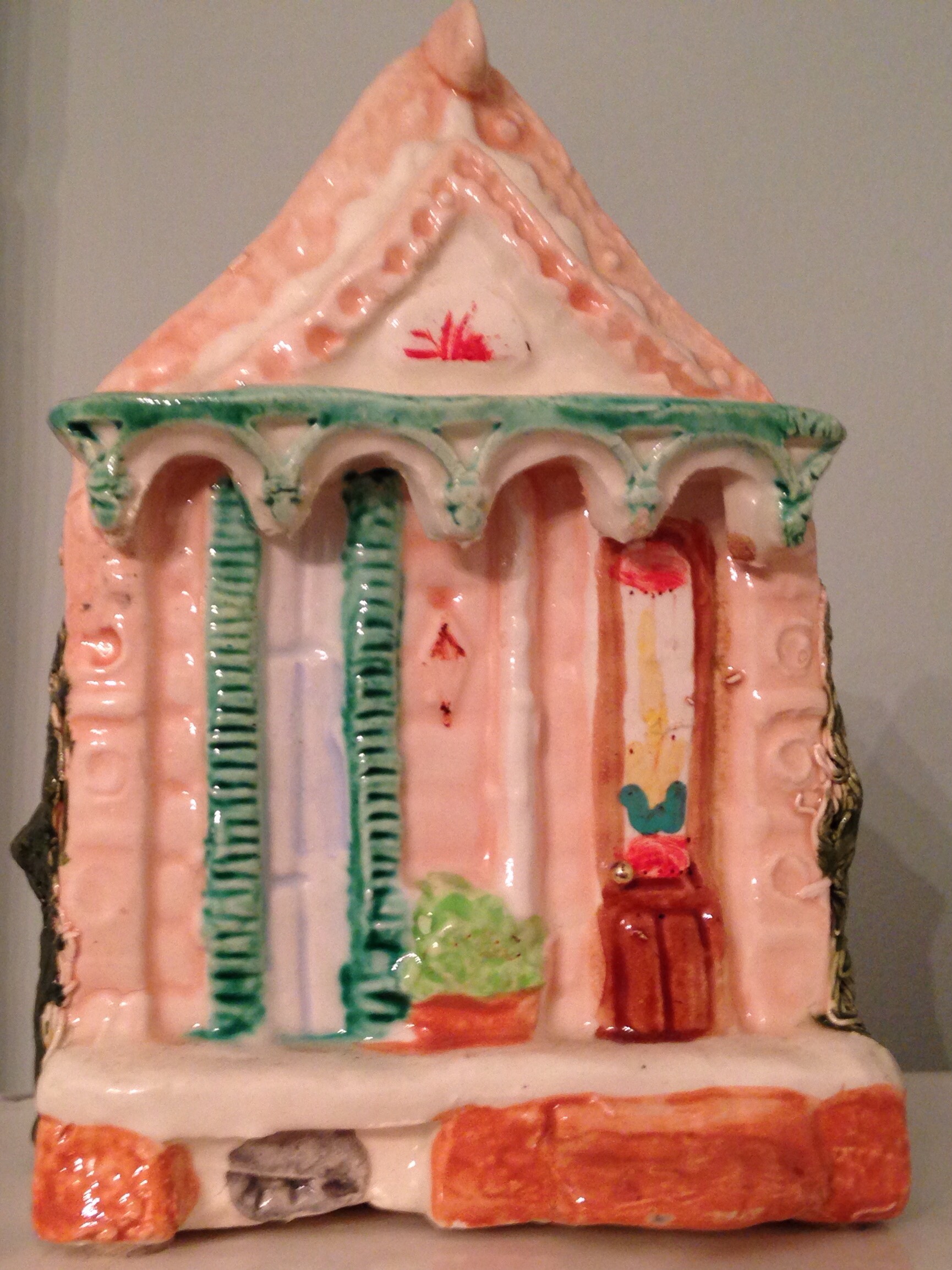
This is a little ceramic house I bought in New Orleans in 1986, at an Arts Fair. They had some with little ferns hanging in the front of the house, but those had all been sold, so I bought this one. It’s pretty, and peach used to be my favorite color at that time.
This is the Mona Lisa I bought at the Louvre in Paris in 1977. I was 17, and life was an enchanting adventure. Actually, I think it still is, in many ways. Now they know this is Lisa Gherardini also known as Lisa del Giacondo, therefore the name La Giaconde for the painting.
This is a little craft project my son did in kindergarten, it’s a burr, on it he painted a cute little face, and used pumpkin seeds for ears. It’s about 1/2 an inch in size and looks like an adorable little hedgehog! 
This is little Puffin’s fur. She is gone, but I still think of her and love her.
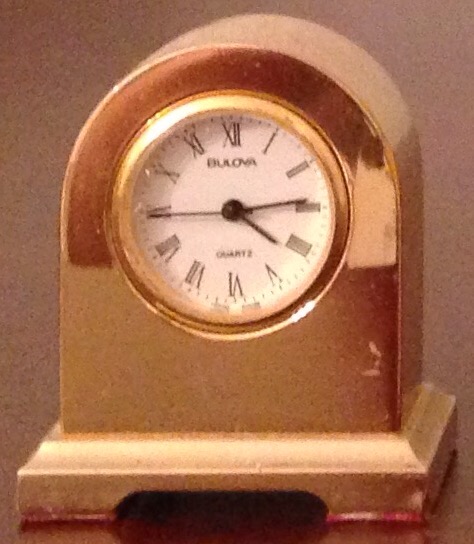
This is my mom’s little Bulova clock. She loved miniature things, and this one is about 1.5 inches tall and still works.
All is well
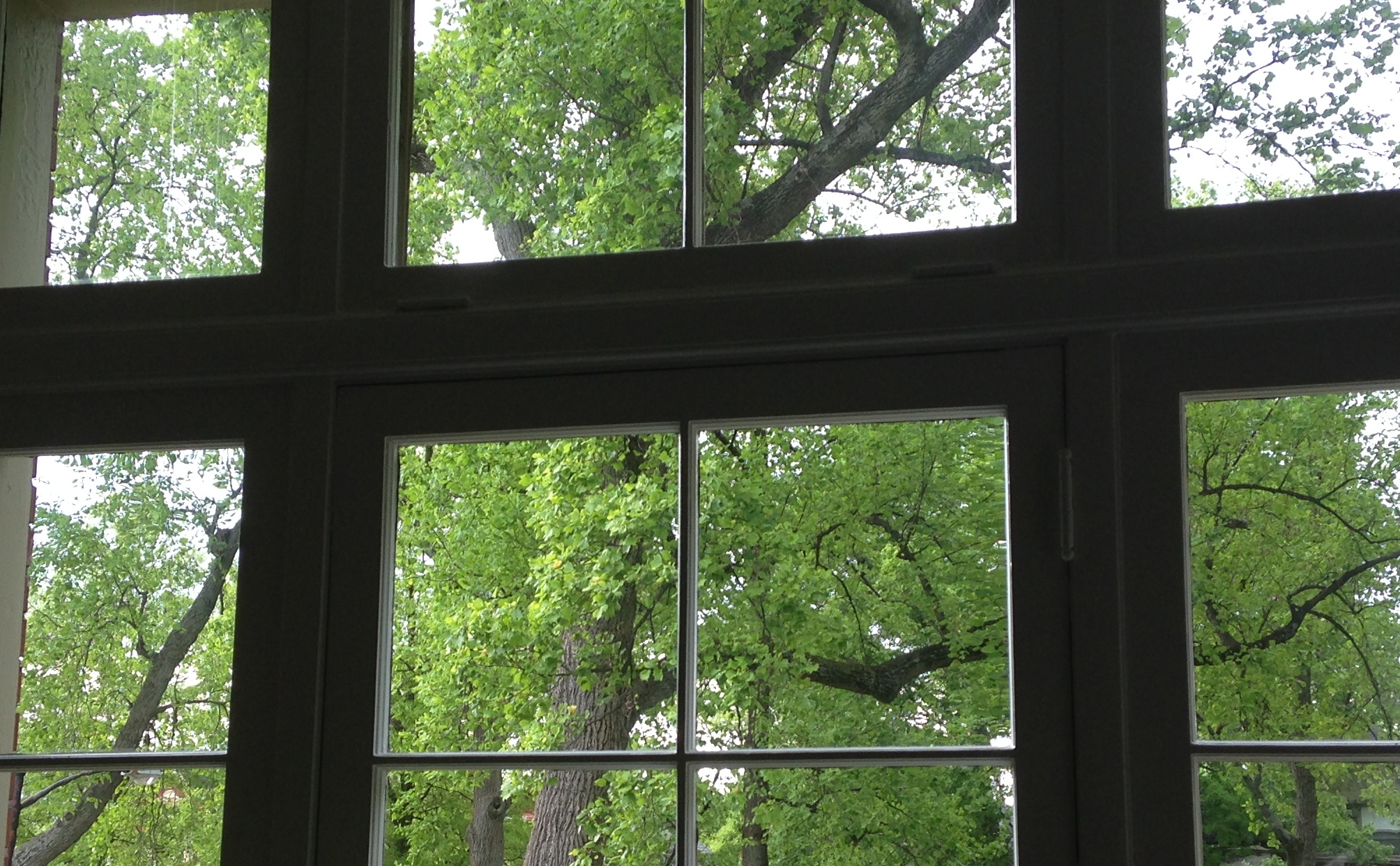
Sitting in my dining room, looking out of the picture windows. Everything is emerald green. I feel like I am sitting inside of a tropical rainforest. The verdant green, somehow so soothing and relaxing. So fresh, so young, so restful for my eyes. Today is a good day, a relaxed day, a “normal me” day. I’m always writing about all my anxiety, and bad feelings, so I really wanted to share today, a blissfully normal, calm, peaceful day. How many more of these are in store? Don’t know. In fact, today, I don’t care. I’ll just take this day and enjoy it. I have done nothing monumental or earth shattering, I have just sat here and enjoyed the view from my window, I have done laundry (haha) I have made lunch for myself, keeping in ming all my food allergies, I have fed my kitty Fluffin and given her her medicine. I’ve played Scrabble online, It isn’t important what I’ve done. What is important is that I have done it feeling calm, peaceful, and normal. Is there a lesson in this? Yes! It doesn’t matter what you do, it matters how you do it, that is to say in what state of mind you do it! Oh I really do hope this mood stays around for a while. I am going to do all in my power to make it stay. I really like it when I can smile, for no reason, just smile 🙂 And feel strong, and in control of my moods. Did this happen because of the meds? Because of the season? Because of some amazing insight I had? Maybe al little of all of the above. The perfect concoction, prescription, potion of all the ingredients, with a pinch of exercise thrown in. Yaaay! Today is my favorite day in all the days that have recently passed. Now I am getting ready for a cocktail party, and later going to Salsa dancing with my friend Cata! Bye, gtg and get ready! Love and hugs for you all.
Dismal
The Department of Justice estimates that about 15 percent of state prisoners now “report symptoms that met the criteria for a psychotic disorder.”
http://www.vox.com/2015/4/29/8515489/clinton-mental-health-prisons
“Our prisons and our jails are now our mental health institutions,” Democratic presidential contender Hillary Clinton declared in a Wednesday speech on criminal justice reform.
Data on the incarceration of mentally ill Americans bears out Clinton’s point. In the past 50 years, there’s been a marked shift of mental health patients away from state-run institutions and to jails and prisons.
One recent report found that America’s jails and prisons now house 10 times as many mental health patients as state institutions.
This shift, as Clinton noted in her remarks, began with good intentions. In the 1960s and 1970s, mental health practitioners began to move patients out of long-stay psychiatric facilities — the type that came to be associated with abuse and neglect — and into more community-based treatment centers.
“You and I know that the promise of de-institutionalizing those in mental health facilities was supposed to be followed by the creation of community-based treatment centers,” Clinton said in her remarks. “Well, we got half of that equation — but not the other half.”
As the number of hospital beds at state psychiatric hospitals has shrunk, advocates have become concerned that patients lack access to adequate treatment, and that the prison and jail system has become a stand-in for the psychiatric hospitals that are disappearing.
“Looking back, it is possible to see the mistakes, and a primary problem was that mental health policy makers overlooked the difficulty of finding resources to meet the needs of a marginalized group of people living in scattered sites in the community,” Chris Koyanagi of the Bazelon Center for Mental Health concluded in his 2007 history of de-institutionalization.
The Department of Justice estimates that about 15 percent of state prisoners now “report symptoms that met the criteria for a psychotic disorder.” Inmates with mental health problems are more likely to be charged with violating the facility’s rules, with either physical fighting or verbal assaults. They are also more likely to have a history of substance abuse, be victims of physical or sexual abuse, and to have experienced homelessness in the year before their arrest.
Advocacy groups say prisons and jails are ill-equipped to provide mental health patients with the treatment they need. Inmates with serious mental health problems tend to have worse outcomes while incarcerated. Advocates cite previous studies showing that those with serious mental illness are disproportionately held in solitary confinement and frequently attempt suicide.
Here’s the thing about suicide
I just read an article in the Washington Post about a young woman named Natalie Fuller, her suicide (see below.) That’s what brought on this discussion, on this sad and awful subject. But as long as I am writing about it, I may as well do a sincere and truthful job, difficult to read and write, but truthful. Here’s the thing about suicide, mentally ill people, who commit suicide are not well. They do it because of the illness. If they were their well selves, they would never do it. Either they are totally out of touch with reality and are having auditory, or visual, or some sort of hallucinations, so the voices tell them to do something and they listen. Or they are in so much pain, as happens in a depression, that they just want to stop the pain. Again, it is mental illness that makes them do it. I have been in a depression so severe that I seriously thought about and even planned my suicide. I couldn’t stand the pain and I couldn’t stand to live without myself, because the depression had swallowed me up whole and I was gone. My personality was gone, I was gone. This blank, hopeless, scared, shadow of a person, this was not the real me. It was not the Me who is typing this post. It was my mental illness, it was my illness, it was illness. If I had died by my own hands, it wouldn’t really have been so. Just like someone dies of cancer, I would have died of a possibly terminal illness named bipolar d/o.
It takes a lot, a lot, a lot of strength to live with mental illness. For me, I have to do it because I have a son, a niece, a nephew, a brother and a sister. I won’t put them through the trauma we went through after my brother. I will absolutely not! I so wish Natalie Fuller could have been saved.
Here’s the The Washington Post article, it’s called “My daughter, who lost her battle with mental illness, is still the bravest person I know” (link below.) It’s about a young woman, who shortly before her 29th birthday, stepped in front of a train in Baltimore. Her mother wrote the article. Natalie Fuller, this bright young woman went into a psychotic phase at age 22, in her sophomore year in college. As is typical, her mental illness symptoms had been developing, probably at least a year before she was diagnosed. She went into a psychotic phase (out of touch with reality), she started hearing voices that told her to do things, like trespass on her neighbors’ property. She was arrested for this, which is also pretty typical. Finally, she was diagnosed with severe bipolar d/o, in a severe manic phase. She was hospitalized for 2 months, given medication until she was symptom free, and then released. She came home just like her normal, effervescent, energetic, bright self, stayed with her mother, cooked, made art work. She went back to college, to start her senior year. And then… she abruptly stopped taking her medication and fell ill again. She again had to be hospitalized, this time for 8 months! Again she was put on medication, and came home in a normal state, although, according to her mother, more subdued, less like herself. The illness had taken its toll on her. (This is usually not the case with bipolar d/o, recovery is pretty complete, no lasting effects as long as you stay on the meds. Of course, there are medication side effects that can cause fatigue and weakness.) She went through this cycle many times. Even if she missed her meds for a few days, the voices would come back, and the voices invariably told her to stop the meds totally. The final time she went into this cycle, she was convinced that she was 1/4 people for whom drugs did not work. She made the decision to stop taking the meds altogether. And a few months later, she stepped in front of a train.
This is all so familiar. My brother. My brother. He had been showing symptoms for, most likely, a year and a half before he had his psychotic break (break with reality.) He heard voices. We had to call the police to get him hospitalized. They gave him meds in the hospital that returned him to his normal state of being, as right as rain. He was convinced he didn’t need the meds, although he did, desperately need them, he was convinced that he could control his own brain. No one could convince him otherwise. He would throw all his meds in the trash dumpster outside the hospital the day he was released. This cycle repeated itself five or six times. Each time, he would be hospitalized, put on lithium and other meds, each time he became absolutely normal, each time, upon release, he would throw out his meds. Until finally, his wife left him, taking the children, I know the last morning he was alive, he called his wife at 7 am and asked to speak to the kids, she told him he could not, they were asleep. At 8 am he left… and he was gone. We never saw him again. My sweet, movie star handsome, very intelligent, kind, loving, sensitive, adorable and adored brother. I don’t know if the voices told him to stop taking his meds, but he lost his battle with this infernal disease. I wish I’d never heard of bipolar d/o, I wish I didn’t know anything about it, I wish my brother was still here, I wish I hadn’t spent half my life battling this illness. No one really wins against it. You cope, you fight, you live. The more severe the form, the more severe the loss. It is not a blessing in any way, as some deluded people seem to think so. It is loss. Sorry, it’s very hard not be negative and sad after talking about my baby brother. Mostly, I am fine though. And as long as people stay on their meds, they will be, more or less, fine as well.
But here are some statistics that may help if you or your loved one is newly diagnosed:
- Typically people have symptoms for 70 weeks before they are diagnosed with a psychotic mental illness.
- Often people are arrested and put in jail in psychotic phases.
- Often people start exhibiting symptoms (http://www.mayoclinic.org/diseases-conditions/bipolar-disorder/basics/symptoms/con-20027544) in their late teens or early twenties.
- Many newly mentally ill people maintain that they “are fine, everybody else is crazy.”
- Mentally ill people also come off their meds, and of course they get sick again. Perhaps it’s because they miss the high of mania… (my manias are not high, but very anxious, in a way this is lucky, because I don’t miss the anxiety when I am not manic.)
- And if they stop their meds, if we stop our meds, the outcome can be devastating.
Please Beware! Belle Gibson, Australian Wellness Blogger, Lied About Cancer Diagnosis
This woman, Belle Gibson, claimed that she cured her “malignant brain cancer” with only eating whole foods and holistic medicine. She claims she never used any allopathic medicines or chemotherapy. And she developed a bestselling app called “The Whole Pantry”, which apparently is still available on Apple itunes. She also wrote a book, also named “The Whole Pantry.” The book has been pulled by the publisher, it’s been taken off shelves. She has been accused of fabricating the whole thing. What’s really bad is that she has about 200,000 social media followers, and 😦 some of her followers have been refusing meds and chemo for their cancer treatment, opting for nutritional therapy, as she claims she has done. If you or anyone you know is being influenced by this fraudulent woman, please beware! Link for article and part of the article below.
http://www.huffingtonpost.ca/2015/04/22/belle-gibson-cancer-lie-wellness-blogger_n_7120796.html
Belle Gibson said she cured her brain cancer with natural therapies and healthy foods.
But she never had cancer at all, an investigation from Australian Women’s Weekly revealed.
The 23-year-old Australian wellness writer became famous in 2013, when she said on social media that she had treated her malignant brain cancer using whole foods and holistic medicine for four years, after being given only months to live.
She also claimed she had seizures, a stroke, and cancer in her liver, kidneys and spleen, The Herald Sun reported.
Gibson developed a bestselling app, “The Whole Pantry,” pitched as the “world’s first” to focus on health, wellness and lifestyle, in 2013, and built a social media following more than 200,000 users strong.
She also wrote a book by the same name, in which she recounted her alleged cancer diagnosis and how she left chemotherapy with the aim to “heal myself naturally,” The Independent reported.
Elle Australia called her “The Most Inspiring Woman You’ve Met This Year” in its December 2014 issue.
But questions arose about her claims when The Australian newspaper talked to specialists who said the only brain tumour that could kill a patient was a Grade 4 glioblastoma.
They found no evidence of anyone surviving with such a tumour without treatment for five years.
In an interview with Australian breakfast show Sunrise last year, host Samantha Armytage remarked that she looked “incredibly healthy.”
Why Do So Many Women Have Anxiety Disorders? A Hormone Hypothesis (NPR.com)
Hmmm, why do so many women suffer from anxiety? Is there a hormone connection? This researcher found that when women were in a menstrual phase in which their estrogen levels were high, their “fear extinction capacity” was much better, in other words “they were able to control their fear, or express much less fear, compared to the women that came in in the early phase of their cycle… when they had low estrogen.”
Since men have very low estrogen levels, why aren’t they really anxious? Because testosterone is converted to estrogen in the brains of mean by am enzyme!
Gosh, I have Premarin sitting in my cabinet, my psychiatrist prescribed it saying that low estrogen levels cause anxiety. I have not taken a single pill because the last time I used a hormone replacement therapy patch, it actually gave me panic attacks 😦 But the hormone replacement patch has progesterone and other components in it. Therefore the panic attacks may have been from the combination or from one of the other hormones.
Hormones are one of the fundamental substances in human development. Most importantly they are involved in the development of secondary sexual characteristics such as genitals, and body development. They are also involved in the development of the male and female reproductive systems. They are surely involved in trans gender individuals’ development. Therefore, they are of primal importance.
As in seen in PMS, PMDD, postpartum depression and mood and anxiety level changes after menopause, hormones are intimately associated with mood.
Sex hormones affect mood. Thyroid hormones affect mood. Mood disorders affect moods. Neurotransmitters affect moods and are affected by mood disorders as well. Complicated? Ummm Yes! Women, are we Effed? Umm yes!
Maybe I’ll try the Premarin one of these days. Just don’t want anything bad to happen, moodwise…