Palestine WILL Be Free

Another link between inflammation and mental illness! “Could a runny nose make you depressed? Hay fever sufferers may be four times more likely to develop the mental illness.”

I have horrible seasonal allergies, I have food sensitivities, I have manic depression, aka bipolar disorder. My grandmother had rheumatoid arthritis, my mother had RA and elements of lupus. My brother had bad seasonal allergies. A case study in inflammation, immune and autoimmune responses and mental illnesses in the same individuals!  And here is yet another link between inflammation and mental illness! Hay fever sufferers may be much more likely to develop depression. Hay fever peaks during spring, the rates of suicide also peak in Springtime all over the world. There may be a simple cure for allergies, as simple as Ibuprofen, a non steroidal anti inflammatory (NSAID). Hope scientists     figure out the link between inflammation and mental illness, it could save many, many lives.

Could a runny nose make you depressed? Hay fever sufferers may be four times more likely to develop the mental illness.

http://www.dailymail.co.uk/health/article-3321143/Could-runny-nose-make-depressed-Hay-fever-sufferers-four-times-likely-develop-mental-illness.html

Hay fever sufferers may be four times more likely to develop severe depression, according to new research. But it’s not just a runny nose and itchy eyes that triggers mood slumps.

Scientists think inflammation in blood vessels and tissues throughout the body caused by an allergic reaction to pollen has a long-lasting harmful effect on the brain.

This inflammatory response – the cause of typical allergy symptoms, such as sneezing – is the body’s way of trying to get rid of an allergy trigger, such as pollen. But there is a growing body of evidence that sustained exposure to low-level inflammation for several months, such as during the hay fever season, could have serious psychiatric effects later in life. However, treatment such as simple ibuprofen could help.

Around ten million people a year in Britain suffer during the hay fever season, which peaks during the late spring and summer. Researchers are investigating whether inflammation can trigger depression, bipolar disorder and schizophrenia.

In the latest study, scientists at the National Yang-Ming University of Taiwan looked at nearly 10,000 teenagers with hay fever and 30,000 without it.

They monitored both groups for almost a decade and recorded how many went on to be diagnosed with bipolar disorder – a condition characterised by periods of mania (when people appear over-excited and have an inability to concentrate or sleep) followed by deep depression. The results, in the Journal of Psychosomatic Research, showed that adolescents with hay fever were four times more likely to be diagnosed as bipolar as adults.

An earlier Danish study, in 2010, discovered people with allergies such as hay fever had a 30 per cent higher risk of suicide than those who were allergy-free.

Researchers from Aarhus University came up with the findings after comparing allergy rates among suicide victims with those of a group of healthy people.

But how could something as innocuous as a runny nose be linked to mental illness?

Scientists are not completely sure, but it’s already known that during any allergic reaction, the brain churns out substances called pro-inflammatory cytokines.

These are proteins that then trigger inflammation and the release of chemicals in the blood in a bid to flush out foreign ‘invaders’, such as pollen. Inflammation develops in order to alert the immune system that the body is under attack. Normally, it subsides once the threat has been eliminated and the inflamed tissue heals. But problems develop when the inflammation does not dampen down.

More recent research also suggests cytokines can cause a dip in the brain’s levels of serotonin, the so-called happiness chemical, low levels of which can lead to depression.

This could be a vital clue to why allergy-induced inflammation leads to psychiatric illness.

Now, researchers are investigating whether anti-inflammatory drugs, such as ibuprofen, could treat depression.

Earlier this year, King’s College London began the largest ever investigation into inflammation in depressed patients by scanning their brains.

In the past, inflammatory markers have been found in the blood of depressed patients, but this does not prove that inflammation is also present in the brain, which is what is thought could cause depressive symptoms.

The scientists will now test if anti-inflammatory drugs can help patients who have not responded to antidepressants by improving levels of serotonin.

Dr Valeria Mondelli, one of the researchers, said that because inflammation is a natural response, up to a certain level it can protect the brain against infection. ‘But if it is chronic, then it appears to start to damage brain cells,’ she says.

Here’s a link to a video that talks about Immunotherapy to treat allergies: http://www.dailymail.co.uk/health/article-3321143/Could-runny-nose-make-depressed-Hay-fever-sufferers-four-times-likely-develop-mental-illness.html#v-3789507278001

Read more: http://www.dailymail.co.uk/health/article-3321143/Could-runny-nose-make-depressed-Hay-fever-sufferers-four-times-likely-develop-mental-illness.html#ixzz3sHb4yitQ
Follow us: @MailOnline on Twitter | DailyMail on Facebook


25 Things Only Someone with Bipolar Disorder Would Understand

This is from Healthline.com, they actually asked me for my feedback, which I gave them. It is funny, and it takes away the catastrophizing that we intensely emotional people who have bipolar d/o do. It was a much needed reminder for me that everything isn’t always awful. It was a reminder for me to stop taking everything so seriously and take it easy! That really things are fine, only my intensely emotional brain tells me they are not. This was a very welcome reminder to laugh and have fun. There’s a novel concept. Fun! No, it really isn’t, I am a lot of fun normally, just wish that was all the time. Anyway, everyone can enjoy these cartoons and jokes, especially we who have BPD. The fun side to mental illness, that might be the real novel concept, haha. And humor really is the best medicine! And I’m still laughing at #4!!!

http://www.healthline.com/health/bipolar-disorder/would-understand#1

25 Things Only Someone with Bipolar Disorder Would Understand

 Learn to laugh along with your condition.

1. You can tell when you had a manic episode by looking at your credit card bill.

credit card bill

2. Even though you live on your own, it often feels like you’re waking up with a stranger.

waking up with stranger

3. You have so many racing thoughts you should be a NASCAR analyst.

nascar analyst

4. You don’t suffer from a sense of superiority – you’re remarkably modest for an emperor of all humanity.

emperor of all humanity

5. You just realized people can drink beer for fun, not because they’re self-medicating.

drink beer for fun

6. Every morning you wake up thinking, “today is going to be a great day. Just not for me.”

mornings

7. Family members have mistaken you for the Incredible Hulk.

incredible hulk

8. If someone is described to you as “moody” you think to yourself: amateur.

amateur

9. You eat fear for breakfast.

fear for breakfast

10. You don’t know the meaning of “psychosomatic,” because you can’t concentrate on reading a word that long.

psychosomatic

11. Your cat would describe you as the aloof and needy one.

aloof and needy

12. Your psychiatrist spends so much time balancing your moods she now has a side job as a professional juggler.

psychiatrist professional mood juggler

13. You remember when Prozac was cool.

prozac

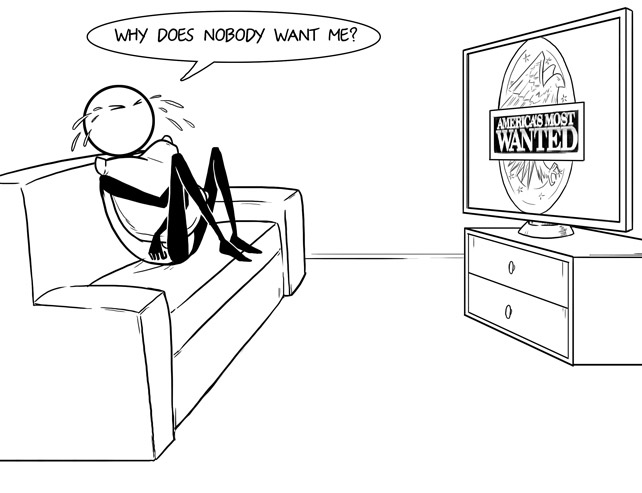
14. When you’re down you watch “America’s Most Wanted” and cry out: “Why does nobody want me?”

americas most wanted

15. Your depressive spells make you forgetful, which is a shame because if you thought about your manic stages it might cheer you up.

depressive spells

16. You wonder how someone who feels so empty can put on so much weight.

weight gain

17. When you’re manic, nothing makes you angrier than someone suggesting you’re irritable.

irritable

18. Manic episodes give you a heightened sex drive, which makes it unfortunate you can’t maintain any relationships.

heightened sex drive

19. You can’t sleep at nights, which would be OK if you had more insomniacs for friends.

insomniac friends

20. Your depressed self probably wouldn’t be so depressed if your manic self didn’t make so many commitments for it to keep.

depressed vs manic self

21. If you could cycle as quickly as your moods, you’d be the next Lance Armstrong.

lance armstrong mood swings

22. You meet the same person at two different parties and have to convince them you’re not your pain-in-the-ass twin brother.

good vs evil twin

23. Friends say you’re the life and soul of the party, but you avoid parties like the plague.

parties

24. You’ve cried on the pizza delivery guy’s shoulder.

pizza delivery guy

25. You’ve been told the warranty on your car does not cover existential crisis.

existential crisis

Bipolar Disorder Treatment: Brain Cells May Reveal Why Lithium Doesn’t Work For Everyone

There it is in a nutshell, folks: “Neurons are normally activated by a stimuli and respond. The cells we have from all six (bipolar) patients are much more sensitive in that you don’t need to activate them very strongly to see a response.”

Researchers took skin cells from 6 people with bipolar d/o. They made them turn into stem cells, which then differentiated into neurons. When they activated these neurons, they saw that neurons from people with bipolar d/o didn’t need a very strong stimulus to become activated. So our neurons can be activated by very weak stimuli. In other words we react much more strongly to things than people who don’t have bipolar d/o! Hunh! I think I already knew that! I do it all the time. I have extreme reactions to small stimuli! And now here is the reason, in black and white, our neurons fire at stimuli that wouldn’t make the neurons of people without bipolar d/o.

“Mitochondria — the energy producing powerhouse of the cell — were more active in the bipolar neurons.” This means that bipolar neurons also produce more, therefore have more energy.

“Cells from the patients who responded to lithium showed weakened excitability after growing in the lithium bath, while cells from patients who hadn’t been helped by the drug remained hyperexcitable. The findings didn’t explain why exactly lithium works in certain patients but not others, but it provided a great starting point for probing at what those differences are.”

So cells from people who respond to lithium show weakened excitability in response to lithium, whereas cells of people who don’t respond to lithium keep being hyperexcitable. Again a difference at the cellular level.

This is so amazing, because now for lithium resistant patients, they can test other medications to see which will decrease the hyperexcitability.

http://www.medicaldaily.com/bipolar-disorder-treatment-brain-cells-may-reveal-why-lithium-doesnt-work-everyone-359316

In one of the first studies to show how bipolar disorder affects the brain at a cellular level, researchers have discovered that the brains of people with the disorder are more sensitive to stimuli than those in people without it.

The findings, published in the journal Nature, also suggested the reason why some bipolar patients respond to treatment with lithium while others do not. “Researchers hadn’t all agreed that there was a cellular cause to bipolar disorder,” said Rusty Gage, a professor in Salk’s Laboratory of Genetics and senior author of the study, in a press release. “So our study is important validation that the cells of these patients really are different.”

Bipolar disorder, which affects over five million Americans, is characterized by severe mood swings between depression and elation. The disorder can be challenging to treat because when lithium doesn’t improve the mood swings, mental health professionals must piece together a unique treatment plan with antipsychotic drugs, antidepressants, and mood stabilizers. Oftentimes, though, these treatments only affect one of the mood extremes, not both.

For the study, Gage and his team recruited six bipolar patients and collected skin cell samples. They reprogrammed the cell samples into stem cells, then coaxed the stem cells into becoming neurons. These induced bipolar neurons were then compared to the normal neurons of healthy people.

“Neurons are normally activated by a stimuli and respond,” said Jerome Mertens, a postdoctoral research fellow and first author of the new paper. “The cells we have from all six patients are much more sensitive in that you don’t need to activate them very strongly to see a response.”

Mertens also noted that the mitochondria — the energy producing powerhouse of the cell — were more active in the bipolar neurons.

Three of the bipolar patients’ cells responded to lithium treatment, while the three others’ did not. The scientists tested how the cells reacted to growing in a liquid with lithium, and then remeasured how sensitive they were. Though all of the bipolar patients’ neurons had been more sensitive than healthy ones in the first test, this test showed they behaved differently after lithium exposure.

Cells from the patients who responded to lithium showed weakened excitability after growing in the lithium bath, while cells from patients who hadn’t been helped by the drug remained hyperexcitable. The findings didn’t explain why exactly lithium works in certain patients but not others, but it provided a great starting point for probing at what those differences are.

“Now that we have neurons that show differences in excitability, we can use them to screen for better drugs,” Mertens said.

For example, a new drug that reverses the hyperexcitability at a cellular level would likely be able to treat bipolar disorder in patients. The team plans to study the affected cells for longer periods to determine whether the hyperexcitability it measured is simply an initial manic phase or more long-lasting.

“After a few months, it’s possible that this hyperexcitability becomes too much for the cell to handle and it crashes into a less excitable state,” Gage said. “That could signal the shift between the depression and mania that patients experience.”

Source: Gage R, Mertens J, Yongsung K, Yu D, Pham S, Diffenderfer K, et al. Bipolar patients’ brain cells predict response to lithium. Nature. 2015.

I’m trying!

IMG_9029 IMG_9029

I have been stuck in the past forever, going over things that happened years ago, in fact I just posted a post about why I didn’t finish my PhD, and the comment left on that post by my good friend Barb led me to write this post.

Her comment: “My friend…..this is my new ideology…..maybe it will help you.
NO REGRETS!
I USE to feel guilty about EVERYTHING and repeat these scenes in my head over and over….now NO REGRETS…we are here right now on this planet to learn and become better humans….so if we did everything perfectly there would be nothing for us to learn…..therefore…NO REGRETS!”

She is so right. Regrets and rumination, they will keep you stuck in the past, and keep you in a depressed mood, they may not put you in a depression but they will definitely exacerbate it. The past is over, get over it! Can’t change it, have to move forward from here on out. No point in second guessing it, you can’t go back there and change anything.

Actually I have not been feeling well since I came back from Philadelphia. It was such a positive experience, my heart soared, and what goes up must come down… at least that is what happens if you have bipolar disorder. Sigh…

So not only do regrets keep you depressed, but they are the direct result of having gone into a depressive phase. So there, I admitted it, I have been in a depressed phase for the last few days. And it feels awful. I am tired, don’t want to do anything or go anywhere.

How do I pull myself out? Well, I’m having a Halloween party and the house isn’t going to decorate itself. Also heeding Barb’s advice will help, actually I think just reading her words made my brain produce some much needed neurotransmitters, in other words reading her comment made me feel better. That’s how simple it is. We get by with a little help from our friends!

No regrets! Onwards and upwards! I’m trying!

My talk in Philadelphia (video)

I was invited to give a talk about my story of bipolar d/o and my experience with medications for bipolar d/o. The invitation was extended by Healthline.com and the talk was for Astra Zeneca drug reps and ad reps. This is a video of this talk, I made it with my iPhone. The talk was given on October 22nd, 2015, in Philadelphia. My talk was really well received 🙂 There were also two other bloggers, Jon Pressman and Julie Fast, who gave talks as well. After our talks, we had a question and answer period, where the Astra Zeneca people asked us many questions about the illness and treatment and what patients needed from them. It was a singular experience, drug companies don’t usually talk to people who suffer from illnesses for which they make medications! Even more singular for them to speak to people who have a mental illness. I commend them, and really thank Healthline.com for putting this together and allowing the drug companies and we, people who suffer from bipolar d/o, to convene and discuss issues that are important to us as patients, and to voice our opinions about what drug companies need to do to ensure better health for us. We, with all our experience and insight into this terrible illness, were given the opportunity to speak to a large pharmaceutical company such as Astra Zeneca, and they listened! And we were taken seriously! Phenomenal!

I fell in love with Philadelphia, it is such a beautiful city! I’ll post pictures I took there in another post.

Amazng! Reconstruction and Simulation of Neocortical Microcircuitry (digitally building a slice of a rat neocortex)

FIGURE 1 Reconstruction Workflow v1

Digitally reconstructing a slice (just a slice) of the rat neocortex allowed these scientists to study many slices of neocortex (using supercomputers) under different conditions such as sleep and when the brain is under stress! Then they saw that changing just one parameter, such as Ca++ ion concentration, can change the state of the brain. Then they theorized what if, in illness, the brain is stuck is the “wrong” mode! For example, when the fight or flight response is initiated through adrenocorticotrophic hormone, how do tunnel vision and aggression occur as a result of that? This is AMAZING! And this could be a valuable, valuable tool in studying mental illness. Imagine if they took a slice of my brain and reconstructed it digitally, then even a comparison to someone’s brain who doesn’t have bipolar d/o (BPD) would be enormously valuable. Also studying how my neurons fire, what are the ionic levels, how do these differ than “normal” neurons? How can we treat my neurons to better resemble normal neurons? This is an AMAZING technology that has been developed! Please, someone, start studying BPD with this and who knows, a cure may be imminent! I know people say “the sky’s the limit” all the time, but in this case, the sky really is the limit, in fact beyond the sky is the limit! Genius work, hope it affords us some tangible help and treatment options, and soon!

Summary: Scientists digitally reconstructed a slice of juvenile rat brain. This digital slice has over 31,000 neurons, 55 layers of cells and 207 different neuron subtypes. They have discovered nearly 40 million synapses and over 2,000 connections between each brain cell type. Wow!

The scientists then used super computers to see how these virtual brain slices work during sleep or when under stress!  The principal scientist, Henry Markram said “It paves the way for predicting the location, numbers, and even the amount of ion currents flowing through all 40 million synapses.”

Once the reconstruction was complete, the investigators used powerful supercomputers to simulate the behavior of neurons under different conditions. Remarkably, the researchers found that, by slightly adjusting just one parameter, the level of calcium ions, they could produce broader patterns of circuit-level activity that could not be predicted based on features of the individual neurons. For instance, slow synchronous waves of neuronal activity, which have been observed in the brain during sleep, were triggered in their simulations, suggesting that neural circuits may be able to switch into different “states” that could underlie important behaviors.

“An analogy would be a computer processer that can reconfigure to focus on certain tasks,” Markram says. “The experiments suggest the existence of a spectrum of states, so this raises new types of questions, such as ‘what if you’re stuck in the wrong state?'” For instance, Markram suggests that the findings may open up new avenues for explaining how initiating the fight-or-flight response through the adrenocorticotropic hormone yields tunnel vision and aggression.

Article reference and part of article below: http://www.cell.com/cell/abstract/S0092-8674(15)01191-5?_returnURL=http%3A%2F%2Flinkinghub.elsevier.com%2Fretrieve%2Fpii%2FS0092867415011915%3Fshowall%3Dtrue

Reconstruction and Simulation of Neocortical Microcircuitry Introduction

Since Santiago Ramón y Cajal’s seminal work on the neocortex (DeFelipe and Jones, 1988, Ramón y Cajal, 1909, 1911), a vast number of studies have attempted to unravel its multiple levels of anatomical organization (types of neurons, synaptic connections, layering, afferent and efferent projections within and between neocortical regions, etc.) and functional properties (neuronal response characteristics, synaptic responses and plasticity, receptive fields, functional neocortical columns, emergent activity maps, interactions between neocortical regions, etc.). However, there are still large gaps in our knowledge, especially concerning the anatomical and physiological organization of the neocortex at the cellular and synaptic levels.

Specifically, while neurons have been classified in terms of their electrophysiological behaviors (Connors and Gutnick, 1990, Kasper et al., 1994,McCormick et al., 1985), expression of different calcium-binding proteins and neuropeptides (Celio, 1986, DeFelipe, 1993, Gonchar and Burkhalter, 1997,Kawaguchi and Kubota, 1997, Toledo-Rodriguez et al., 2005) and morphological features (Kisvárday et al., 1985, Larkman, 1991a, Tamás et al., 1998, Wang et al., 2002), there is still no consensus on an objective and comprehensive classification of neuron types. Although the distribution of protein and genetic markers for different neurons (Grange et al., 2014, Hendry et al., 1989,Kawaguchi and Kubota, 1997, Meyer et al., 2002, Toledo-Rodriguez et al., 2004) and the relative proportions of some morphologically and electrically classified neurons (Beaulieu and Colonnier, 1983, Cauli et al., 1997, Hendry et al., 1984,Meyer et al., 2010a, Rudy et al., 2011) have been described, we lack a comprehensive view of the number of each type of neuron in each layer. Since the advent of paired recording techniques, several studies have characterized the anatomical and physiological properties of synaptic connections between some types of neurons (Cobb et al., 1997, Feldmeyer et al., 1999, Frick et al., 2008,Gupta et al., 2000, Mason et al., 1991, Reyes et al., 1998, Thomson et al., 1993), but a large proportion have yet to be studied. Although labeling with retrograde and anterograde tracers and trans-synaptic viral vectors, imaging with array tomography, and saturated reconstruction with electron microscopy have made it possible to begin mapping pre- and postsynaptic neurons for individual neocortical neurons (Boyd and Matsubara, 1991, Callaway, 2008, Glenn et al., 1982, Kasthuri et al., 2015, Killackey et al., 1983, Micheva and Smith, 2007,Micheva et al., 2010, Wickersham et al., 2007), we know neither the numbers and types of the pre- and postsynaptic neurons associated with any specific neuron type nor the numbers and locations of the synapses that they form with their immediate neighbors.

At a functional level, there have been many investigations of emergent behavior in neocortical slices (Cunningham et al., 2004, Mao et al., 2001, McCormick et al., 2003, Sanchez-Vives and McCormick, 2000, Yuste et al., 1997), correlated activity (Hasenstaub et al., 2005, Livingstone, 1996, Salinas and Sejnowski, 2001, Shu et al., 2003, Silberberg et al., 2004, Singer, 1993), and the functional impact of individual neurons across cortical layers (Sakata and Harris, 2009,Schroeder and Foxe, 2002, Silva et al., 1991, Steriade et al., 1993), as well as in vivo activity in somatosensory and other cortical areas (Chen et al., 2015,Klausberger et al., 2003, Leinekugel et al., 2002, Luczak et al., 2007, Reyes-Puerta et al., 2015, Wilson et al., 2012), However, we still lack an understanding of the cellular and synaptic mechanisms and the role of the different layers in the simplest of behaviors, such as correlated and uncorrelated single-neuron activity and, more generally, synchronous and asynchronous population activity. For example, it is known that different types of neurons are connected through synapses with different dynamics and strengths, strategically positioned at different locations on the neurons’ dendrites, somata, and axons, but the functional significance of this organization remains unclear. Computational approaches that abstract away this level of biological detail have not been able to explain the functional significance of such intricate cellular and synaptic organization. Although future experimental research will undoubtedly advance our knowledge, it is debatable whether experimental mapping alone can provide enough data to answer these questions.

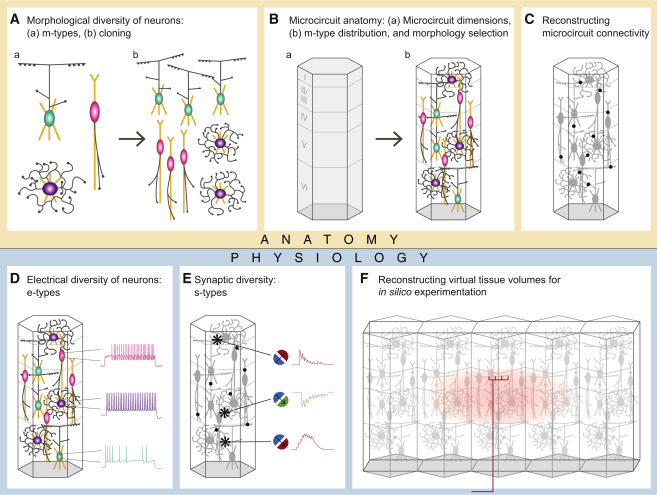
Here, we present a complementary algorithmic approach that reconstructs neuronal microcircuitry across all layers using available sparse data and that leverages biological principles and interdependencies between datasets to predict missing biological data. As a test case, we digitally reconstructed a small volume of tissue from layers 1 to 6 of the hind-limb somatosensory cortex of 2-week-old Wistar (Han) rat. This model system was chosen not only because it is one of the most comprehensively characterized in the neocortex, but also because experimental data on its cellular and synaptic organization are readily available and validation experiments are relatively easy to perform. In brief, we recorded and digitally reconstructed neurons from in vitro brain slices and classified the neurons in terms of well-established morphological types (m-types;Figure 1A), positioned the neurons in a digital volume of objectively defined dimensions according to experimentally based estimates of their layer specific densities (Figure 1B), and reconstructed the connectivity between the neurons (Figure 1C). Neurons were then classified into electrical types (e-types), using an extended version of the classification proposed in the Petilla convention (Ascoli et al., 2008), and models were produced that captured the characteristic electrical behavior of each type. (Figure 1D); similarly, synapses were modeled to capture the characteristic synaptic dynamics and kinetics of particular synapse types (s-types; Figure 1E). Finally, we constructed a virtual slice and reconstructed thalamic input using experimental data (Figure 1F; Meyer et al., 2010b).

This approach yielded a first-draft digital reconstruction of the microcircuitry, which was validated against a multitude of experimental datasets not used in the reconstruction. The results suggest that it is possible to obtain dense maps of neural microcircuitry without measuring every conceivable biological parameter and point to minimal datasets required, i.e., strategic data. Integrating complementary, albeit sparse, datasets also makes it possible to reconcile discrepancies in the literature, at least partially addressing the problem of data quality and reproducibility. Simulations exploring some of the emergent behaviors of the reconstructed microcircuitry reproduce a number of previous in vitro and in vivo findings and provide insights into the design and functioning of neocortical microcircuitry. The experimental data, the digital reconstruction, and the simulation results are available at the Neocortical Microcircuit Collaboration Portal (NMC Portal; https://bbp.epfl.ch/nmc-portal; see Ramaswamy et al., 2015).

Here we go again! The positives of having bipolar d/o? Zip, zilch, nada, NONE!

IMG_0478

People keep asking this idiotic question: What are the positives of having bipolar disorder? Seriously? One thing of which I am certain, no one with bipolar d/o would ask this question, I know this as surely as I sit here typing! How about asking a cancer patient who has been given a few months to live, and is puking their guts out from chemotherapy, how about asking them the positives of having cancer? Really? Bipolar d/o is an awful, very often terminal disease that takes over your life and tortures you! What exactly is positive about this? If people who have bipolar d/o are creative, they would still be so without this hellish illness. If people with bipolar d/o are empathetic, they would still be so without this awful illness. This is an illness, there is NOTHING positive about having it! For International Bipolar Foundation to ask this tired and insulting and patronizing question really gets my goat! http://www.ibpf.org/article/5-positives-living-bipolar-disorder-besides-creativity

What are they saying? Since this is a mental illness, we don’t need to take it seriously, so lets ask people what the positives are about having it? Really? What’s positive about staying in bed for days on end, crying and contemplating suicide? I mean organizations like International Bipolar Foundation are there to support and promote understanding of people with BPD, not ask idiotic, patronizing, dismissive questions like what are the positives of having an awful illness that can make you kill yourself. Just stop with this idiotic question, please just stop!

My answer on their post on FB: “There are NO positives of having this hellish disease! None. Such an idiotic question, would you ever ask a cancer patient what the positives of having cancer are? This is a deadly disease no one needs. If people are creative. it isn’t because of bipolar disorder, they’d be creative even this illness hadn’t claimed their lives. Please stop trying to put a positive spin on this ugly illness. I expect more from an organization who calls themselves “International Bipolar Foundation” :-(“

Don’t believe the lies bipolar d/o tells you!

IMG_7799

When you are in a manic phase, skimming the world of what’s real and what’s not, your ill mind will tell you how special you are! Don’t believe it, you are not special because you can do what other people need LSD to do, you are sick, and in this state, you don’t have control of your mind. And that is not special, that is sick and scary.

When you are in a manic phase, your ill mind will tell you you are a genius! Look at all these brilliant ideas you are generating! Any one of them may very well save humanity from extinction and all of them are worthy of a nobel prize! Don’t listen to this! Yes you are getting a lot of ideas, some of them may actually be interesting, but they are only ideas, and require years of work to prove or implement. For example, I had the “brilliant” idea that mental illness was autoimmune in my manic phase in 2008. I wrote books and books about my theory, also weaving yoga ideas and psychoneuroimmunology precepts as well straight immunology. I still have pictures of those books, because I was so paranoid at that late stage of mania, that I thought my husband would steal my (groan) brilliant ideas and steal my nobel prize from me! Taking deep breaths as I write this… So I took pictures of the pages of the books and downloaded them into iphoto, kind of James Bondish… hahaha  Haven’t really looked at all those pages since that manic time, but I’m sure if I did, they will be all over town, making sweeping statements, connecting things that possibly have no connection… hell i should take a look at them jsut for fun. Of course other people have had the same idea, that mental illness is autoimmune, there certainly are autoimmune illnesses associated with mental illness, like rheumatoid arthritis, Hashimoto’s thyroiditis and others. There certainly is cell death in the brain thereby enlarging the ventricles, this is seen in schizophrenia and in bipolar d/o. This cell death could be a result of our immune cells killing our neurons… this would require many years of experimentation and documentation, not something you can do in a manic phase. Ok, I’ll grant you, one may get brilliant ideas in mania, yes it can happen, but mostly what you get is flight of ideas, flitting from thought to thought and you also get delusions of grandeur, which make it seem all your thoughts are brilliant. But they’re not. If you are intelligent before mania, you do not become a genius when you are in mania, it just seems like it, haha.

When you are in a severe depression, your ill mind will tell you you’re not worth anything, don’t believe it. You are worth a LOT! Your mind is just sick at the moment and feeling bad, don’t believe anything it says, don’t believe it if it tells you to do away with yourself. Do not! You are valuable, you are beloved, you are loving. Depression or the depressed phase of bipolar is just an illness, this phase tells you lies too. Don’t believe them. Believe what your loved ones are telling you, believe what your doctor is telling you, have faith in your medication. It will work and you will come out of this awful downturn.

Don’t believe anything bipolar disorder tells you. Take your meds and be well.

Please contribute your stories in the comments section. Thank you.

My baby brother Farooq, born on October 3rd, 1964.

F1 IMG_3720 F3

October 3rd, 1964, Farooq was born. I was 4 years old and I picked his name. I remember when he lay in his bassinet, a chubby, beautiful, rosy cheeked baby. I remember him as a toddler, a cherub, with pouty, red lips. My parents got divorced before he was a year old. We moved from Karachi to Islamabad to live with my aunt and uncle. My mother who was an obstetrician and gynecologist, found a job in Lahore, so within a year we moved again. My grandmother, aunt, and uncle came with us. My beautiful little brother was so young and was traumatized by all these moves and no longer having a father. But he rallied, my uncle played games like 20 questions and cricket with us. My aunt took care of us, and my grandmother loved us to bits. Then my mother met my stepfather to be, and she married him, and left my brother and me in Pakistan, with her older sister, for a year, while they moved to the States to find medical training, my stepfather wanted to train to be a heart surgeon, and he did. They found residencies in Buffalo NY, and called us there. My little brother and I came to Buffalo in June of 1972. We settled in, started school in September. My gorgeous, little, sensitive brother, trying to be brave, wanting to be loved. My mother had two more children in Buffalo, my new baby brother and sister. My brother Farooq was a loving older brother, always looked to be loved. He was sensitive, intelligent, with gorgeous, movie star looks. He had friends who loved him. So unfortunately, he had no relationship with my step father and he was always looking for a father figure. But that would have been fine, if only in his late teens he hadn’t developed bipolar disorder. From there on, his life unraveled. He go married, had two children, and never had the chance to fully accept the fact that he was ill. He refused to take his medication. I always wonder what would have happened if he had had a chance to only deal with his illness, in peace (if there can be such a thing), without the responsibility of a wife or family. There was so much upheaval, and tortuous drama in his life after he got married, how could that have been good for him? I wonder if he would have come to some understanding with himself about his illness and realized that he needed to take his medications. I am incredibly, incredibly grateful for my beautiful and most beloved niece and nephew.

This was his life. This incredibly beautiful, sensitive, kind, considerate, loving baby brother of mine. His loss is a tragedy, in the purest form of the word. He came into this world looking for love, as we all do, and he left this world much too soon, looking for love. The last thing he said to me was “I love you.” And I love him and miss him so, incredibly much, everyday.

The things we have to live through, if someone had told me this was going to happen to me, to us, I would not have believed it. I may have declined the penalty.

Irony! We landed at Washington National airport on June 20, 1972. And Farooq left us on June 21st, 1991. (Before his 26th birthday.) What if we hadn’t settled 20 minutes from Niagara Falls? What would he have walked into then? I wanted this post to be a celebration of his life, because it is his birthday today, he would have been 51 years old!!! Can’t even imagine that. But oh how wonderful that would have been. My mother spared the almost unbearable heartache of losing her son. We, all of us, specially his children, spared such a tragic loss. Yes I wanted this to be celebratory post, in celebration of his life. But I can’t. I don’t have it in me, his name, the thought of my poor little brother is laced with sadness and tears. That is how it is when you lose someone precious to suicide.

Keep Taking Your Meds!

Today, something reminded me that when we, people with mental illness, are feeling better, we still have to take our medication. We can not think “Oh, I am feeling fine, I don’t need to take my medication anymore!” Because the reason we are feeling better is because we are taking our medication. If we stop, we will start to feel bad again. If we stop our antidepressants. we’ll start feeling bad again, if we stop our mood stabilizers, we may become manic or depressed, and for people with schizophrenia, if medication is stopped, they might become psychotic (out of touch with reality) again.

So please remember that your symptoms have abated and you are feeling better because you are on your medication. Again a comparison to a physical illness will illustrate this: If you have diabetes and you’re taking insulin and your blood sugar is in the normal range, that’s all well and good. Now, would you think “Oh, I’m feeling fine, I’ll come off the insulin”? Well what would happen if you do stop taking insulin? Well your blood sugar would go sky high again! So what happens when you stop taking the medication that is helping keep your depression and other mental illness symptoms at bay, if you stop, they will come back!

So friends, fellow bloggers, readers, please stay on your medications. If you are having problems with side effects, please talk to your doctor. Don’t just come off the meds, because then the symptoms you were taking the meds for will resurface.

Just some advice.